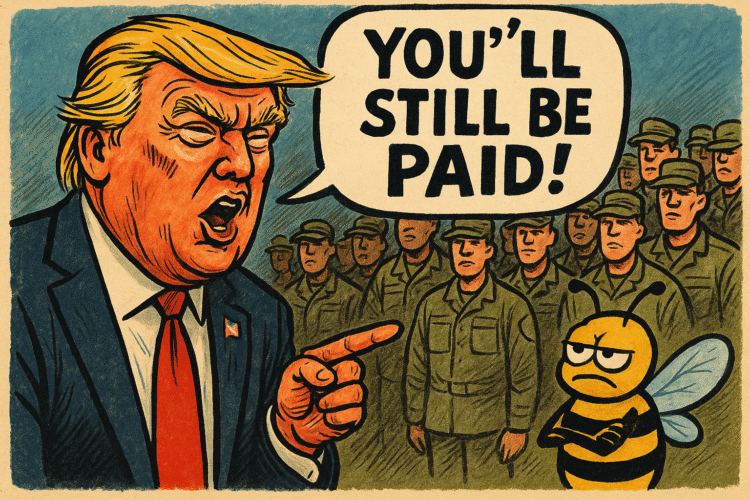
At a Navy ceremony touting 250 years of might, President Trump looked out over ranks of sailors and Marines and vowed: despite the government shutdown, service members “will still be paid”—teasing raises and calling the promise ironclad. Watching that, one might imagine gold coins raining from the sky onto fatigued boots. But the legal landscape is less magic, more quagmire.
The Department of Defense’s own guidance, in fact, says the opposite: when appropriated funds lapse, service members are required to report for duty without pay until Congress passes a law. Unless a “Pay Our Troops Act” is enacted, the mid-October paycheck is at risk. The result is a collision—between bombast and statute, promise and bank account—for troops, families, and morale.
Let me walk you through what the president said, what the rules actually demand, and how the clash reveals just how unhinged rhetorical warfare has become.
The Presidential Promise vs. Statutory Constraint
At the Norfolk event, amid speeches and patriotic banners, Trump’s tone turned protective. “You will be paid,” he declared. “We’re going to make sure you get every penny—no exceptions.” He even alluded to raises, as though the shutdown were a minor hiccup. In the same speech, he invoked Bin Laden, war zones, and loyalty, as though troops in uniform cannot understand paradox: “Even when government’s doors close, our defense must not.”
That moment will replay for months: the president, standing in front of uniforms, pledging certainty in a moment built on uncertainty. But here’s the catch: Trump can’t override standing law by rhetoric. The Antideficiency Act prohibits obligating funds in the absence of a valid appropriation. In plain English: you cannot spend money unless Congress has passed it. That applies to civilian and military pay.
Pentagon guidance—issued promptly when the shutdown began—made that clear. It instructed service members to continue reporting for duty without pay unless or until Congress enacts a law. The legal default is non-payment beyond whatever portion of a pay period falls into the shutdown. As of now, unless Congress passes a standalone troops-pay statute (two versions were introduced earlier in the year, one in March and one in September), the October 15 paycheck is not assured.
Timeline & Mechanics
When the funding lapse hit at midnight, October 1, the shutdown began. Senate talks had collapsed—not surprisingly given the posture from the White House and Republicans. On that same day the Defense Department posted its “non-pay status” rules: you report, you serve, you hope Congress acts.
Meanwhile, military family and veterans groups mobilized quietly, pressing Congress for a “Pay Our Troops Act” to immunize servicemembers from funding gridlock. The White House countered with threats: mass civilian layoffs if the budget impasse “goes nowhere.” Civilian employees, nonessential staff, contract workers—everyone trembled. But the troops, forced to rely on a promise and not a statute, stand in limbo.
The ordinary pay period structure further complicates things. The Oct. 1 to Oct. 15 pay cycle is partially covered by appropriations that predated the shutdown—so those hours may be in limbo but can be compensated for “pre-shutdown” hours. After that, the next full paycheck is under full threat. No law, no funds, no pay.
If pay stalls, the knock-on effects are real: the DFAS (Defense Finance and Accounting Service) cycles will jam; most service members have allotments that cover mortgages, car payments, groceries—those will bounce. Permanent Change of Station (PCS) reimbursements freeze. BAS (Basic Allowance for Subsistence) and BAH (Basic Allowance for Housing) may not adjust properly. Commissaries may scale back hours if staffing is hit. In short: the entire ecosystem of military livelihood shifts into suspended animation.
The Moral Theater
What’s maddening is how the president sounds: commanding, paternal, yet untethered. He assures troops they’ll be paid, while agencies issue non-pay guidance. He teases raises, while lawyers whisper about unconstitutional obligations. The performance is more important than the policy.
He wove in Bin Laden that day—invoking distant wars, deaths, threats—as though the moral weight of combat justifies breaking domestic financial law. That absurd logic: we face terrorists abroad, so we must violate our own legal ceiling at home. As if war justifies default. The derangement is real: constitutional limits rescinded by rhetorical inflation.
It is theater, and the troops are the backdrop.
Reactions & Stakes
Military families—thousands deep—are incredulous. Many live paycheck to paycheck. They brace for defaults. Unions, veterans’ groups, service advocacy organizations all warn of a morale collapse if troops go days without pay. Some members reportedly are reaching into savings, others consulting financial counselors.
Congress is torn. Some Republicans fear political blowback if soldiers aren’t paid. Others prefer to use the delay as leverage in the broader funding standoff. Democrats demand a standalone payment bill, a clean riders-free assurance that military pay is untouchable—even in budget fights.
Administratively, the Pentagon must juggle public promises vs. internal policy. Do they build morale messaging around the “promise” while preparing for non-payment fallout? Do they delay processing allotments, tape over automated payments, suspend nonessential functions? How do they communicate calm when the financial circuits are already dying?
The Absurdity Exposed
Here’s the grand satire: The president, in front of service members, promises certainty. But the law, like an old sentinel, stands unmoved. The pedestal of rhetoric towers over the cave of debt.
It is ironic that the institution he leads—military service, discipline, order—is most vulnerable to chaos when its pay is politicized. The very force that defends borders is now held hostage by budget brinkmanship.
The public hears, “We’ll pay you.” The law hears, “We may not.” And the troops hear the tension.
Closing Thought
If you believe in democracy, in law, in responsibility, then you cannot let this moment slide. Troops cannot be bargaining chips. Their pay cannot be a spectator sport. The president’s pledge, while politically powerful, does not supersede statute. Congress must act. The optics must align with law. Because when you promise everything and deliver nothing, trust dies.
If the shutdown drags on and troops miss pay, we will not remember how many expressives the president deployed. We will remember how many uniforms went unpaid. That will be the real indictment.
May the day come when the commander in chief’s words carry money—and when no promise rings hollow above a soldier’s empty bank statement.