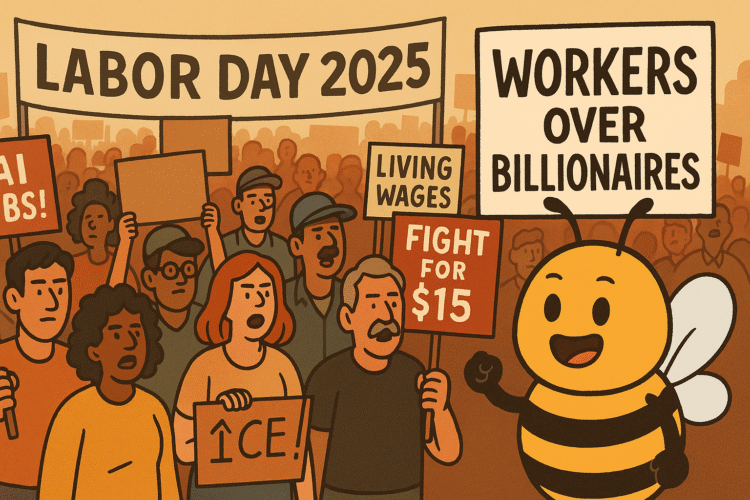
On September 1, 2025—Labor Day— America finally remembered what the holiday was supposed to be about: not barbecue sales at Home Depot, not posting an “end of summer” bikini pic, but actual workers demanding rights. Thousands marched in hundreds to 1,000+ “Workers Over Billionaires” rallies nationwide. The very phrase carried its own absurd poetry. Workers. Over. Billionaires. Like a stack ranking for dignity.
The rallies stretched coast to coast: New York, Chicago, D.C., Los Angeles, Cleveland, even Greensboro. A broad coalition—**May Day Strong, AFL-CIO, One Fair Wage, Indivisible, MoveOn, and unions both local and weary—**brought bodies to streets that still faintly smelled of fireworks and grill smoke. Protesters carried signs blasting Trump’s agenda as pro-billionaire and anti-worker. They demanded a living wage. They decried ICE expansions and National Guard rumors. They flagged privatization schemes and cuts to Social Security and Medicaid. They warned that AI-driven job loss wasn’t coming—it was already eating through payrolls like a slow acid drip.
It wasn’t just a protest. It was a referendum. The streets versus the suite. The picket sign versus the glossy White House post where President Trump, in all caps, saluted the workers of America while standing next to billionaires who haven’t touched a mop since Reagan was governor.
The $7.25 Reality Show
At the center of the fury was the federal minimum wage—still $7.25. A number that hasn’t moved since the iPhone 3GS was state of the art. Protesters chanted it like a curse, a reminder that in the land of billionaires launching themselves into space, workers still earn less than the cost of a Chipotle burrito per hour.
The White House insisted Trump’s policies were “pro-worker,” pointing to vague promises of job growth through deregulation. Protesters countered that deregulation meant billionaires could now replace you with an algorithm that doesn’t need breaks, sleep, or health insurance. AI doesn’t call in sick. AI doesn’t unionize. AI doesn’t march on Labor Day.
And so the day became a portrait of contradiction: workers in the street, chanting for wages, while billionaires refreshed their portfolios and politicians refreshed their feeds.
A Parade of Symbols
Every city found its own symbol.
In the Bay Area, a 17-mile human chain snaked across highways, like solidarity rebranded as a traffic jam. In Houston, hotel workers staged a walkout, proof that even in the hospitality industry, patience has an expiration date. Outside Trump Tower in Manhattan, thousands waved signs so high the gold lettering glinted under protest chants.
Chicago’s Mayor Brandon Johnson vowed to uphold sanctuary policies in the face of ICE expansions, because nothing screams Labor Day irony quite like protecting workers from deportation while billionaires dodge taxes with offshore shell companies. Evanston’s Daniel Biss went further, framing the whole moment as a stress test for democracy itself. When former mayors start using engineering metaphors, you know the republic is wobbling.
The Billionaire Problem
The name of the rallies said it outright: Workers Over Billionaires. But America can’t quite decide if it wants to worship billionaires or guillotine them. The same week Elon Musk bragged about a new AI model, Jeff Bezos unveiled another yacht, and hedge fund managers flew private jets to Aspen to discuss the plight of ordinary people.
Trump’s Labor Day message only added to the absurdity. The White House posted a glossy photo-op of Trump saluting workers while flanked by billionaires in golf polos, the caption reading: “America’s workers are the backbone of this nation.” The internet responded: “Then why do you keep breaking our backs?”
The ICE and Guard Card
Adding fuel to the marches were the looming expansions of ICE and whispers of possible National Guard deployments in urban centers. Nothing says “we value workers” quite like threatening to militarize their neighborhoods. Protesters held signs that read: “Don’t Send Troops. Send Wages.” Others mocked ICE vans as “the Uber Black of authoritarianism.”
In Chicago, organizers insisted the presence of police and federal agents was minimal, but the rumor mill kept churning. Labor Day rallies, they warned, could become the next excuse for “law and order” politics. After all, a billionaire-aligned state prefers its workers obedient, not marching.
AI Eats Jobs, But Not Billionaires
Every rally had at least one speech about AI. It’s the new boogeyman and the new scapegoat rolled into one. Protesters called it “bossware”—management in code, automation in a hoodie. The anxiety wasn’t abstract. Call center workers are already replaced. Truck drivers see it coming. Even white-collar jobs, the ones that thought they were immune, are now rebranded as “replaceable.”
Yet AI doesn’t seem to threaten billionaires. If anything, it multiplies their fortunes. The rally signs spelled it out: “Robots Don’t Need Raises. We Do.”
Peaceful, But Not Quiet
Despite some isolated skirmishes, most events remained peaceful. The real conflict wasn’t in broken windows—it was in rhetoric. Protesters clashed with counterprogramming: the administration’s insistence that privatization is modernization, that cuts to Social Security are “savings,” that billionaires are “job creators” and workers are simply “job havers.”
It’s the same inversion that has always defined American politics: those with the least are blamed for wanting too much, while those with the most are praised for taking more.
The White House’s Glossy Mirage
Trump’s Labor Day salute was pure branding. The photo: glossy. The tone: patriotic. The subtext: hollow. Workers saluted as “the backbone of America,” while the actual backbone is brittle from decades of economic scoliosis.
The administration insisted its policies were “worker-focused,” citing vague initiatives about infrastructure and jobs. Protesters responded that “jobs” don’t matter if the wages can’t cover rent, healthcare, or a grocery cart that doesn’t require a side hustle.
Labor Day became less about honoring workers and more about defining who gets to claim them: the billionaires funding policy or the people marching against it.
Nostalgia vs. Reality
Labor Day was once about unions flexing muscle, parades with brass bands and solidarity speeches. Now it’s about nostalgia colliding with the reality of Amazon warehouses and Uber drivers. The rallies tried to revive the old spirit, but even solidarity now lives half online, half in the street. Signs became memes. Speeches became soundbites. The 17-mile human chain trended on TikTok, less as activism and more as aerial drone footage set to Billie Eilish.
The nostalgia is powerful, but nostalgia doesn’t pay rent. Workers don’t need sepia-toned memories of the New Deal—they need a raise.
The Haunting Close
By sunset, the marches dispersed. The Bay Area chain broke apart. Hotel workers in Houston trickled back. Trump Tower was still standing. The glossy White House post was still pinned. America’s billionaires were still billionaires, untouched, unbothered.
Labor Day 2025 was left as a split-screen: workers chanting in the streets for wages, billionaires smiling in photo ops, the White House insisting it’s saving workers from themselves.
And the haunting truth is this: America knows exactly what side it’s on. Not workers over billionaires, but billionaires over workers—until the day the backbone finally breaks.