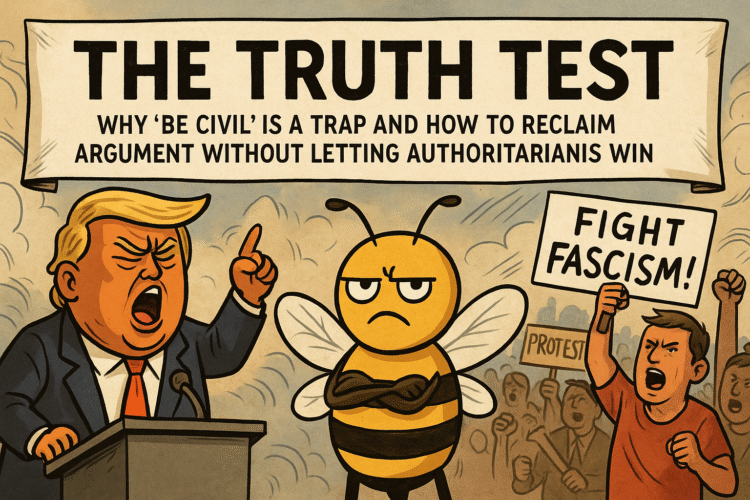
There is a comfortable version of civic medicine that liberals love to prescribe: a warm sermon about niceness, a gentle chiding to turn down the volume, a plea to swap Twitter tirades for polite coffee with people you secretly loathe. It sounds virtuous, and in a vacuum it would be. But these are not normal times. Calling for civility as if truth were optional is the ideological equivalent of telling someone to tidy their living room while a burglar ransacks the kitchen. The New York Times essay that set off the latest debate was right to insist that the disease is not mere rudeness. The problem is unreasonableness. The cure cannot be small talk.
Unreasonableness is not merely shouting or rude behavior. It is the practiced rejection of facts, the systematic laundering of falsehood until it becomes an accepted pretext for power grabs, the elevation of rage into policy, and the conversion of rumor into the basis for law. It is a culture that says, openly and repeatedly, that courts should be distrusted when their rulings are inconvenient, that elections can be delegitimized if the count cuts against your team, and that violence is a rhetorical device that can be gaslit into legitimacy. In that world, “be civil” functions as censorship. It muzzles those pointing out lies, absolves those who tell them, and treats moral clarity as impoliteness.
So what should replace tone policing? Not a ban on satire, not a prohibition on protest, not a vow to avoid calling fascism fascism. The political struggle must be fierce, morally unyielding, and nonviolent. The piece I am riffing off of proposes a set of enforceable norms, minimal standards for political participation that go beyond etiquette and aim at reality itself. They can be summarized as truthfulness, nonviolence, procedural fairness, and pluralist tolerance. Those are not optional niceties. They are operational thresholds for participating in civic life in good faith.
Truthfulness means more than “try not to lie.” It means refusing to reward serial fabricators with megaphones, refusing to build laws on false premises, and binding institutions to verification. Newsrooms must stop pretending that all claims are equal. Platforms must stop treating repeat falsehoods as harmless content. Public institutions, from courts to school boards, must enforce consequences for officials who deliberately mislead the public. That could look like press-union blacklists for chronic liars; platform penalties that escalate for repeated, provable falsehoods; and cross-partisan pacts that promise to call out disinformation even when expedient politics suggests looking away.
Nonviolence sounds obvious until you realize it is not merely about fists and Molotov cocktails. It is about language that invites or celebrates harm, about leadership that normalizes vigilantism, and about an enforcement apparatus that privileges some forms of intimidation over others. To insist on nonviolence is not to tame protest. It is to preserve the moral clarity that makes protest effective. We can and must call fascism fascism without calling for fists. We can and must defend ourselves without seeking violence. That paradox is the muscle memory democracies need to develop: fight like hell in the voting booth, on the airwaves, and in the streets, but do it without handing authoritarians an excuse to unleash force.
Procedural fairness is the scaffolding of trust. It does not mean every side gets their preferred outcome. It means accepting the legitimacy of agreed upon processes – the counting of votes, the operation of courts, the administration of budgets – and making contestation occur within those processes, not beneath them. When actors refuse process because process is inconvenient, they create a template for lawlessness. That template must be degraded administratively and politically. The remedy includes tightening rules around the handling of contested counts, creating statutory penalties for officials who lie about election procedure, and building independent auditing mechanisms that rapidly surface fraud claims for adjudication rather than spectacle.
Pluralist tolerance is the hardest because it asks us to tolerate things we desperately dislike while refusing to tolerate rule-breaking. It requires holding two things at once: we will defend your right to speak, and we will not let your speech erode the common rules that allow speech to continue. This separation is crucial. You can allow someone to petition while stripping them of official platforms that were given under false pretenses. You can force a public figure to submit to fact-checking while still allowing them to hold a megaphone at a rally. Tolerance is not a blank check.
Now for the part most people want: the practical stuff. How do you operationalize a set of norms without stifling vigorous politics?
First, cross-partisan pacts against disinformation. Political leaders and major institutional actors need to sign binding agreements that they will not knowingly disseminate demonstrable lies about elections and fundamental civic processes during critical windows: budget negotiations, certification of results, judicial review. These pacts must have enforceable teeth: coordinated media boycotts of signatory violators; expedited judicial remedies; and ligation-ready clauses that allow for rapid injunctions when falsity is weaponized. Yes, that sounds draconian because it is serious. We are past the point where soft norms can do heavy lifting.
Second, newsroom rules that withhold megaphones. Media organizations must stop valuing “both sides” framing when one side traffics in fabrication. That means elevating expertise over spectacle and refusing to deploy pundits whose business model is amplification of falsehood. It also means creating fast lanes for corrections, public naming of repeat offenders, and a shared code of ethics across outlets to deny legitimacy to those who repeatedly undermine basic facts. The press is not neutral ground between truth and lies. It is the arena where truth is defended.
Third, platform penalties proportionate to repeat offenses. Social media companies must tie escalating penalties to proven, repeated falsehoods. Start with visibility reduction, move to temporary account restrictions, and escalate to longer suspensions or deplatforming for persistent, malicious actors. The caveat is clear: these must be transparent, appealable, and governed by public rules that apply equally regardless of political stripe. We fight for robust free speech, but we do not have to offer a bully pulpit to those systematically eroding democratic processes.
Fourth, civic education and local forums. The long game is about building a citizenry that knows what democracy requires. Update civics curricula so students understand peaceful transfer of power, the technicalities of electoral administration, the harms of doxxing and deepfakes, and how to evaluate sources. At the community level, create face-to-face forums where people from different ideological camps must listen, question, and be accountable to common facts. These are not kumbaya exercises. They are rehearsals for public life.
Fifth, legal and political consequences. This is where the uncomfortable part comes in. Norm-breakers should face not just rhetorical disapproval but real costs. Per the essay, this can mean criminal investigations for threats and incitement, civil liability for coordinated disinformation campaigns, and removal from official roles for repeated breaches of public trust. This will require political courage. It also requires careful legal architecture to avoid weaponizing the law itself. The point is to make norm-breaking costly enough that it disincentivizes institutional decay.
Let us be blunt about the trade-offs. Rewarding reason and punishing bad faith will look, to some, like censorship or overreach. That is why procedural fairness and transparency are vital. The penalties must be predictable, appealable, and nonpartisan. If the system is to be weaponized against dissent, it will not repair democracy. But if calibrated correctly, consequences can be the scaffolding that sustains open, adversarial debate.
Now to an argument you will not hear in polite company: satire matters. Protest matters. Calling fascism fascism matters. The essay I started from does not ask for silence. It asks for standards. You should be able to scream on street corners, burn a symbolic object, or skewer a politician in the sharpest satire imaginable without crossing into illegality or endorsing violence. Satire is moral muscle memory; it trains people to resist demagoguery by ridicule and truth. We must protect that muscle while ensuring that satire does not slip into doxxing, targeted harassment, or incitement.
In short, the fix is not polite. It is not a sermon on manners. It is an institutional retuning that treats truth as a public good worth defending, and unreasonableness as an actionable pathology. We can protest. We can speak out. We can call out cruelty, authoritarianism, and the erosion of process. We can defend ourselves in every nonviolent way available. We do not bow our heads. We do not normalize lies because someone with a megaphone prefers them. We fight.
Finally, remember the moral irony. Civility without shared reality is just varnish on violence. If we say “let’s be civil” while refusing to insist on the facts, we are prettifying a knife fight. Conversely, enforcing truth and refusing to tolerate threats and lies does not make us illiberal. It makes us defenders of the public square. The work is hard. It is unglamorous. It is necessary.
Fight like hell with your facts. Protest like your life matters without breaking the law. Satirize the liars until their fibs become comedic relics. Build institutions that penalize those who keep rewriting the rules midgame. If we do that, civility will re-emerge organically as a practice rooted in shared reality rather than a plea to silence the righteous. That is how democracies heal. That is how we win back the argument without losing our souls.