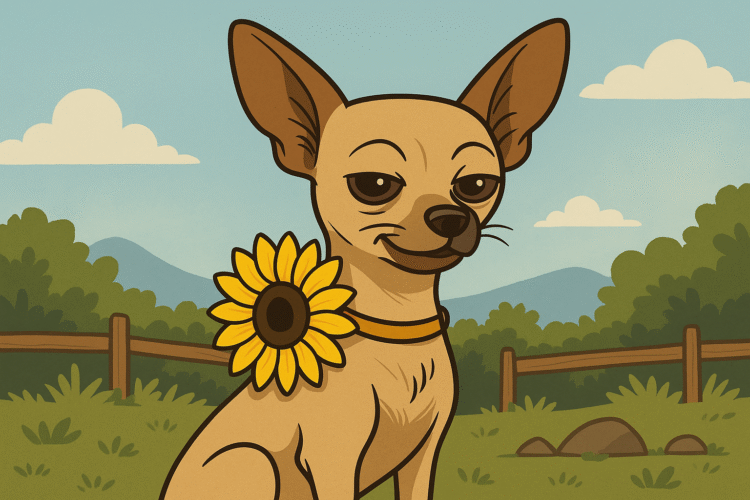
There’s a kind of poetry in loss—a slow, unexpected elegy that weaves through the days, a mournful melody that reminds you that even in absence, someone can fill your life with meaning. While You Were Here isn’t just a story about grief; it’s a fictional memoir about living—and sometimes barely surviving—with Daisy, the little chihuahua who turned out to be so much more than a pet. She was, and still is, my constant companion, a guardian of my fragile heart, and the beacon that kept me tethered to life when everything else crumbled.

I didn’t set out to write a tale of loss and longing. I set out to understand how something so small could hold so much power. Daisy wasn’t just a dog—she was a living reminder of unconditional love and the quiet persistence of hope. In the darkest days, when the weight of past losses, relentless grief, and broken promises pressed down on me, her presence was a lifeline. I wrote While You Were Here to honor that bond, to articulate the unspoken language shared by a person and their dog, where a nudge, a lick, or a warm cuddle speaks louder than words.
From the very first line, I wanted the reader to sense that this isn’t your typical memoir. It’s not a polished narrative full of tidy endings and neat resolutions. Rather, it’s a raw collection of moments—filled with hesitations, stutters, quiet joys, and spontaneous bursts of defiant laughter. As I once wrote,
“I didn’t rescue her. That’s the lie they sell you in the pet store. Daisy was the one who did the saving. All I did was show up.”
That line encapsulates it: I came into this story broken, unsure, a wanderer in a bleak landscape of unmet expectations, but Daisy—without ever uttering a single human word—reminded me of what it meant to persist, to love, even when it hurts.
There were days when I could barely get out of bed, when every breath felt like a battle against the invisible weight of past traumas—losses of family, health, and love. During those moments, Daisy would settle beside me, her small body a comforting presence on my chest, her gentle snoring an assurance that I wasn’t entirely alone. In her eyes, I found a kind of fierce resilience, a silent promise that tomorrow might be a little brighter than today.

“She didn’t need me to be okay. She just needed me to be honest.”
That honesty runs deep in the pages of this book. It’s not just a recounting of our days together; it’s an exploration of what it means to be human—to grapple with grief, to work through pain, and still find remnants of joy amid the ruins. Daisy’s simple acts—the insistent nudge when I hesitated to take another step, the way she curled up next to me during sleepless nights—became metaphors for my own struggle. They were tiny, living affirmations that even in solitude, hope can flourish.
This memoir is structured like the labyrinth of memory itself. It’s a series of moments, sometimes disjointed, sometimes painfully clear—a collage of shared glances, hushed conversations in the dark, and even the mundane details of daily routines that, in hindsight, became sacred rituals. There are chapters where I describe our quiet walks in the early morning, the soft hum of the city giving way to the gentle rustle of leaves; and chapters where the silence of an empty apartment speaks louder than any words could.
I’ve come to understand that grief isn’t a single emotion. It’s a medley of feelings: the bitter tang of regret, the warmth of remembered laughter, the loneliness of unspoken goodbyes, and, surprisingly, a spark of humor in the absurdity of it all. Daisy, in her own way, became the counterpoint to my melancholy—a living, breathing reminder that even when everything seems lost, life insists on continuing.
“Grief is just love that didn’t get to finish what it started. And I had so much left to give.”
When I began writing, I realized that my own journey mirrored the rhythm of a heartbeat—persistent, sometimes erratic, always pulsing with the promise of redemption. Daisy’s presence wove through every memory, every late-night conversation with myself in the mirror, every time I wondered if I could face another day. She was there when I learned that love isn’t about perfection, but about showing up—even when you’re scared, even when you’re broken.
Some days, I’d find myself replaying moments like a looped cassette tape: the way she eagerly greeted me after even a short absence, the soft clatter of her paws on the hardwood floor as she followed me from room to room, and the quiet moments of stillness where her warm weight on my leg told me more about trust than any conversation ever could.
While You Were Here is both a celebration and an elegy. It celebrates the resilience found in unexpected companionship and mourns the quiet loneliness of loss. It’s a reminder that every day, in the midst of life’s chaotic trials, there can be small miracles—a wagging tail, a gentle nudge, or a look that says, “I’m here. You’re not alone.”
As I look back on those turbulent times, I realize that writing this book was my way of keeping the memory of those moments alive. In a world that often demands silence in the face of grief, I chose to shout it from the rooftops, to write it in ink, to let you know that every scar, every tear, every moment of pain is also a testament to the beauty of survival.
Daisy is still with me, still a warm spot on my couch, still a quiet guardian of my heart. And through these pages, her spirit lives on—reminding me, and hopefully you, that love, in all its messy, imperfect glory, is what makes us truly human.
So, here’s to Daisy, the girl who saved my life more than once. Here’s to the lessons learned in the silence, in the chaos, and in the soft, unwavering presence of a true friend. While you were here, you made life worth fighting for.