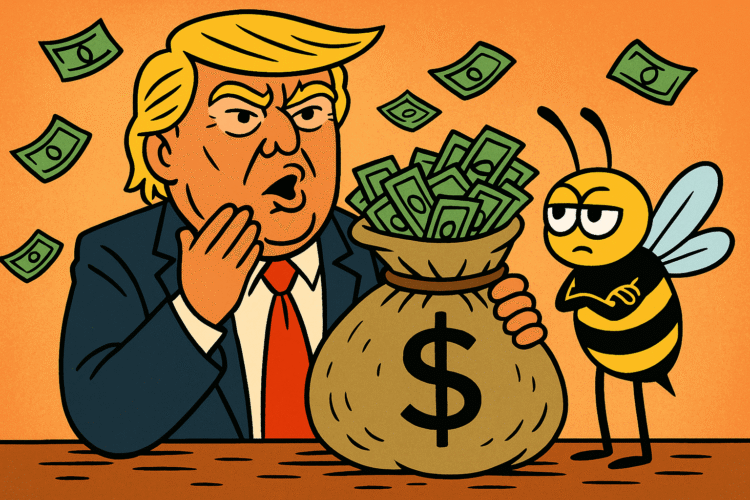
It’s hard to take a “billionaire” seriously when he keeps losing count of his billions. But here we are again, watching Donald Trump tell the country that if the Supreme Court rules against his tariffs, America will owe “three trillion dollars.” Three trillion. By breakfast, that number will probably be six. By dinner, he’ll say the entire planet will collapse unless we keep his slush fund safe from math.
It’s the oldest Trump story in the book: the number keeps changing because the truth never mattered in the first place. The tariffs were supposed to be patriotic revenue, a punishment for China, a “win” for American workers. But now that the Court might actually call it what it is—a tax he imposed without Congress—he’s suddenly warning that undoing it will bankrupt the country. Translation: the bill came due, and he might be the one who has to pay.
Let’s rewind to the courtroom before the panic post. Justices, including Amy Coney Barrett, grilled his solicitor general about whether these tariffs violated the Constitution’s most basic principle: Congress controls taxes, not the White House. The lawyer argued that the tariffs weren’t really about money—they were about “national security.” The revenue, he said, was “incidental.” That’s the polite way of saying: don’t look at the receipts. Because if you do, you’ll find a $90 billion line item sitting in a slush bucket that never went through Congress.
Hours later, Trump went online at midnight to warn that a ruling against him would cost “three trillion dollars.” The number tripled between arguments and bedtime. Either the Supreme Court moves markets in its sleep or Trump was cooking the books again—something between creative accounting and fan fiction.
The thing is, this panic post has an edge of desperation that feels different. It reads like a man who knows that if refunds are ordered, he might have to explain where all that tariff money actually went. The government collected billions from importers, which means American businesses and consumers paid the tab. But in classic Trump style, the rhetoric flipped. He called it “China money.” He said China paid us. In reality, your grocery store did. Your car dealership did. Every company that imported goods passed the cost to customers. So if the Court orders refunds, that money isn’t sitting in Beijing—it’s buried in federal ledgers and political favors.
The deeper you look, the worse it gets. Between Treasury records, CBP filings, and Trump’s own contradictory claims, the math simply does not add up. His administration bragged about collecting nearly one hundred ninety-five billion dollars annually in tariff revenue, yet his campaign promised a two thousand dollar “tariff dividend” for every household. That alone would cost more than half a trillion dollars. Even Trump’s accountants would need smelling salts after trying to reconcile those ledgers. Economists estimate that the monthly take peaked around thirty-five billion, but the promises outpaced the cash flow from day one.
And that is where the panic becomes policy. In oral arguments, justices from both wings—Barrett, Kavanaugh, even Roberts—questioned whether the International Emergency Economic Powers Act (IEEPA) gives a president the right to tax the entire economy by executive order. What started as a “trade war” now looks like a constitutional brawl over whether the executive can invent new revenue streams by declaring emergencies. The government’s argument—that it was about “regulation” and not “taxation”—collapsed under its own contradiction. You can’t spend what you collect, call it revenue, and then claim it wasn’t a tax. It’s like saying you robbed a bank to improve security.
By November 5, the tension had broken into open absurdity. Trump left the courtroom spin cycle and hit Fox, ranting that if he lost, the United States would face a “three trillion dollar unwind.” He claimed foreign nations would be “laughing at us.” The next day, his campaign distributed press hits insisting that the tariffs had already funded infrastructure, Medicare, and “dividends” for “hardworking Americans.” The same Americans, of course, who saw their grocery and car prices skyrocket because of those tariffs. It was the same old Trump logic: burn down the house, hand out ash as proof of ownership.
Markets noticed. Importers began gaming out repayment procedures, filing contingency paperwork for possible refunds. Corporate counsel called emergency meetings with trade lawyers to model refund mechanics in case the Supreme Court gutted the program. Analysts at major banks quietly mapped out what a ninety billion dollar payback would look like, factoring in interest, penalties, and logistical chaos at Customs. And yet, the White House kept saying it was all fine—calling it a “national security event.” It’s always national security when you need to hide the math.
Trade lawyers were blunter. They pointed to major questions doctrine limits that make it clear: a president cannot impose a tax masquerading as a security measure without Congress. The Court itself hinted that refunding money might be messy, but necessary. And the mess is the point. The government would have to reclassify billions in tariffs, reopen thousands of cases, and issue checks to companies that already passed costs to consumers. That’s how you end up with double dipping and triple counting—the Trump accounting model in its purest form.
Meanwhile, inside the Beltway, the contradictions stacked higher. Treasury claims nearly two hundred billion in annual tariff revenue. Trump warns of a three trillion dollar catastrophe. His lawyers say revenue doesn’t matter because the tariffs were about national security. But CBP data shows steady collections from imports of cars, appliances, and consumer goods—exactly the opposite of national security goods. None of the numbers align, which suggests one of two things: either the government’s books are cooked, or Trump’s panic post was an accidental confession that his entire tariff scheme was never real money, just leverage.
This brings us to the political consequences. If the Court rules against him, the refunds become not just an accounting nightmare but a political one. Congress will have to reassert control over taxation and appropriations, meaning Trump’s favorite tool—executive emergency decrees—might be neutered for good. Expect fireworks from his base about “judicial tyranny” and “deep state theft.” Expect talking heads to call the refund a globalist plot. And expect Trump to keep inflating the numbers until even he forgets what they mean.
Here’s the timeline for anyone still keeping score. On November 5, oral arguments shredded the administration’s position. Within hours, Trump started shouting about a multi-trillion dollar “unwind.” By the weekend, importers began prepping refund claims. By the following Monday, Treasury staff leaked that contingency plans were being “reviewed.” That’s bureaucratic code for panic. Now, trade firms and manufacturers are quietly aligning their lawyers and accountants, ready to file for reimbursement the second the gavel falls.
What happens next depends on how the administration tries to spin defeat. They can publish “contingency guidance” for repayments and hope no one notices how arbitrary the math is. They can claim refunds are “one-time credits” to obscure the true liability. Or they can lean into chaos and let Congress take the blame for not approving emergency refund legislation. It’s not strategy—it’s triage. And the entire time, Trump will be on Truth Social declaring victory, no matter what the numbers say.
And let’s not forget the absurd contradictions in his “tariff dividend” fantasy. He promised that every American would receive a two thousand dollar check funded by tariffs. That’s roughly half a trillion dollars per year, assuming 250 million adults. Yet Treasury only collects about 195 billion in tariff revenue annually. Even a magician couldn’t make that arithmetic work. It’s the political version of an overdrawn account—spend what you don’t have, claim profit, then blame the teller when the bank seizes your car.
The stakes extend beyond economics. The case will decide whether presidents can weaponize emergency statutes to bypass Congress entirely. If the Court strikes the tariffs, it’s a ruling against imperial presidency. If it upholds them, it’s an open invitation for every future president to tax, regulate, and redistribute by decree. That’s not trade policy—it’s monarchy with paperwork.
So, where does that leave Trump? His panic reveals more than fear of a financial hit. It exposes the heart of his governance style: rule first, reconcile later. The tariffs were never about protecting American workers or rebuilding supply chains. They were about spectacle. They created the illusion of control while hiding the costs behind patriotic branding. Now, the illusion is unraveling in real time, and the question that looms over the entire mess is brutally simple: will the Court force him to refund what he never truly earned?
In the coming days, keep an eye on the telltale signs of bureaucratic panic. If Commerce quietly posts new “revenue baselines,” they’re trying to retroactively justify the collections. If CBP suspends refund procedures, they’re stalling for political cover. If Congress suddenly schedules hearings on tariff authority, it means lawmakers smell blood in the ledger. And if Trump starts throwing around even larger numbers—five trillion, seven, maybe infinity—it means the walls are closing in and the math is finally catching up.
The sad truth is that there may not be enough left to refund. The money has already been spent, diverted, absorbed into the machinery of deficit theater. When the smoke clears, the only balance that remains will be a rhetorical one: the gap between what Trump promised, what the books show, and what the courts are about to demand. He told Americans tariffs would make them rich. Instead, they got higher prices, hollow promises, and now, a looming bill that no one seems ready to pay.
When all is said and done, and the Supreme Court hands down its decision, the question won’t be whether America can afford the refund. It will be whether Donald Trump ever could. Because every con ends the same way—somebody’s left holding the receipt. And this time, it’s the country.