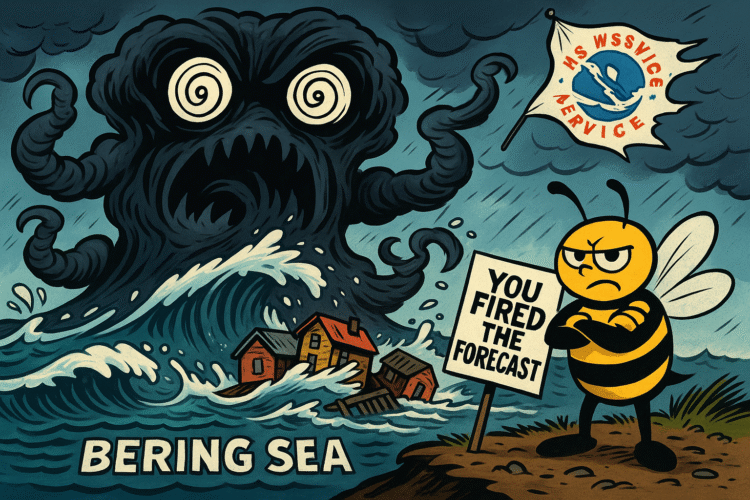
America loves a good disaster, as long as it happens far enough away to make for cinematic B-roll. The Bering Sea monster that shredded western Alaska this week—one part typhoon, one part apocalypse—checked all the right boxes: 100-mile-per-hour winds, a record storm surge, homes swallowed whole, hundreds displaced, one confirmed death, and a governor insisting everything was “under control.” But behind the headlines and the soaked heartbreak lies the punchline nobody wants to say out loud: this didn’t happen in a vacuum. It happened in a data void, the kind of void you get when an administration treats the weather like a woke conspiracy.
Because here’s the thing: the storm wasn’t the first warning. The hole in the sky came first.
The Forecast That Never Stood a Chance
Before the waves breached seawalls and the winds clawed houses off their stilts, the National Weather Service had already been hollowed out like a Halloween pumpkin. Staffing cuts, buyouts, and “streamlining initiatives” had turned a once world-class observation network into a half-staffed group chat.
Twice-daily weather balloon launches—the bread and butter of forecasting—had been quietly scaled back in multiple sites across Alaska and the Lower 48. Imagine trying to predict a hurricane with one eye closed, one ear plugged, and your hands zip-tied behind your back. That’s how meteorologists have been working since Trump’s “reform era” hit NOAA like a budgetary chainsaw.
You can’t model what you can’t measure. You can’t measure what you don’t observe. And you can’t observe if you’ve laid off the guy who used to launch the balloon.
But sure, tell us again how “the deep state” was the real problem.
The Monster That Ate a Coastline
This storm—technically the remnants of a Pacific typhoon—slammed western Alaska with the kind of energy that makes God check the warranty on the planet. Kipnuk, Kwigillingok, and other small coastal villages became collateral damage in a bureaucratic failure disguised as cost-cutting.
CNN and the AP describe it like a slow-motion drowning. Houses turned into driftwood. Roads disappeared. Boats became roofs. The Coast Guard’s overflights found people clinging to debris like extras in a Michael Bay film, only this was real and funded by the same Congress that slashed their disaster budgets.
It’s one thing to face nature’s fury. It’s another to face it blindfolded, because your government sold the weather balloons for parts.
Cutting Balloons, Cutting Corners
At first, the story sounded absurd—how could missing weather balloons make a storm worse? But in the fragile ecosystem of meteorology, it’s all connected. Every balloon carries instruments that read temperature, humidity, pressure, and wind through the atmosphere. These soundings feed into models that decide whether a storm will stall, spin, or strike. Lose enough of them, and your forecasts go fuzzy at the edges.
When the balloons stopped flying, so did accuracy. When accuracy slipped, so did evacuation timing. When timing failed, people died.
It’s not rocket science—it’s balloon science. But tell that to the Office of Management and Budget, where someone probably high-fived themselves for saving 0.00003% of the federal budget by cutting “redundant” atmospheric data collection.
The Party That Brought You Climate Denial Now Brings You Forecast Denial
Under Trump’s climate “strategy,” NOAA’s funding was treated like a dare. Proposals aimed to slash its budget by a quarter and gut climate research entirely. The administration even considered privatizing parts of the National Weather Service because apparently “storm warnings” sound too socialist.
It’s all part of the larger American tradition of treating infrastructure like an optional subscription service. Roads, bridges, healthcare, science—cancel any time! The irony, of course, is that the party that mocks “big government” always calls for more FEMA when their state floods.
The Alaskan storm is the perfect example of what happens when ideology meets meteorology: one screams “hoax,” the other screams “run.”
Forecast Fatigue and the Death of the Expert
The Washington Post calls it “warning fatigue,” a term so polite it could be printed on a tote bag. What it really means is that meteorologists are burning out. Hundreds of positions are unfilled, and the people still standing are overworked, underpaid, and blamed for every missed projection.
Imagine being a forecaster tasked with saving lives using models held together with duct tape and prayer, then being told you’re the problem because you didn’t “see it coming.” It’s like firing the entire fire department, then suing the remaining two guys for water damage.
We’ve reached the point where experts aren’t just ignored—they’re endangered.
The Great Balloon Shortage of 2025
You’d think balloons would be the one thing America couldn’t screw up. Yet here we are, a superpower with more billionaires than working weather stations.
When the typhoon’s remnants were bearing down, multiple Alaskan sites had already stopped launching balloons “due to staffing constraints.” Translation: we don’t have enough humans to fill the helium tanks. The result? A data hole so large you could fly a Category 5 through it.
This isn’t just bureaucratic negligence—it’s vandalism disguised as governance. When you dismantle the apparatus that measures the world, you start living in a world that can’t be measured.
And that’s exactly what authoritarians want: a country too confused to tell truth from spin, science from superstition, weather from politics.
The Price of Ignorance Comes Due
For the villagers who lost everything, this wasn’t a theoretical debate about budgets and data models. It was the difference between staying dry and being swept into the sea.
Coast Guard crews are now rescuing people who never got the warnings they should have. Tribal authorities are coordinating food, fuel, and shelter for families stranded without homes or power. Relief convoys are battling washed-out roads in communities that can only be reached by air or water—roads that could have been closed earlier if forecasts had been sharper.
Every missed balloon launch isn’t just a gap in the sky; it’s a human story ending in tragedy.
Trump’s Budget Logic: Spend a Trillion on Space Force, Cut the Sky Itself
If this administration’s policies had a slogan, it would be “Why fix Earth when you can ruin space too?” Remember the grand plan to redirect Air Force Reserve funds to Space Force during a government shutdown? Now imagine applying that same fiscal brilliance to the weather.
They cut NOAA’s budget while spending billions to paint rockets red, white, and blue. They gutted atmospheric science while expanding propaganda networks. The result: we can’t track storms, but we can livestream the end of civilization in 4K.
This is how empires collapse—slowly, then all at once, under the weight of their own irony.
From the Jet Stream to the Propaganda Stream
The right-wing war on science didn’t stop at climate denial—it metastasized into meteorology denial. The same pundits who claim global warming is a hoax now insist “the models are lying.” Every storm becomes a culture war skirmish. Every scientist becomes a suspect.
Weather itself has been politicized. Rain isn’t rain anymore; it’s a liberal conspiracy to make you buy an umbrella. The very phrase “record-breaking storm” now triggers think pieces about “media exaggeration.”
But when your information ecosystem is shaped by algorithms designed to enrage, facts become collateral damage. Which is why a once-in-a-century typhoon can rip through Alaska, and half the country won’t even know—or care—until the memes drop.
The Balloon Guy Was the Canary
Let’s be clear: the balloon technician isn’t just a worker. He’s the canary in the coal mine of American governance. When the guy responsible for measuring the wind gets laid off, it’s not cost efficiency. It’s a slow-motion surrender.
Science can’t survive in a system that values ideology over accuracy. The Weather Service doesn’t make money, so it doesn’t matter. It doesn’t go viral, so it doesn’t exist. It doesn’t donate to campaigns, so it gets defunded.
And yet when the storm hits, everyone suddenly believes in meteorology again. Until the next election cycle, when “cutting red tape” once again means “cutting the parachute cords.”
We Cut the Forecast, Now We Live in It
When people ask, “How did this happen?” the answer is as simple as it is damning: we made it happen.
We let politicians treat climate scientists like bureaucrats and bureaucrats like enemies. We cheered for “draining the swamp” without realizing they were draining the data. We let the balloon deflate, then acted shocked when the storm arrived unannounced.
Western Alaska isn’t just a tragedy—it’s a forecast for the entire country. Every time we cut science, we cut survival. Every time we gut research, we gamble with lives. Every time we let ideology decide what’s worth knowing, the sky grows darker.
The Bee’s-Eye View
Our signature cartoon bee hovers over the wreckage—tiny, unimpressed, holding a clipboard that reads “Budget Savings: $0.00.” Beneath it, meteorologists bail out data servers with buckets while congressmen pose for disaster photo ops. The caption writes itself: “You fired the forecasters, now you’re shocked it’s raining?”
That’s the American loop. Ignore the experts, defund the infrastructure, then film yourself handing out bottled water when the consequences hit.
Final Forecast: Permanent Storm Watch
The next time a politician talks about “cutting government waste,” remember that to them, a functioning warning system is waste. A weather balloon is socialism. A scientist is a liability.
And yet, as the Bering Sea monster recedes and the villages dry out, the rest of America will move on. The headlines will fade. The balloon budget will stay gutted. And the next storm—because there’s always a next storm—will arrive just as blind, just as brutal, and just as predictable.
Because here’s the real punchline: the weather doesn’t care about politics. The wind doesn’t vote. The sea doesn’t watch Fox News. And the next time a typhoon takes aim at our data-starved coastline, the only thing left to forecast will be how much irony we can drown in before someone decides that maybe—just maybe—facts are worth funding again.