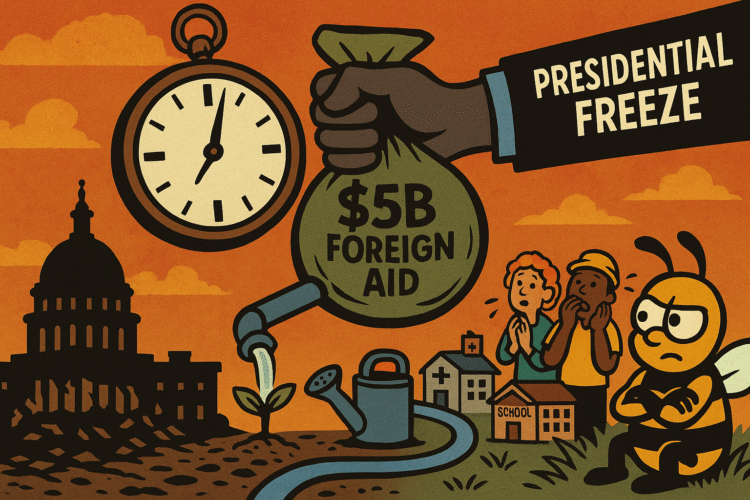
On September 26, 2025, in a terse one-sentence emergency order, the U.S. Supreme Court allowed the Trump administration to keep nearly $5 billion in congressionally appropriated foreign aid frozen—overturning a lower-court injunction and giving institutional blessing to what amounts to a year-end “pocket rescission” strategy. The effect: delay the money’s disbursement until it expires on September 30, and let the funds vanish. Cue the constitutional alarm bells, the aid agencies sputtering, and the long-running struggle over who really holds the purse strings: Congress—or the president.
This is not merely budget drama. It is a structural pivot in the balance of power. It is a warning that democracy assistance, humanitarian programs, and global obligations can be held hostage by institutional gamesmanship. And it is a moment when the doctrine of executive discretion bleeds into executive impoundment, with consequences far beyond the court’s terse paragraph.
Here’s how we got here—and what it means.
1. The Order, the Dollars, and the Moment of Truth
The Supreme Court’s one-page emergency order was as minimal as it was momentous. It granted the administration the right to withhold the foreign aid funding—nearly $5 billion—by staying the injunction that had compelled disbursement. The administration had argued that the funds must be deferred until end of fiscal year expiration; otherwise, it would have to spend them. The Court’s order left the lower court’s decision submerged. The suspended programs must wait—or die.
By effectively treating expiration as rescission, the Court let the executive bypass regular congressional purposes. It nodded at a doctrine called executive discretion over appropriation timing, treading dangerously near the disfavored doctrine of impoundment—the idea that the president can refuse to spend money that Congress has appropriated. Historically, such power was deeply curtailed by Congress after the Nixon impoundment scandals. But now that line seems blurrier.
2. Timeline & Litigation Flow
- Initial Appropriation: Congress passed foreign aid budgets as part of annual and supplemental spending bills; the $5 billion was designated for U.S. international programs, diplomatic missions, global health, democracy aid, U.N. pledges, and development projects.
- Freezing the Funds: The Trump administration withheld the funds late in the fiscal calendar, arguing that executive agencies needed flexibility or that spending at year-end would force unwanted obligations.
- Lower Court Injunction: Aid organizations and congressional oversight plaintiffs sued. A federal district or appellate court granted an injunction ordering the administration to release the funds, citing congressional intent and the text of appropriations law.
- Emergency Appeal to Supreme Court: The administration petitioned for emergency relief, asking the Court to stay the injunction pending full appeals.
- SCOTUS Order on September 26: The Supreme Court granted stay, effectively allowing the freeze to remain in place. The winter clock now counts down to September 30, after which the funds expire if unused—thus making the freeze a practical rescission without going through legislative repeal.
That is the sequence. The legal theory: executive agencies have discretion over timing unless Congress explicitly limits that power. The counterargument: appropriations are commands, not suggestions, and the president cannot simply nullify them with timing gimmicks.
3. Legal Theory: Impoundment, Discretion & the Power of the Purse
A central constitutional fault line is here: when does executive discretion become unlawful impoundment? The Impoundment Control Act of 1974 was Congress’s response: after Nixon tried to freeze funds he didn’t like, lawmakers required that the president report proposed cutbacks and prevented wholesale deferrals. The law assumes spending mandates must be followed unless Congress agrees otherwise.
The current administration’s argument leans into statutory ambiguity: appropriation language sometimes allows for “obligations incurred before the end of the fiscal year,” meaning that agencies have some leeway for timing. The Trump government contended that delayed disbursement is different from outright cancellation. The Supreme Court’s order tacitly accepts that reading—at least in emergency posture—giving the executive a hemisphere of flexibility.
But critics warn this undermines the Constitution’s design. Congress holds the power of the purse by making appropriations. If the executive can freeze or delay those at will, Congress is hollowed into a fig leaf. The Supreme Court’s acquiescence invites presidents to treat appropriations as optional until they choose otherwise.
4. Reactions: Dissents, NGOs, Congress & the Administration
The dissenting justices (those who opposed the emergency stay) lamented that the order erodes Congress’s constitutional role. They warned that a court granting permission to withhold funds for months until expiration is effectively nullifying legislative choice by sleight of hand. They pointed out the harm to aid recipients who depend on timely disbursements and cautioned that this lowers the threshold for future impoundment gambits.
The administration celebrated. It described the Supreme Court decision as affirmation of executive flexibility and authority. Press statements framed the freeze as necessary prudence—no program cuts, just a moratorium to avoid waste. Treasury and foreign aid agencies were instructed to hold the lines.
Congressional reactions were sharp but divided. Some Republicans applauded executive audacity, casting Congress as too slow, too partisan to authorize spending on foreign causes. Some Democrats, and even a few Republicans uneasy with unilateralism, warned that this sets a dangerous precedent—where presidents can simply withhold funds for any cause displeasing to their agenda. Oversight hearings were called. Threats of legislation to restrict executive delay powers surfaced.
Aid organizations and NGOs responded with alarm. International development coalitions warned that entire country programs—on health, water, democracy, education—would be delayed or cancelled when funding vanishes. Local partners abroad scrambled to manage payrolls without known budgets. U.N. agencies and regional allies began preparing fallback plans. Some warned that U.S. credibility would take years to rebuild—the message sent: if your American funding can vanish overnight, don’t count on it.
5. Consequences on the Ground & for Democracy Aid
The freeze is not abstract. For recipients abroad, it is catastrophe. Programs that provision clean water, vaccine distribution, legal aid, election monitoring, climate projects—all hinge on annual disbursements. Staff may be laid off; contracts canceled; partner trust evaporated. In fragile states, sudden funding gaps can destabilize governments and crush small NGOs.
U.N. contributions may be affected. The U.S. owes assessments and dues. If those are delayed or withheld, U.S. influence in global institutions diminishes, giving room to illiberal powers to fill vacuums. Democracy assistance, especially programs in transitional or repressive environments, will lose funding just when stability is most fragile. The message this sends to global allies—the U.S. abandons commitments when politically inconvenient—is corrosive.
In the coming years, agencies will budget conservatively or over-allocate risk buffers. Recipients will demand stricter contracts. Future donors will impose conditional clauses or avoid U.S. funding altogether. The freeze becomes a blow not just to this year’s programs, but to the structure of foreign aid itself.
6. Political Theater, Structural Realignment & What It All Means
This Supreme Court order is more performance than policy—but that is its power. By issuing a minimal order, the Court sheds responsibility while empowering whatever comes next. The administration gets to claim constitutional validation without full litigation. Congress is shown to be impotent. Aid recipients bear the brunt.
The order reshapes the spending balance. It signals to every president: Congress’s clock ends on September 30; the executive’s discretion begins on October 1. It invites rolling freezes, pocket impoundments, and rumors of withholding funds that challengers cannot easily reverse.
When the next contested appropriation occurs—whether defense budget, climate relief, education aid—the temptation will be stronger. The blueprint is now credible: freeze, litigate, let courts bless delay, watch funds “expire,” then restart in phase two as if nothing happened.
It’s a constitutional realignment. The executive moves from steward to gatekeeper.
The Silence Before the Money Runs Out
The Supreme Court’s terse order did not announce a revolution. But it whispered one. By allowing the freeze, the Court transformed delay into de facto cancellation, bending the power of the purse toward the presidency. The boardrooms, the aid agencies, the Congresses watching—none expected that a joke about satire would evolve into a legal blueprint governing billions and democracy itself.
When a democracy pretends that $5 billion in aid can vanish by deadline, it invites larger vanishings: of credibility, of commitment, of constitutional boundaries. Whether courts, Congress, aid groups or citizens resist this creep will determine whether the clock ends on September 30, or whether democracy itself is allowed to expire by inertia.