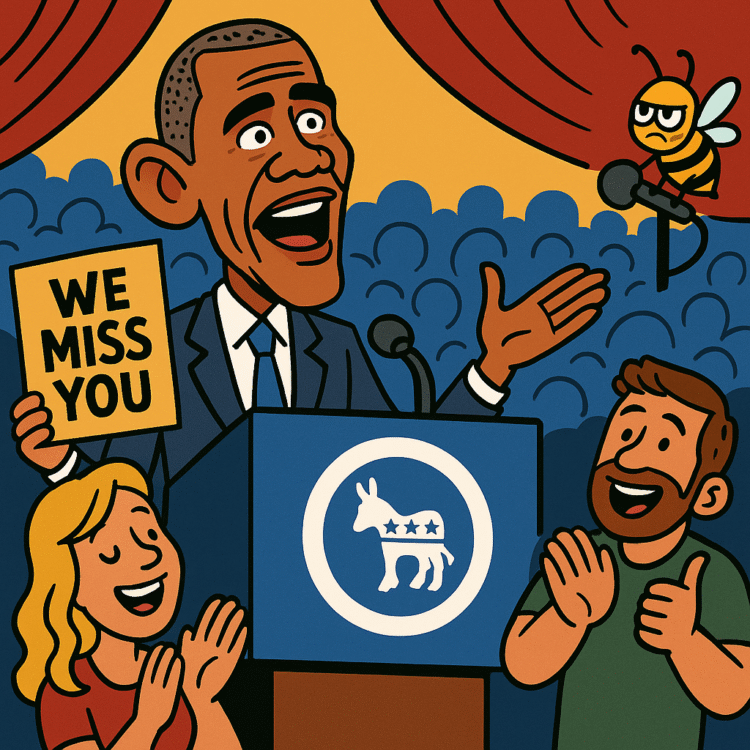
There are few sights as surreal as watching a former president outshine his successors while trying not to. Barack Obama, ten years out of office, has become the most effective voice in the Democratic Party again, not because nostalgia sells, but because competence apparently does.
His reemergence on the campaign trail for down-ballot Democrats feels less like a comeback and more like an intervention. Packed arenas, roaring crowds, and the rhythmic blend of humor and indictment that only Obama can deliver—it’s part rally, part therapy session for a party still trying to remember what coherence sounds like.
In Norfolk last week, thousands lined up for hours to hear him remind the country that “democracy doesn’t work on vibes.” He roasted Trump’s governance style as “chaos disguised as leadership,” lamented the “purges of career officials,” the “performative deployments,” and the “culture war scapegoating” that have become the daily soundtrack of American politics. The crowd chanted “we miss you” with the kind of fervor usually reserved for boy band reunions.
But underneath the applause is the haunting realization: they do miss him. And constitutionally, they can’t have him back.
The Long Arc of the Encore
Obama’s return wasn’t spontaneous. It’s been building for months, a quiet drumbeat of speeches, fundraisers, and podcast cameos that has now crescendoed into a full-fledged tour.
By conservative counts, he’s logged more than two dozen public engagements since the start of the year—campaigning for gubernatorial candidates in Pennsylvania, Wisconsin, and Virginia; headlining democracy forums in Chicago and New York; cutting viral videos explaining health care and book bans; even stepping into international summits to remind the world that America used to do diplomacy without subtitles.
Each appearance draws crowds that dwarf those of current officeholders. Reporters who cover the circuit note a familiar pattern: Democrats running for reelection quietly begging for an Obama stop because his rallies still fill arenas while their own events fill folding chairs.
It’s not just nostalgia. It’s the vacuum.
The Norfolk Moment
The Norfolk rally, nominally for two local Democratic candidates, became a national headline because of what Obama said and how he said it.
“Government is not a reality show,” he declared, pacing with the same unhurried confidence that once made even Senate filibusters seem fixable. “If your idea of leadership is firing people on live TV, deploying troops for photo ops, or promising to investigate your enemies, you might be running a cartel, not a country.”
The audience erupted. Reporters jotted down quotes like they were rare minerals. Clips hit social media within minutes. One line—“We tried chaos. It doesn’t build roads”—became a rallying cry across Democratic accounts by morning.
Obama wasn’t unveiling new policy. He was doing something rarer: explaining governance in plain language, without euphemism, without the consultant varnish that turns every Democratic press release into a dissertation.
He was doing what no one else on his side seems able to do—tell the truth with rhythm.
The Mirror Effect
Every Obama rally functions as both an inspiration and a diagnosis. He reminds Democrats of what a confident, coherent argument for democracy sounds like, which simultaneously highlights how little of that has been coming from their current messengers.
Joe Biden governs competently but speaks like a man wrestling with static. Kamala Harris is still trying to prove she can speak above it. Congressional Democrats alternate between procedural indignation and existential panic.
And then there’s Obama—walking into a basketball arena, cracking jokes about “grown men on cable news who can’t name a bill but know every TikTok dance,” and suddenly the crowd remembers why they voted for him twice.
He gives the party what it has been missing: a through line. He connects policy to morality, decency to functionality, cause to consequence.
He makes governance sound like something you’d actually want to defend.
The Constitutional Ghost
The cruelest twist is that he can’t run again. The 22nd Amendment stands like a velvet rope at the entrance to 2028, politely reminding everyone that the man who can still pack a stadium is permanently off the ballot.
Obama himself has leaned into the absurdity. At a Wisconsin rally, when someone yelled “Run again!” he laughed and said, “I did—twice. That’s enough for both of us.” The line got a standing ovation and a tinge of melancholy that no one could quite disguise.
Because everyone knows what they’re really cheering for: not Obama the man, but Obama the function. The explainer-in-chief. The adult in the room. The one who could say “folks” and make it sound like empathy instead of focus group residue.
The party doesn’t need him to run again. It needs someone who can talk like him again.
The Stakes Beyond the Applause
His reentry has strategic implications far beyond the emotional.
Messaging: Obama’s stump speeches cut through in ways policy white papers never will. His cadence and clarity simplify the stakes. He doesn’t talk about “bipartisan pathways” or “cross-sector frameworks.” He talks about roads, teachers, and air you can breathe. When he says “government matters,” people don’t roll their eyes—they nod.
Morale: Democrats are facing an enthusiasm problem, especially with younger voters. Obama’s presence electrifies crowds that other candidates can’t reach. His events have become morale chargers, the political equivalent of plugging into an old power source that still works.
Movement Energy: The larger significance is organizational. Obama’s Organizing for America network, reactivated through allied PACs and grassroots efforts, is quietly rebuilding ground game capacity in states that the national party has neglected. He’s reminding Democrats that turnout isn’t just about charisma—it’s infrastructure.
But the more he dominates the conversation, the more he exposes the gap between charisma and leadership in the current lineup.
The Media Whiplash
Coverage of Obama’s return has produced a predictable split.
Liberal commentators praise his “moral clarity.” Moderate pundits frame it as a “wake-up call” for the party. Conservative media, of course, accuses him of plotting a “shadow presidency.”
But what no one denies is that he drives the narrative. His Norfolk remarks about “spectacle over service” dominated three news cycles, even as the administration tried to sell its latest budget compromise. Late-night hosts quoted him. Editorial boards echoed him.
One line from his stump speech crystallized the moment: “We’ve got leaders now who think governing means posting about governing.”
The irony, of course, is that he said it while trending on every platform. But unlike most trending topics, his words survive the algorithm.
The History He Warned About
Obama has been warning about the erosion of democratic norms since he left office. His 2020 convention speech predicted “a slow unraveling of the rule of law.” His 2022 remarks at Stanford warned that “misinformation will make democracies ungovernable.” He’s been the Cassandra of civic literacy, watching his prophecies come true in real time.
Now, as Trump’s second term unfolds like a parody of itself—executive purges, military deployments for optics, and Cabinet meetings that look like reality show panels—Obama’s old warnings sound less like rhetoric and more like transcripts.
At the Norfolk rally, he brought it full circle: “We thought we could survive four years of spectacle. Then we decided to try eight.”
The crowd booed. He smiled, shook his head, and said, “I know. I’m just here to remind you there’s still an election coming.”
It was equal parts sermon and therapy, a reminder that democracy still requires participation, not just nostalgia.
The Charisma Gap
Every columnist from Maureen Dowd to Ezra Klein has pointed out the same thing: Obama remains the only Democrat who can match Trump’s charisma onstage.
But charisma, in his case, isn’t flash—it’s coherence. He doesn’t command attention by being outrageous. He earns it by being grounded. He’s proof that the antidote to chaos isn’t another showman. It’s someone who can tell the story of government as something nobler than content.
Democrats have been struggling to learn that lesson. In the post-Trump era, many tried to meet spectacle with spectacle: louder ads, flashier slogans, viral gimmicks. Obama, by contrast, has returned to the basics. Policy, humor, and receipts.
When he jokes about “folks who think windmills cause cancer,” it lands because he pairs the humor with facts. He roasts, but he also rebuilds.
It’s a masterclass that no one else seems able to replicate.
The Crowd as Commentary
At every stop, the same chant surfaces: “We miss you.” It’s less a slogan than a collective exhale from people tired of politics as performance art.
Obama handles it with practiced humility. “You shouldn’t miss me,” he says. “You should miss governing that works.”
But the chant is telling. It’s not about nostalgia for the past. It’s about starvation in the present. Voters aren’t craving another Obama presidency. They’re craving another adult in one.
The 2028 Shadow
Every appearance, every viral clip, every applause line creates a ripple in 2028’s political pond.
If the next generation of Democrats—Whitmer, Newsom, Warnock, Buttigieg, and others—want to lead, they’ll need to learn from this playbook. Not mimic the voice, but match the clarity.
Obama has set an impossible standard, but he’s also set a roadmap: humor plus policy plus humanity equals persuasion. It’s not complicated. It’s just rare.
The question is whether anyone else can deliver it without the halo of history.
The Real Test Ahead
The coming months will reveal whether Obama’s resurgence translates into tangible outcomes.
Will turnout rise in states where he campaigns? Will media coverage refocus on policy instead of spectacle? Will Democrats rediscover how to speak like humans instead of press releases?
The early signs are promising. Polling shows improved enthusiasm among Democrats in states where Obama’s held rallies. His fundraising appeals outperform official party emails by double digits. Even independent voters report higher trust when he’s the messenger.
But the deeper test isn’t electoral—it’s existential. Can a democracy survive if it requires its retired leaders to remind citizens what decency sounds like?
Section Title: The Echo Chamber of Competence
The irony of Obama’s return is that he’s filling a void he never meant to leave. He’s supposed to be a supporting character, not the star of the sequel. Yet here he is, the only Democrat who can explain government without PowerPoint or panic.
He’s reminding voters that politics doesn’t have to be chaos, that policy still matters, and that charisma and integrity don’t have to be opposites.
The tragedy is that the message works precisely because it shouldn’t have to be said.
In the end, Obama’s return isn’t about nostalgia. It’s about necessity. He’s the mirror the party didn’t ask for but desperately needs, reflecting both its highest potential and its current mediocrity.
He is, once again, the adult in the room, reminding the class that the homework is due, the country is still on fire, and yes, the substitute teacher is doing a better job than the principal.