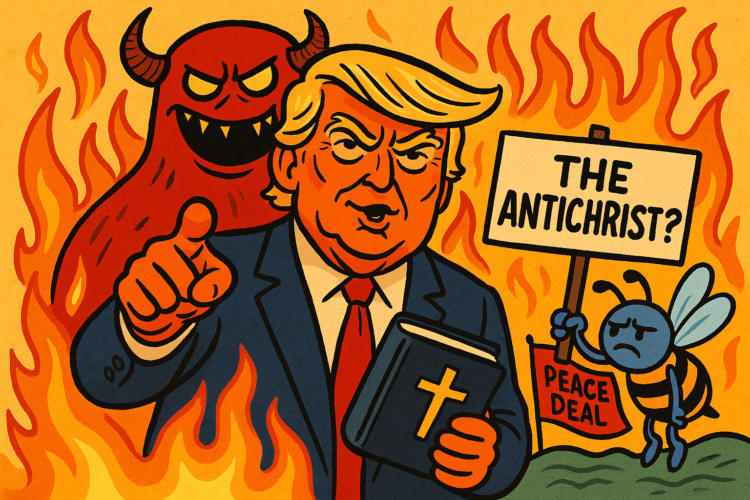
There’s an old superstition that when the world begins to eat itself, a showman appears to tell it the apocalypse is just a ratings opportunity. Even if you don’t believe in God, hell, or horned beasts rising from the sea, you have to admit that Donald Trump’s recent “peace deal” in the Middle East reads less like diplomacy and more like Revelation fan fiction. From an atheist perspective, it’s not about prophecy fulfilled but archetype repeated — a man embodying every warning label the Bible ever printed about false saviors, lawless rulers, and the blasphemous theater of ego run wild.
You don’t have to believe in the Antichrist to recognize one when you see his outline cast in orange light. The idea of a deceiver who comes wrapped in patriotism and peace rhetoric isn’t divine foresight; it’s political pattern recognition. Whether you call it myth, metaphor, or mid-tier cable news, the story is the same: when institutions falter and truth loses market share, the crowd crowns whoever sells certainty the loudest.
The Blueprint of the Beast
The Bible’s Antichrist is less monster than marketer. He sells unity while sowing division, peace while staging war, righteousness while hollowing morality. The text calls him “the man of lawlessness,” a figure whose power depends on spectacle and deception. For believers, he’s an omen; for atheists, he’s an allegory for what happens when power learns to perform faith instead of earn it.
In secular translation, the Antichrist archetype describes someone who replaces collective reason with personal worship. He erases the line between politics and religion by turning himself into both. The beauty of myth is that it doesn’t need to be true — it just needs to feel familiar, and Trump’s public life feels like déjà vu from an ancient warning.
The False Peacemaker
In prophecy, the Antichrist begins his reign with peace. He negotiates treaties, ends conflicts, and calls it proof of divine blessing — until the peace turns to domination. Trump’s new “peace deal” between Israel and its neighbors carries the same perfume: theatrical handshakes, grandiose speeches, and a self-congratulatory tone that screams messiah complex more than mediator. It’s a deal framed less around stability and more around his need to play the hero who did what no one else could.
The spectacle is what sells. He doesn’t broker peace; he performs it, selling the illusion of calm while stockpiling resentment for the next act. Even the Bible could appreciate the irony: a self-anointed savior whose diplomacy doubles as campaign footage. Peace, in this case, isn’t a covenant — it’s a commercial.
The Cult of the Chosen One
If the Antichrist is a deceiver who demands worship, Trump’s rallies qualify as tent revivals with better merch. The faithful chant his name as if reciting scripture, and dissenters are cast out like heretics. He positions himself not as a public servant but as the embodiment of a cause — the singular vessel of redemption for a country he claims is in moral ruin, which, conveniently, he can fix if you just believe a little harder and vote a little louder.
This isn’t religion in the theological sense; it’s religion in the psychological one. The audience needs belief more than the leader needs power, and that symbiosis is what keeps the show running. Trump doesn’t have to perform miracles; he just has to make disbelief look unpatriotic.
Lawlessness as Virtue
The Antichrist doesn’t break laws — he redefines them. Scripture says he will “exalt himself above all that is called God or is worshiped,” which, in modern terms, sounds like a politician declaring himself the sole arbiter of truth. Trump’s disregard for constitutional norms isn’t defiance; it’s doctrine. Every indictment becomes persecution, every court ruling a blasphemy against the divine order of Trumpism.
The deeper satire is that his followers call this rebellion “freedom.” They cheer as he replaces the rule of law with the rule of loyalty, mistaking chaos for authenticity. In the Bible, the Antichrist deceives nations through false righteousness; in America, he just does it through social media and campaign hats.
The Miracles of Media
When Revelation speaks of the Beast performing “great signs and wonders,” that’s easy enough to translate into the 21st century: spectacle as magic. Trump’s miracles are optical illusions — markets rising on his tweets, peace deals born of posturing, lies so audacious they wrap back around to truth. His greatest trick isn’t deception; it’s fatigue. He makes people so exhausted by the chaos that they surrender to the narrative out of sheer mental economy.
He floods the zone until reality itself begins to buckle. That’s the postmodern miracle — not walking on water, but convincing millions that the flood is fake news. The Antichrist of our era doesn’t summon plagues; he trends on hashtags.
Commerce, Control, and the Mark of the Brand
The old scripture warned of a beast who would control buying and selling, forcing allegiance through economic dependence. In 2025, that’s not a prophecy — it’s a business model. Trump’s empire runs on branding, licensing, and the commodification of loyalty. He doesn’t need a literal mark; the red cap is close enough. The logo substitutes for the mark of the beast, and the merchandise becomes both talisman and tax.
His manipulation of trade, tariffs, and media economies creates the illusion of mastery over markets. The Antichrist’s system wasn’t just spiritual—it was transactional. Trump’s system is pure capitalism dressed as divine favor, where profit masquerades as providence and devotion doubles as subscription.
The False Resurrection
Every scandal that should end him somehow resurrects him instead. That’s the modern resurrection narrative: a fallen idol reborn through outrage. Each indictment, loss, or humiliation becomes an origin story, as though political accountability were just another form of crucifixion. He doesn’t die politically — he trend-cycles.
For the Antichrist, death and rebirth were symbolic of false immortality; for Trump, it’s algorithmic. The outrage machine breathes life back into him every time he flatlines. If Christ conquered death, Trump conquered irrelevance.
The Theology of the Grift
The Antichrist’s kingdom thrives on deception and spectacle. In a world that rewards performance over principle, he doesn’t need faith, only followers. Trump’s theology is transactional: donate, adore, defend, and maybe salvation (or a tax cut) will follow. The entire mythos is inverted — grace becomes loyalty, repentance becomes applause.
He baptizes greed as patriotism and vengeance as virtue. His gospel is grievance, his communion a rally, his altar the camera lens. Even atheists can see the religious structure: confessionals traded for cable segments, holy wars fought in comment sections, tithes paid through online stores.
The Inevitable Betrayal
Biblically, the Antichrist’s reign ends with betrayal. He breaks the very peace he promised and exposes his followers’ faith as folly. It’s not far-fetched to imagine Trump doing the same: a grand betrayal of allies, believers, or even his own cause when the theatrics stop serving him. His loyalty lasts only as long as the applause does.
If history repeats, the collapse won’t be sudden but slow, disguised as victory. His undoing will look like triumph until the final curtain drops, because in a cult of personality, failure can’t be acknowledged — only rebranded.
Why the Metaphor Works (Even Without God)
From an atheist’s view, none of this proves prophecy. It proves psychology. The Antichrist isn’t real, but the idea of him explains something real about human nature: our hunger for certainty, our worship of strength, our addiction to spectacle. Every age invents its own false messiah; ours just happens to have a reality show.
The value of using biblical myth here isn’t belief — it’s vocabulary. The Antichrist is the West’s oldest metaphor for power unrestrained by conscience. So when a modern figure embodies that pattern, it doesn’t make him supernatural; it makes him symbolic. The point isn’t that Revelation predicted Trump — it’s that Trump reveals Revelation.
Final Benediction from the Church of Skepticism
You don’t have to believe in apocalypse to recognize one forming in slow motion. The Antichrist story isn’t about religion; it’s about warning systems. When a man demands loyalty instead of truth, worship instead of accountability, and peace without justice, the parable comes alive again — whether you believe or not.
So maybe Trump isn’t the Antichrist. But if the world ever needed a demo version of one, 2025 would be the beta test. The rest of us, atheist or otherwise, can only watch in disbelief as the show goes on — and pray, metaphorically speaking, that someone finally changes the channel.