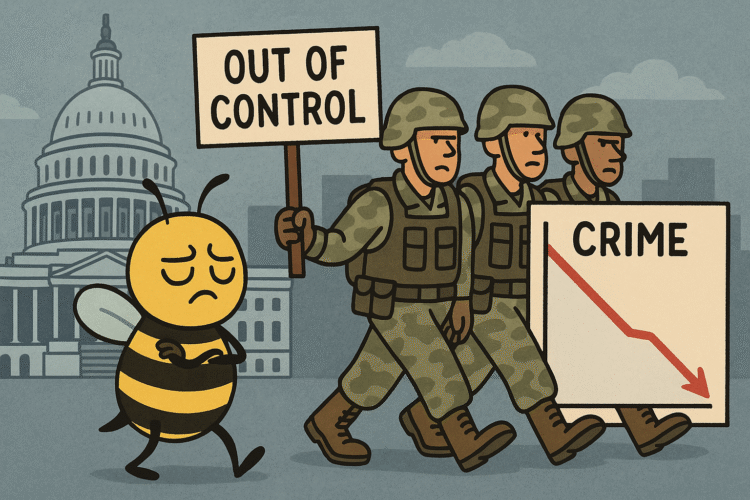
Washington, D.C. is enjoying its lowest violent crime levels in over thirty years. The data says so: a 35% drop in 2024, another 26% decline so far in 2025. Homicide is down. Robbery is down. Carjackings are down. The FBI and DOJ dashboards are practically waving at us with little “congratulations, you survived the nineties” banners.
So naturally, the White House has declared the capital city “out of control” and summoned National Guard units from West Virginia, South Carolina, and Ohio—three states where, inconveniently, some of their own major cities have higher per-capita murder rates than D.C. If irony were a felony, this would be the most violent week in America.
The Optics Parade
The optics were cinematic. Picture it: three contingents of National Guard troops rolling into D.C. under the command of governors who can barely control their own murder statistics. Cleveland recorded 105 homicides last year in a city with half D.C.’s population, giving it a higher per-capita rate. North Charleston and Myrtle Beach regularly post violent-crime levels that make D.C. look like a neighborhood block party. But sure—dispatch them to the capital, where the numbers are actually falling.
If Democrats even dreamed of sending Massachusetts Guardsmen into Texas because Houston’s numbers were spiking, Fox News would be holding a week-long “Invasion of the Blue Helmets” special. But when it’s Trump? It’s not an invasion—it’s “presence patrols.”
“Presence Patrols” and Other Euphemisms
The phrase “presence patrols” deserves its own place in the Orwellian Hall of Fame, nestled right between “enhanced interrogation” and “alternative facts.” Presence patrols suggest a benevolent stroll, perhaps troops window-shopping along M Street, asking politely if you’ve seen any crime in the area.
But make no mistake: troops in fatigues with sidearms aren’t ambiance. They’re intimidation by design, a walking press release that says, “We control your streets, even when the data doesn’t.”
The White House insists this isn’t about politics, just public safety. This, despite the fact that the numbers—the FBI’s numbers, not Rachel Maddow’s fanfiction—scream otherwise.
The Trumpian Theater of Fear
What this is, of course, is the spectacle. The “crime wave” narrative is the Swiss Army knife of authoritarian ambition: it justifies force, excuses surveillance, and sells fear like a limited-edition MAGA hat.
Never mind that 2023 was already the statistical peak and things have been trending downward ever since. In Trump’s version of reality, numbers don’t fall; they just wait for him to grab them by the throat and wrestle them into submission.
And what better way to make that performance pop than to fly in red-state Guards to “rescue” a blue city from a crisis that exists mostly in his press releases?
Newsom’s Shadow
The irony is that while California’s Gavin Newsom has been rolling out ballot proposals to counter gerrymandering, Trump has been rolling tanks into D.C. Not because of an emergency, but because nothing says “vote for me” like a parade of troops in a city with declining crime rates.
Newsom is working the system through elections. Trump is working the optics through intimidation. It’s a choice between ballot boxes and ammo boxes, and the difference couldn’t be clearer.
Who’s Saving Whom?
It’s not about whether D.C. needs saving. The numbers tell us it doesn’t. It’s about whether Trump needs to be seen saving it. The red-state troops aren’t here to protect residents; they’re here to protect a narrative.
And the narrative is fragile. Because every time a DOJ dashboard updates, every time the D.C. Metropolitan Police tweets another “crime is down” chart, the narrative shatters. And when the narrative shatters, so does the claim to strength.
The Bee in the Room
Let’s be honest: if you’re safer statistically walking the streets of Dupont Circle than you are in downtown Cleveland, who exactly is out of control here? It isn’t D.C. It’s the White House.
The administration is so desperate for a crisis that it’s importing one by bus. The uniforms, the salutes, the optics—they’re all props in the most expensive, least convincing community-theater production America has ever staged.
And just like any bad play, the audience eventually starts checking the exits.
Final Line: The numbers don’t lie, but the uniforms do. And when soldiers march in to rescue a city that isn’t burning, it’s not protection—it’s performance.