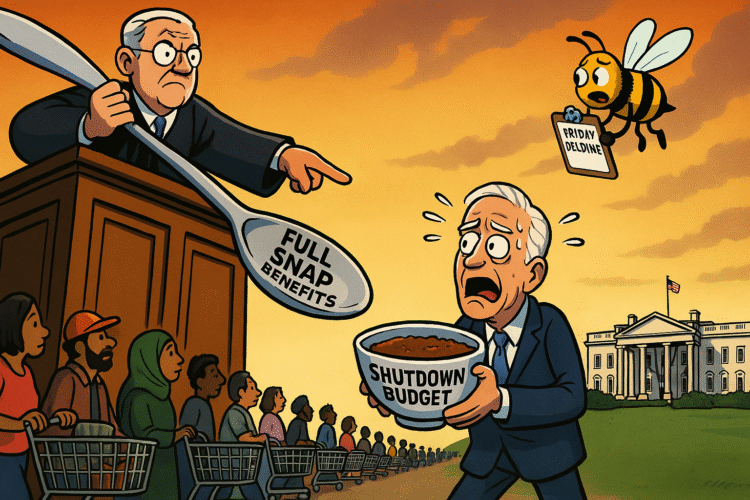
There are countries where courts decide matters of constitutional doctrine, high-stakes mergers, or the limits of executive war power. And then there is the United States of America, where a federal judge now has to order the President to feed hungry people like he’s reminding a teenager to take out the trash.
This week, Judge John J. McConnell Jr. of the District of Rhode Island became the unexpected protagonist in a civics parable about governance by cruelty. In a blistering ruling, he ordered the administration to release full SNAP benefits by Friday, after discovering that the Department of Agriculture had decided, in its infinite wisdom, to respond to a shutdown by partially starving the nation.
The decision was not subtle. According to Judge McConnell, USDA “arbitrarily and capriciously created this problem,” which is judicial dialect for “good grief, what is wrong with you.” He then directed the agency to use a 5.5 billion dollar contingency pot, pair it with Section 32 child-nutrition funds, and stop pretending it cannot perform the most basic task of social policy: helping people get groceries.
The administration responded with the dignified urgency of a toddler caught hiding vegetables under a napkin. They immediately announced they would appeal the ruling. Because nothing says fiscal discipline like fighting in court for the right to underfeed forty two million Americans.
Act I: The Shutdown Diet No One Asked For
The timeline reads like a script from a government satire that test audiences would reject for being too on the nose. The federal shutdown triggered a freeze in the normal schedule of SNAP payments, which millions rely on as their primary source of food. USDA, instead of planning for continuity, reacted with what officials described as a “partial payment pivot.” What that meant in English: cut benefits in half and hope the optics land softer than the impact.
They claimed they could only use the 5.5 billion dollar contingency reserve for partial disbursements, ignoring the existence of Section 32, a deep and rarely discussed child-nutrition pot designed exactly for emergencies. For weeks, states warned the federal government that half payments would cause administrative chaos, with EBT processors preparing for cascading delays, card outages, and frantic families lining up at food banks already stretched past capacity.
The administration’s response was to shrug, point at the shutdown, and claim their hands were tied. Judge McConnell, reading the statute with what we used to call “logic,” promptly noted that hands were tied only because USDA tied them.
Act II: The Emergency Hearing, or How to Lose a Case in One Afternoon
The hearing that led to the court’s order was, by all accounts, an unmitigated disaster for the administration. Plaintiff groups argued that SNAP is an entitlement program under the Food and Nutrition Act, meaning the government cannot withhold or arbitrarily reduce benefits unless Congress says so. USDA lawyers tried to claim that states could not process full payments anyway, citing “systems strain.” State officials, invited by plaintiffs to explain themselves, flatly contradicted that claim.
One state director testified that “the only thing stopping us is funding.” Another explained that USDA told them partial payouts were “necessary,” even though Section 32 funds remained untouched.
When pressed on why they chose half payments, USDA offered an argument so weak it could have been printed on tissue paper: “We believed this interpretation was consistent with past practice.” Judge McConnell asked for precedent. None existed.
He asked for policy analysis. None had been drafted.
He asked whether they considered the harm to forty two million people. After a long pause, the government conceded that perhaps the full scope of impact had not been assessed.
In legal parlance, this is known as “losing the argument so badly that the bench starts doing your job for you.”
Act III: The Legal Spine of a Malnourished Nation
The ruling rests on three pillars:
First, the Food and Nutrition Act. SNAP is an entitlement, meaning eligible households have a legal right to full benefits regardless of shutdowns. USDA is not empowered to invent new funding ratios to balance its books on the backs of poor families.
Second, the Administrative Procedure Act. Agencies cannot take actions that are arbitrary or capricious. This includes making up interpretations of contingency funding on the fly, ignoring available statutory tools, and implementing policies that worsen the very problems they claim to solve.
Third, the Constitution’s separation of powers. Only Congress controls the purse. When agencies manipulate funding structures during shutdowns to achieve political ends, they are not just bending rules, they are rewriting them.
Judge McConnell did not need a law degree to see what was happening. He needed a conscience.
Act IV: The Appeal That Should Embarrass Everyone
Within hours of the ruling, USDA announced it would appeal, warning that Judge McConnell’s order could “create operational strain” and “compromise fiscal integrity.” This is administrative theater. There is nothing fiscally responsible about withholding food assistance. There is nothing operationally efficient about forcing food banks to fill a nine billion dollar hole with donated cans of beans.
The appeal is political, not procedural. The administration does not want a judicial precedent stating that anti hunger programs cannot be weaponized during shutdowns. If courts start requiring agencies to follow entitlement law during crises, the executive branch loses one of its quietest forms of leverage.
The message from the government is clear: it is easier to starve people than admit error.
Act V: The Anatomy of Administrative Harm
Let us dispense with the fiction that SNAP is a marginal program. It is one of the most efficient anti poverty tools in the federal arsenal. When benefits are delayed, families go hungry. When benefits are cut, grocery stores lose revenue. When EBT payments stall, households skip meals so their children do not.
Every shutdown magnifies these harms. During the partial payment period, food banks saw surges in demand that volunteer networks could not absorb. States warned that administrative delays would cause EBT processors to hit bandwidth limits on the very days families were trying to buy groceries before outages. Local officials begged the federal government to release full funds before the shutdown reached a breaking point.
The administration offered sympathy and half checks. Sympathy does not stretch a budget. Half checks do not fill a cart.
Act VI: This Is Not Just Policy, This Is Punishment
The deeper truth behind the ruling is that SNAP became collateral damage in a political stunt. When the administration froze benefits, it claimed that the shutdown left no other option. That was false. They had options. They simply did not like them.
Section 32 is a child nutrition fund derived from agricultural tariffs. It is meant to protect food programs during fiscal disruptions. USDA’s decision not to use it was not an accident. It was a statement. It signaled that hunger relief was negotiable, that entitlement programs could be squeezed to win messaging battles, and that the people most likely to suffer were the ones officials felt least accountable to.
Judge McConnell’s ruling shattered that strategy by stating the obvious: food is not a bargaining chip.
Act VII: The Mechanics Behind the Mandate
To comply, USDA must do the following by Friday:
Pair the 5.5 billion reserve with Section 32 to meet the nine billion dollar need. Work with OMB to secure apportionments that release funds without delay. Instruct Treasury to execute payments to states immediately. Issue binding guidance telling state agencies to process full benefits. Coordinate with EBT processors to avoid system crashes. Provide affidavits to the court confirming compliance.
This is the administrative equivalent of a fire drill, but it is entirely feasible. The agency simply preferred not to do it.
Act VIII: The Political Spin Cycle Begins Anew
Predictably, allies of the administration insist the court overreached. They claim that ordering the government to feed forty two million people “creates an incentive for judicial meddling.” They warn of “budgetary distortions.” They recite talking points about “precedent.”
What they do not mention is that this crisis was engineered. SNAP beneficiaries did not create it. USDA did. And they did it for the oldest reason in politics: leverage.
Act IX: The Checkpoints Ahead
The next few days will determine whether families eat or whether this becomes another round of brinkmanship:
First, USDA must tap Section 32. If they refuse, compliance becomes impossible.
Second, the appeals court may issue a stay. If it does, benefits remain frozen and food banks will assume the burden.
Third, EBT processors must be ready. If systems crash, even full funding will not reach families.
Fourth, states need clarity. Some have already drafted emergency guidance that they cannot implement without federal approval.
Fifth, reporters need to describe this plainly. Not as “budget tensions,” not as “shutdown fallout,” but as a choice to starve people.
Act X: The Cost of Pretending Hunger Is Complicated
You do not need a law degree to understand this case. Hunger is immediate. It is concrete. It is not theoretical. When the federal government withholds benefits, lives get shorter, health outcomes worsen, and poverty deepens. Every day of delay pushes families closer to crisis.
Judge McConnell’s ruling did not create urgency. It recognized the urgency that already existed. His order is not activist. It is basic humanity.
If this administration appeals successfully, it will set a precedent more dangerous than any policy dispute: that the executive can weaponize hunger during shutdowns, and that courts are powerless to intervene. That is not just bad law. It is moral collapse.
Coda for a Nation That Forgot How to Feed Itself
This week, a court had to order the President to feed his people. Read that again. The wealthiest nation on Earth stopped its own anti hunger program, insisted nothing could be done, then demanded credit for offering half rations while families panicked.
This is not governance. It is neglect dressed up as fiscal prudence. It is cruelty hidden behind statutory footnotes. It is a shutdown turned into a slow moving disaster.
The judge gave the administration a choice: comply or defend starvation in appellate court. Either way, the story is the same. The government did not run out of money. It ran out of empathy.
And when a nation forgets that feeding its people is a duty, not an inconvenience, the courts become the last adults in the room. For now, they have forced the government to remember its obligations. The question is whether the administration will remember them long enough to meet the deadline.