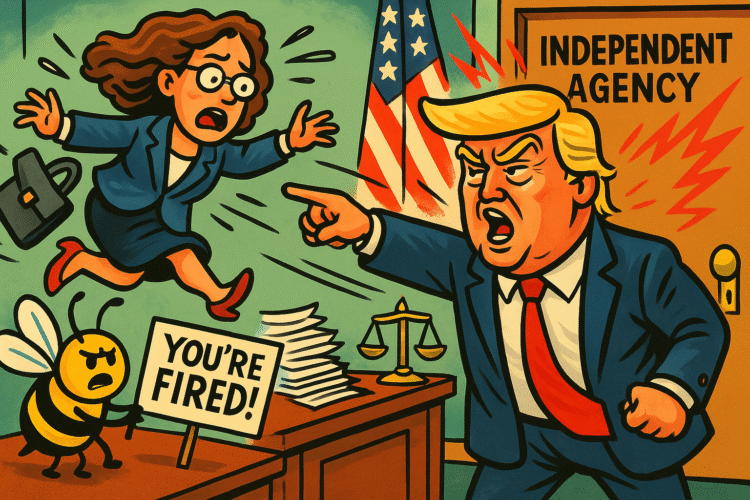
The Supreme Court has once again reminded us that the Constitution is less a sacred text and more a choose-your-own-adventure paperback where one ending includes civil liberties and the other ends with Donald Trump auditioning for The Apprentice: Federal Agencies Edition. On September 22, 2025, the Court—in a tidy little 6–3 order—handed President Trump what he’s wanted since the moment he learned the word “fired”: the power to remove Democratic FTC commissioner Rebecca Kelly Slaughter.
Yes, you read that correctly. Rebecca Kelly Slaughter, one of the last Democratic voices still inside the marble halls of a regulatory agency, was shown the constitutional trap door while the Court simultaneously scheduled full arguments for December to determine if they should just go ahead and bulldoze the 1935 precedent known as Humphrey’s Executor. That 90-year-old case has served as the scaffolding keeping presidents from treating independent agencies like their personal reality show contestants.
Justice Elena Kagan dissented—joined by Sotomayor and Jackson—sounding like the last three rational people at a dinner party where the host insists shots of bleach will cure seasonal allergies. “Congress put safeguards in place for a reason,” she all but shouted into the void. But the majority had no time for such niceties, preferring instead to accelerate Trump’s quest for sweeping control over quasi-independent boards like the FTC and NLRB.
Who, What, When, Where, Why, So What
- Who: President Donald Trump, the Supreme Court’s 6–3 conservative bloc, Democratic commissioner Rebecca Kelly Slaughter, dissenters Kagan/Sotomayor/Jackson. Also in the wings: Federal Reserve Governor Lisa Cook, facing similar litigation.
- What: Trump v. Slaughter—a case asking whether the president can fire officials at independent agencies without cause, and whether courts can stop him when he does.
- When: September 22, 2025 (the order), with full arguments scheduled for December.
- Where: Washington, D.C.—where else? Though the fallout radiates to every independent board from Wall Street to union halls.
- Why: Because Trump wants direct control of regulatory agencies that were deliberately insulated from direct political purges.
- So What: If the Court guts or scraps Humphrey’s Executor, the FTC, NLRB, and even the Federal Reserve risk becoming little more than extensions of whichever president happens to hold office.
The Case: Trump v. Slaughter
The central questions presented could have been written in Sharpie on the back of a Big Mac wrapper:
- Does the president have unilateral authority to remove independent-agency officials without cause? (Humphrey’s Executor says no, but this Court has been itching to say yes.)
- Can courts block removals while challenges are pending? (The order suggests: probably not, unless you have a time machine or a majority that doesn’t think “executive power” means “king.”)
Trump has insisted that these agencies are too powerful to be shielded from him—translation: he doesn’t like having anyone around who might say “No.” Slaughter, a career Democrat who cut her teeth fighting monopolies and corporate overreach, became the first head to roll. The Court’s conservatives called it “interim relief.” Everyone else calls it an authoritarian stress test.
Trump’s Broader Purge
This isn’t an isolated firing. It’s a house-cleaning, and Trump’s already wielded the executive mop:
- Earlier in 2025, Trump muscled through emergency stays that allowed him to oust other Democratic holdovers across various commissions. Each time, lower courts tried to slow him down, and each time, the Supreme Court said, “Expedite it.”
- Now, litigation looms over Federal Reserve Governor Lisa Cook. The Fed—supposed to be the most independent of all—could find itself shackled to Trump’s tweets, rate-cut demands, and gut-level hunches about what “the economy feels like today.”
It’s less of a “purge” than an “alignment exercise,” if you believe Trump’s people. But when every alignment involves aligning to him, you start to notice the difference between balance of powers and corporate synergy.
A Quick History Lesson (Because They Won’t Teach It at MAGA Rallies)
Back in 1935, in Humphrey’s Executor v. United States, the Court told Franklin D. Roosevelt that presidents can’t just fire independent-agency officials for political reasons. These agencies—FTC, SEC, NLRB—were designed to be insulated from political mood swings so that, for instance, antitrust policy wasn’t dictated by whichever administration was currently in bed with big business.
Fast forward 90 years: that insulation is being yanked like asbestos from a ceiling no one wanted disturbed. The same justices who tell us daily they are “textualists” are now suddenly allergic to text, precedent, and structure when it gets in the way of one man’s grip on the bureaucracy.
Kagan’s Dissent: A Cry into the Constitutional Wilderness
Justice Elena Kagan’s dissent, joined by Justices Sonia Sotomayor and Ketanji Brown Jackson, might as well have been subtitled “Please Don’t Burn the House Down.” Kagan warned that eroding congressional safeguards risks converting independent boards into White House fiefdoms.
It was a dissent heavy on historical continuity and light on illusions: Congress deliberately set up these agencies with staggered terms and removal protections because concentration of power in the executive is, to put it mildly, a bad idea. The dissent could be stitched onto a sampler: Checks and balances are not optional.
The Stakes: Separation of Powers or One-Man Show
If the Court pares back or overturns Humphrey’s Executor, here’s what happens:
- FTC: Antitrust decisions—already fragile—swing at the whims of the president. Today it’s Trump; tomorrow it could be someone else. Either way, “independent” becomes an inside joke.
- NLRB: Workers’ rights? Collective bargaining? Gone whichever way the Oval Office wind blows. Imagine unions negotiating with both management and the president’s reelection campaign at once.
- Federal Reserve: The world’s most important central bank suddenly has the credibility of a late-night infomercial. Imagine interest rates cut not because inflation is low but because the president is cranky before bedtime.
- Every Other Board You’ve Never Heard Of: Even the ones most Americans couldn’t name suddenly matter, because they’ll all be synchronized to the whims of a single politician.
This isn’t just about personnel. It’s about whether regulatory stability exists at all. Investors, workers, consumers—they all rely on some level of predictability. But predictability dies when policy is subject to the moods of one man and the cronies he appoints.
Why Now?
The timing is no accident. Trump has spent his first year back in office engaged in what can only be called a “bureaucratic strip-mining operation.” Democratic commissioners, regulators, and agency veterans have been systematically shown the door. The September 22 order simply adds Supreme Court muscle to the project.
Meanwhile, with December arguments looming, the Court’s conservatives are licking their chops at the chance to do what conservative law professors have been writing about for decades: dismantling the administrative state under the guise of constitutional purity.
The Irony Pile-Up
Let’s pause to savor the irony.
- Originalism: The conservative justices who tell us they revere precedent when it comes to guns, abortion, or anything else are suddenly waving goodbye to a 90-year-old ruling because it stands in the way of Trump’s HR preferences.
- Independence: The same voices who howl about “weaponized bureaucracy” now want to weaponize it more directly, by strapping it to the president’s belt like Batman gadgets.
- Transparency: Republicans spent years screaming about “unaccountable bureaucrats.” Their solution? Make them accountable to just one guy, even if that guy thinks tariffs are mood rings.
So What Happens in December?
Come December, the Court will hear full arguments on whether to kill or cripple Humphrey’s Executor. The conservative majority has three likely paths:
- Go Full Guillotine: Overturn it outright. Presidents can fire anyone, anytime, for any reason. Regulatory independence is dead.
- Death by Exceptions: Keep the precedent on paper but carve so many exceptions (FTC, NLRB, Fed) that it no longer applies in practice.
- Pretend Restraint: Leave the precedent mostly intact but uphold Trump’s removal anyway, signaling that in practice presidents can get their way without the Court taking full responsibility.
If Vegas were taking bets, the odds are on Door #2—death by a thousand cuts masquerading as fidelity to history.
The So-What for the Rest of Us
For regular Americans, this fight sounds like inside baseball. But when your grocery bill spikes because a politicized Fed keeps interest rates low to goose an election, or when your workplace rights vanish because the NLRB chair answers to a campaign donor, you’ll notice.
The “administrative state” is not a slogan. It’s the plumbing of modern governance: antitrust enforcement, labor protections, environmental rules, consumer safeguards. Yank out the pipes and you don’t get less government—you get sewage on the floor.
Summary: The Constitutional Circus
The September 22 order wasn’t just about Rebecca Kelly Slaughter—it was a preview of December’s main event: whether independent agencies will remain independent or become the president’s personal cheer squad.
Six justices have already telegraphed their impatience with precedent, while three are left standing guard over a crumbling separation-of-powers wall. Trump is openly salivating at the thought of extending his firings from the FTC to the Fed. The stakes aren’t abstract—they are regulatory stability, market confidence, and the thin line between separation of powers and separation anxiety.
In other words: if Humphrey’s Executor falls, the Constitution doesn’t look like a balance anymore. It looks like a one-man show. And like all one-man shows, it will eventually collapse under the weight of its own ego.