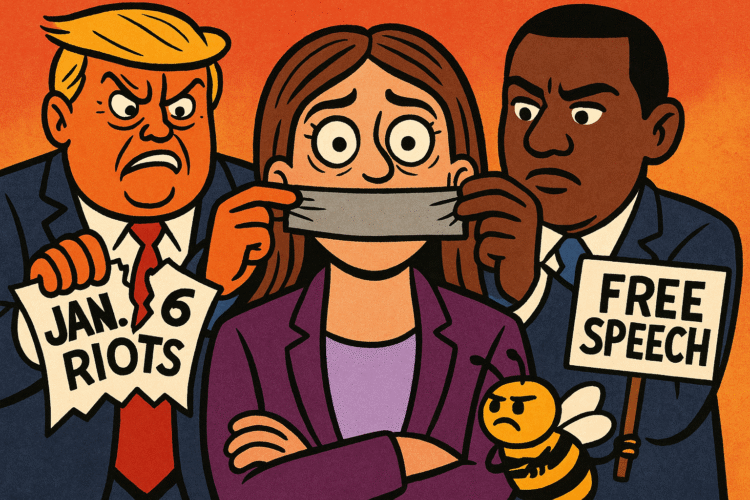
It takes a special kind of government dysfunction to turn a routine sentencing memo into a constitutional crisis. Yet here we are.
Multiple outlets confirmed this week that two Assistant U.S. Attorneys, Carlos Valdivia and Samuel White, were placed on administrative leave—mere hours after filing a memo that did the unthinkable: it described January 6 as “a mob of rioters” and mentioned Donald Trump’s post revealing Barack Obama’s home address. Within the same day, the Justice Department withdrew their filing, scrubbed the Trump and January 6 references, and submitted a sanitized version to the court.
The official reason? None provided. The unofficial one? They told the truth.
The Timeline of a Purge
Morning: Valdivia and White file the memo in the Taylor Taranto case. Taranto, a January 6 participant who received a presidential pardon for earlier conduct but faces new charges for threats and firearms possession, was nearing sentencing. The memo cited his history, the context of the riot, and his proximity to a former president’s social media callouts. Standard stuff for a prosecutor summarizing relevant conduct.
Afternoon: phones start ringing. Someone upstairs has noticed the words “mob of rioters.” Someone else has noticed “Trump.” Within hours, the filing is quietly withdrawn and replaced. The offending phrases vanish like a redacted CIA cable.
By sunset, both prosecutors are escorted out of their offices on administrative leave.
The Justice Department insists this has nothing to do with politics. Which is why, naturally, both men were punished for writing words that accurately describe reality.
What the Memo Said (Before It Was Rewritten by History)
The original filing, according to reporters who captured copies before it disappeared, described January 6 as “a violent assault on the Capitol carried out by a mob of rioters.” It also noted that Taranto “traveled to the Capitol after seeing former President Trump’s social media posts,” including one revealing Barack Obama’s address—a post the FBI later cited in a separate threat investigation.
This is not editorializing. It’s chronology. The riot happened. Trump posted. Taranto acted. Prosecutors included the sequence in context.
The revised version, however, removed every trace of that narrative. Gone were the references to January 6. Gone was Trump’s name. Gone was the connective tissue between cause and consequence.
What remained was an abstract recitation of sentencing factors, stripped of politics, stripped of history, stripped of meaning.
The Legal Stakes: When Truth Becomes a Career Hazard
Federal prosecutors operate under a rulebook thicker than the Bible. They answer to line supervisors, U.S. Attorneys, Main Justice, and ultimately the courts. But they’re also sworn to present the full factual record. A sentencing memo is not a press release—it’s a court document meant to inform a judge’s decision.
By erasing relevant facts, DOJ undermined not only its own credibility but the integrity of the court process itself. Judges cannot weigh intent or risk without understanding context. If a defendant’s actions were influenced by a political event or a public figure’s incitement, that is legally relevant. It’s the difference between a lone threat and an organized ecosystem of violence.
Now, imagine being a judge handed a revised memo scrubbed of those facts. You’re being asked to sentence someone for a crime whose motivations have been bureaucratically erased. It’s judicial gaslighting in real time.
The Governance Stakes: Prosecutorial Independence Meets the Loyalty Test
The Department of Justice runs on a fragile compact known as prosecutorial independence. The premise is simple: career lawyers enforce the law without political interference. The system collapses if prosecutors must ask themselves whether a fact is too controversial to type.
This isn’t just about Valdivia and White. It’s part of a pattern. Over the past year, several line prosecutors involved in January 6 cases have been reassigned, demoted, or encouraged to “pursue other opportunities” after submitting filings that named senior officials or drew uncomfortable parallels between mob behavior and campaign rhetoric.
One veteran prosecutor described the new environment bluntly: “Every edit now feels like career roulette.”
When truth becomes a personnel matter, you no longer have a Justice Department. You have a Ministry of Optics.
A History Revised in Real Time
The irony is almost biblical. The DOJ is punishing its own attorneys for using the same language the DOJ itself once used. The original charging documents against January 6 defendants routinely called the event “a violent riot.” The sentencing memos for Proud Boys and Oath Keepers leaders explicitly linked their actions to Trump’s speech. Those filings are still public record.
But something has shifted. The second Trump term has turned accuracy into provocation. Words once considered descriptive now qualify as insubordination.
We’ve reached a moment when the government cannot decide whether January 6 was an insurrection, a protest, or a staffing issue. And instead of clarity, we get censorship disguised as “professionalism.”
Personnel Rules and Punishment by Process
Administrative leave sounds neutral, but it’s bureaucratic exile. It means your badge doesn’t work, your inbox is frozen, and your reputation is bleeding out in real time. Officially, it’s “pending review.” Unofficially, it’s message-sending.
Both Valdivia and White were career prosecutors, not political appointees. They’ve handled violent crime, national security, and firearms cases for years. Their personnel files were clean. That changed the instant they wrote down something inconvenient.
The Justice Department’s public affairs office refuses to explain who ordered the withdrawal or the suspensions. The U.S. Attorney overseeing their office declined comment but emphasized “apolitical law enforcement.” Which is like insisting the Titanic was unsinkable while the orchestra is already floating.
Court Integrity in a Post-Fact Department
Here’s the part that keeps judges up at night. Sentencing relies on a complete record. When prosecutors sanitize filings, they distort that record.
Judges can’t consider facts that never make it to the docket. They can’t reference motivations that no longer exist in the official version. And defense lawyers can exploit that absence, arguing that the record “contains no evidence” of incitement or broader networks.
If the original memo vanishes from the file, the historical record of the case changes. One more small piece of January 6 disappears, pixel by pixel, from the official story.
The law doesn’t die in one stroke. It dies in edits.
The Reactions: A Nation Split Between Alarm and Applause
Press freedom and rule of law advocates see the suspensions as a five-alarm fire. The Project on Government Oversight called it “a warning shot at truth-tellers.” The American Constitution Society labeled it “an act of historical revisionism through personnel action.”
Civil liberties attorneys warned of a chilling effect: “If prosecutors can’t describe events honestly, every future case becomes political theater.”
Trump allies, meanwhile, celebrated the move as “discipline.” A former campaign adviser told Fox News, “Finally, someone is cleaning house of biased lawyers.” On social media, Trump supporters trended hashtags about “Deep State traitors.”
Even some moderates tried to split the difference. “The language was probably unhelpful,” said one retired DOJ official, as if accuracy were a PR choice.
The Media’s Half-Blind Coverage
Most outlets covered the suspensions as a staffing issue. Headlines read like HR bulletins: “Two DOJ Lawyers on Leave After Filing Error.” Only the smaller print acknowledged that the “error” was factual description.
A handful of journalists tried to sound the alarm, pointing out that DOJ had effectively rewritten the event in court record form. But cable news, perpetually allergic to context, framed it as “controversy over language.”
The words “mob of rioters” are not subjective. They’re factual. To pretend otherwise is to normalize deceit.
Institutional Decay by Euphemism
No democracy collapses overnight. It erodes through euphemism.
“Administrative leave” instead of purge.
“Revised filing” instead of censorship.
“Applies to all parties” instead of targeted silencing.
Each phrase is a linguistic fig leaf covering a branch of government that no longer trusts itself to speak plainly.
This is how institutional norms vanish. Not with jackboots, but with track changes.
What Happens Next
Several key checkpoints will determine whether this story ends in accountability or silence.
- The Court Record: Will the sentencing judge demand the original memo be restored to the record? Federal courts maintain version logs. The judge could order the unredacted filing under seal, preserving the evidence of alteration.
- Inspector General Review: DOJ’s Inspector General has jurisdiction over personnel retaliation. Expect requests for emails, directives, and edit chains tracing who ordered the revisions.
- Congressional Oversight: House and Senate judiciary committees will seize this for opposing reasons. Democrats will call it suppression. Republicans will call it cleanup. Both will pretend to care about transparency.
- Defense Exploitation: Taranto’s lawyers could argue that the government’s internal turmoil undermines the credibility of the prosecution, potentially softening sentencing.
- Public Accountability: Will any major outlet stop treating this as a bureaucratic mishap and start calling it what it is—an attempt to erase facts from federal memory?
The Pattern of Erasure
This episode fits a broader pattern of bureaucratic control over narrative. When civil servants write history in real time, the political class edits it to fit the script. It happened with intelligence reports before the Iraq War. It happened with climate research under multiple administrations. It’s happening now with January 6.
In each case, the playbook is the same: punish the authors, rewrite the record, deny the motive.
The difference this time is proximity. We are no longer redacting foreign intelligence. We are redacting ourselves.
The Human Cost
Valdivia and White aren’t martyrs. They’re career lawyers who made the mistake of believing their oaths meant something. They will now spend months in bureaucratic limbo, their reputations hanging by the thread of “pending review.”
Colleagues will lower their voices in hallways. Supervisors will say “it’s unfortunate.” Reporters will eventually move on. But inside the department, the message will linger.
Write what you see, and you might never write again.
Section Title: The Silence Clause
In every authoritarian drift, there comes a moment when truth itself becomes classified. This is that moment.
The DOJ’s job is not to protect feelings. It is to protect facts. When it starts punishing those who document them, it becomes part of the story it’s supposed to investigate.
The sanitized memo in United States v. Taranto will not erase what happened on January 6. But it will make it harder to say so in court.
That is the quiet coup, the kind that doesn’t need tanks. Just track changes, red ink, and a culture of silence.
Because if prosecutors can’t call a mob a mob, if they can’t name the man who inspired it, then justice has stopped speaking English. It’s switched to something safer: bureaucratic nothing.
And that, more than any riot, is how republics end—sentence by sentence, memo by memo, until the truth itself is placed on administrative leave.