The Headline They Won’t Print
“Colleges Can’t Consider Race in Admissions, But ICE Can When They Stop You on the Street”
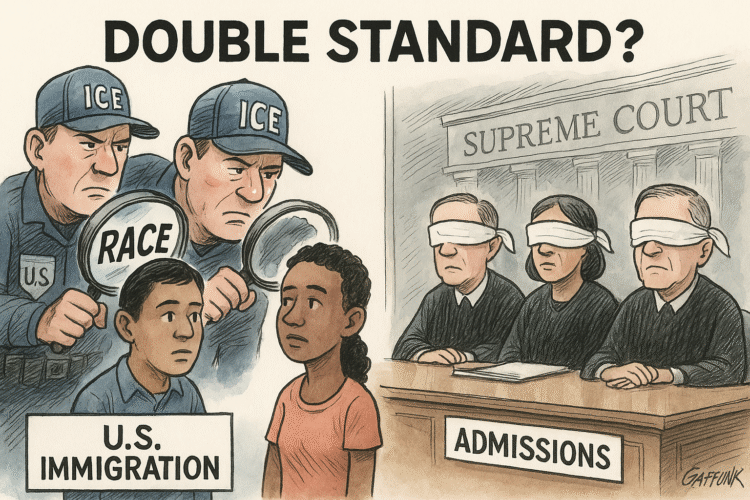
That is the American paradox in its purest form. The same Supreme Court majority that clutched pearls over Harvard and UNC using race as one factor in evaluating applicants has no issue with Border Patrol officers in Chicago literally saying they stop people based on “how they look.” It is the legal equivalent of banning sunscreen at the beach while selling SPF 100 to cops patrolling the boardwalk.
Scene One: Colorblind in the Ivy League
The Trump administration and its judicial offspring delivered a verdict: colleges must be “colorblind.” Never mind that legacy admissions are basically hereditary monarchies for white prep schools. Never mind that zip codes already separate opportunity like oil and water. No, the real threat to “fairness” is the idea that a Black or Latino student’s life experience might count as context in admissions.
Justice Roberts once said the way to stop discriminating by race is to stop discriminating by race. The phrase is so neat, it almost sounds wise—until you realize it translates in practice to: ignore the last 400 years, shred context, and let “merit” mean Daddy’s squash donation.
Scene Two: Racially Attuned at the Border
Shift the camera to Michigan Avenue or the Chicago River, where Border Patrol boats idle like props from a dystopian musical. Commander Gregory Bovino said the quiet part out loud: agents decide whom to stop partly by “how they look.” Not SAT scores. Not recommendation letters. Just the vibe of your skin, your accent, your hair.
Here, race isn’t a taboo consideration—it’s the operating system. And the courts, so allergic to race in admissions, suddenly rediscover flexibility. “National security,” they intone, as though two words can bleach away contradiction.
The Constitutional Costume Change
The Equal Protection Clause has become a quick-change artist. In the admissions office it wears a white blindfold, trembling at the sight of any checkbox mentioning race. In the immigration office it swaps into camo, peers through night-vision goggles, and declares that race is a perfectly fine shortcut to suspicion.
Imagine explaining this to a first-year law student. They would assume you were kidding. The Constitution cannot mean “race counts when excluding but never when including.” And yet that is exactly what it means, once filtered through Trump-era enforcement logic and the Roberts Court’s selective moral panic.
A Tale of Two Justifications
- Colleges: “We’d like to admit students with diverse backgrounds, since research shows it benefits everyone.”
- Court: “Blasphemy! Racial awareness is unconstitutional.”
- ICE: “We’d like to stop people who look foreign.”
- Court: “Sounds administratively efficient. Carry on.”
The Playbook: Law and Order Wins, Opportunity Loses
The Trump legal project has always been simple: dress selective exclusion in the costume of constitutional principle.
- When police profile Black men for “warrants,” it’s pragmatic.
- When ICE profiles Latinos for “papers,” it’s national security.
- But when universities profile a nation’s history to admit a diverse class, it’s heresy.
The hypocrisy is so glaring you could project it onto the side of Trump Tower, and it would still be hard to miss.
The Ghost of Brown v. Board
Brown v. Board was once the North Star: the Constitution cannot tolerate racial segregation because it stamps a badge of inferiority. Today, that star has been dimmed by a Court that treats acknowledgment of race as the problem, while happily tolerating its abuse as a shortcut to suspicion.
We now live in an America where Brown’s promise is recast: equality means colorblindness in the classroom, but color-coded policing in the street.
Scene Three: The Street vs. the Quad
Consider two young men in Chicago:
- Jamal, a South Side teenager, gets stopped for looking like he might have a warrant. Police call it “reasonable suspicion.” Courts call it fine.
- Diego, a DACA kid with a 4.0 GPA, applies to Harvard. Admissions wonders if his resilience through systemic barriers should matter. The Court calls it unconstitutional.
Jamal’s skin color is admissible evidence of suspicion. Diego’s is inadmissible evidence of achievement. The juxtaposition would be funny if it weren’t so lethal.
The Marching Band of Hypocrisy
Picture the annual parade of American jurisprudence:
- ICE leads with banners reading, “We Look at Faces.”
- Police follow with batons labeled “Suspicion = Melanin.”
- The Supreme Court struts behind, chanting “Colorblind for Harvard, Color-coded for Homeland Security.”
- At the rear, students of color stand on broken floats, clutching rejection letters.
It’s the only parade where the Constitution rides on a float shaped like a funhouse mirror.
The Translation
Equal Protection, 2025 edition, means:
- No help for you in admissions, because race is too dangerous to acknowledge.
- But all the help against you in immigration, because race is too convenient to ignore.
It’s not neutrality. It’s not fairness. It’s not even law. It’s a preference list dressed as principle.
The Stakes
Satire aside, the stakes are heavy. Colleges are stripped of one of the few tools they had to chip away at centuries of structural inequality. At the same time, policing and immigration are given carte blanche to double down on race as shorthand for criminality. The effect is clear: reinforce the pipeline that blocks opportunity while fueling incarceration and deportation.
Closing Reflection: A Country of Mirrors
The Constitution is supposed to be a safeguard. Instead, it has become a hall of mirrors. If you are seeking opportunity, it reflects back a blindfold. If you are fleeing suspicion, it reflects back a spotlight.
That is the genius of selective colorblindness: it preserves inequality under the guise of fairness. It tells Harvard to stop seeing race, while telling ICE to never stop. It is a trick, a dodge, a national pastime.
And it is the reason why a Black student can be too Black to walk home without suspicion, but not Black enough for Harvard to admit him with context. It is the reason why a Latino worker can be too Latino to board a Greyhound without papers, but not Latino enough for Yale to say his story matters.