The Uninvited Nocturnal Ball
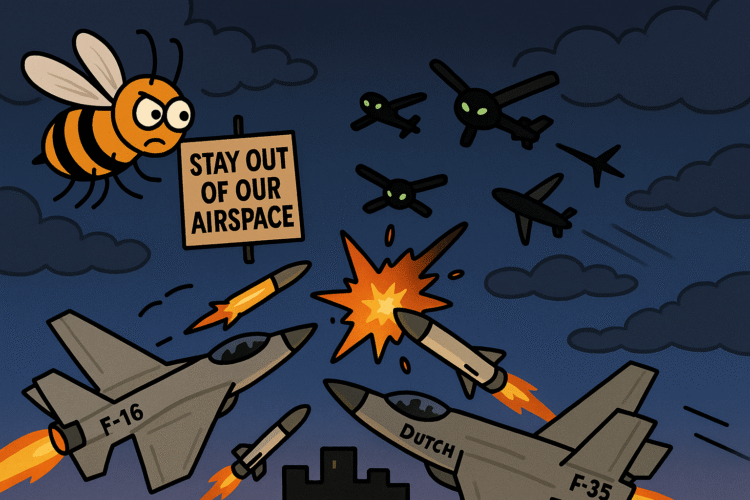
Somewhere between the cosmic nudge of late evening and the brittle patience of dawn, something peculiar happened above Poland. Imagine a nocturne for air defense: an unexpected ballet of over 415 drones and more than 40 missiles gliding where they were neither invited nor expected. Just when Warsaw was narrowing its eyes, calculating “What’s for breakfast?”, the sky erupted—not in dawn’s early light magic, but in a militarized tantrum. Polish F-16s took off in alarmed choreography; Dutch F-35s joined the fray with practiced precision; Italian early-warning systems flickered like nervous stagehands backstage. In the thick of it, NATO officials discovered that yes, for the first time during this conflict, a NATO country had indeed fired—not in bravado, but in defense. Call that progress, a grim milestone marked by the sting of reality.
What makes mockery of absurdity is its predictability.
We’ve arrived at the subtext: “This is what happens when you treat your neighbor—whom you reliably threatened for years—as nothing more than a twilight hobby.”
Prime Minister Donald Tusk, in measured tones anchored to deliberation, reported 19 incursions. A detailed count—because in crises, numerical precision summons assurance. He invoked NATO Article 4, the diplomatic red telephone: “Consultations are in order.” President Andrzej Duda promptly convened the security chiefs. Oh, the gravity! It reads like a chess move in a game nobody wanted to play—except that the pawns here are real homes and real lives.
Debris in Lublin, Denials in Moscow
Meanwhile, in the Lublin Voivodeship—an area that never asked for geopolitical theater—fragments rained upon homes. Residents found themselves in an unwilling play, inspecting shards on their front steps. It must be endearing, in a way, this chance to own a souvenir of conflict over breakfast.
Russia, in its time-honored tradition of selective opacity, denied targeting Poland. A flawless exercise in deflection: define the term “target” narrowly, and you can pretend. At the same time, some drones appeared to enter from Belarus, which is like having an uninvited guest route through your basement and then pretending the doorbell never rang. Meanwhile U.S. and EU leaders condemned the episode as “deliberate”—a categorical declaration more cutting than the debris falling on Lublin’s roofs.
Then enters the figure who needs no introduction, offering his two-word commentary: Trump posted “Here we go.” Whether exasperated, gleeful, or alarmed, the phrase nests itself in the collective psyche of “Wait, is this peak absurdity—or just business as usual?”
A Satire of Escalation, Not Apocalypse
Notice how escalation can sound banal when broken down: 415 drones becomes “technical airspace violation.” 40 missiles becomes “heightened threat.” Homes damaged becomes “‘externalities,’” as though decimated walls are merely statistical collateral. The tone remains strangely formal, drenched in crisis-management jargon, when real walls are crumbling.
We lean into mock formality and irony: The Polish government, in a flurry of diplomatic liturgies, responded as though juggling quills in parliament, instead of managing fires—literal and metaphorical. NATO deployed assets, yes; but the real deployment was respect: respect for the fact that its charter means something, that Article 5 isn’t a dusty clause in an old treaty, it’s a lifeline.
One imagines the scenario as editorial cartoons in living color. A night sky full of tiny mechanical threats, while cartoon F-16s and F-35s scribble angry silhouettes across the canvas. A bee—of all creatures—hovers over Warsaw, wearing a trench coat, holding a placard: “Mind your wings, chum.” The bee asks nothing, except taken seriously enough to be featured in the metaphor, embodying the petty insistence that every creature, drone or diplomat, respects the border lines drawn in ink and blood.
The Daily Comedy of Assurance
Authorities convene. Consultations occur. Airspace is defended. NATO stands firm. Residents count cracked window panes. Clouds roll on. Disinformation follows like a loyal shadow. And somewhere in Washington or Berlin, the phrase “deliberate provocation” is uttered as though it adds structural clarity—when it just weighs heavier.
But what does “standing firm” actually mean? It means reinforcing not just territory, but shared conviction. It means saying: “Not here. Not on our watch. Not on our soil.” And yet, the heavy irony is that all the rhetoric comes only after the uninvited drones cross the line—or zigzag all over it. Defense still remains reactive, not proactive; resolute, but not reassuring.
Meanwhile, deformation of habit happens in Lublin. Residents glimpse reality: “War may one day light up headlines, but tonight it lay shards at my doorstep.” The poetic imagery is too sober to be beautiful. It is the layering of absurdity—the juxtaposition of everyday domestic life and the extraordinary threat.
The Irrational Logic of Borders
Borders are imagined lines that govern behavior. They are taught in schools, depicted on maps, sworn upon in parliaments. Yet when a drone ignores such drawings, the result is unpredictable theater. The drones are machines; refusing to respect paperwork isn’t mechanical failure—it’s threat realization. The irony lies in the fact that the only response deemed appropriate—from out the comfort of bulletins and bulletproof assessment—is sheer force. The drones are met by jets.
Would humor reign if the drone politely texted: “Excuse me, I seem to be lost. Is this Warsaw?”
No. Because irony is structural, not decorative. Here is a safety net frayed by autopilot. Here is sovereignty violated by some series of unseen triggers. And here is every defender thinking, “Thank heavens for F-35s and Article 4, but must it always come to this?”
NATO’s resolve drives the narrative. A collective will expressed in the uncomfortable shadow of exploding metal above. One wonders: in a less fractured world, could diplomacy arrive early, before laws-of-atmosphere are breached? Yet such idealism is incompatible with the tenor of the moment: deterrence must be demonstrable, and loitering drones demand expulsion.
When the Night Speaks
The sky’s default is mute indifference, but tonight it spoke through violence—machines intruding, walls vibrating, families shaken. The waking call isn’t for alarmism, but attention. Every inch of allied territory matters not just for land’s sake, but for what it represents: a commitment beyond diplomatic niceties, held in readiness and resolve.
This episode isn’t an isolated comedy of errors—it’s a reprise in a longer opera of mistrust. It is a signal that escalation may be thoughtless, miscalculation easy, but response must be deliberate, precise, resolute. We may mock the absurdity—drones treated as aggressors, jets scrambled like emergency bake-offs—but beneath the sarcasm lies something more delicate: the fragile normalcy that is worth teeth-gritting defense.
When the night speaks—through missiles or drones—our obligation is not to roar back in panic, but to stand, speech precise, wings of alliance unfurled. And remember: borders, no matter how invisible, should be defended, not because they turn war, but because they protect the quiet conviction that every household, every shard-littered doorstep, deserves safe air.