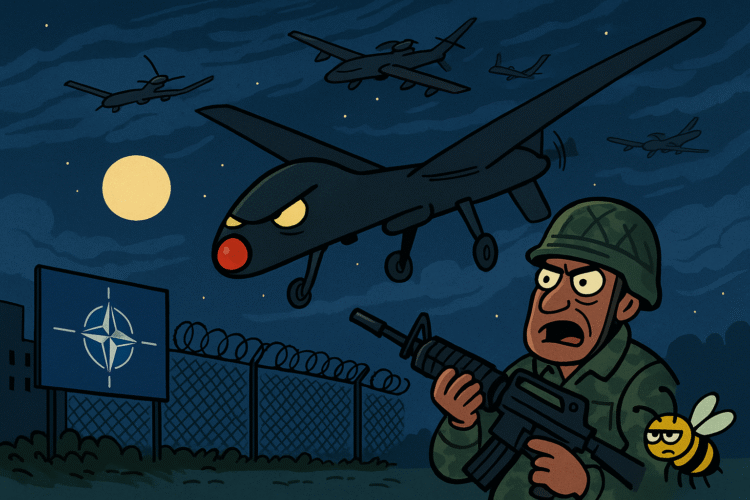
Some stories write themselves; others are written at 3 a.m. by frantic air defense operators staring at radar screens while politicians rehearse their outrage in bathroom mirrors. The overnight drone incursion into Polish airspace belongs to the latter category, a saga of buzzing machinery, scrambled jets, and the uncomfortable realization that Article 4 of NATO isn’t just a historical footnote—it’s a live-action theater piece with pyrotechnics included.
Let’s sketch the picture. Russia launched one of its marathon drone-and-missile festivals against Ukraine—415 drones, more than 40 missiles, enough hardware to make you wonder if Moscow bought Amazon Prime Defense with free next-day delivery. But this time, the debris didn’t politely confine itself to Ukrainian skies. Instead, a swarm wandered into Poland’s backyard. Not metaphorically—literally.
Dutch F-35s swooped in like the cool kids at an air show, Italian early-warning planes lent their eyes, and Polish defenses chalked up three confirmed kills, maybe four. Airports near Warsaw shut down, nineteen airspace violations were logged, and Poland invoked Article 4 for the first time in this war—the alliance equivalent of hitting the “everybody into the group chat now” button.
Denial as a Geopolitical Reflex
Russia, with its usual straight face, denies any intent. The drones, they claim, were merely confused, straying like drunk tourists with poor GPS. Never mind that they launched from Belarus, whose role in this war is to pretend neutrality while acting as Russia’s Airbnb host for munitions. “Unintentional,” say the Kremlin’s spokespeople, as if drones are just large, expensive pigeons with faulty navigation systems.
The denial is structural, not persuasive. Russia knows NATO is allergic to ambiguity. If the drones were intentional, it’s escalation. If they weren’t, NATO looks neurotic. Either way, Moscow gets the satisfaction of making everyone else look twitchy. It’s geopolitics as trolling—send a swarm, then shrug innocently when neighbors scramble jets.
Article 4: The Forgotten Clause Gets a Cameo
Article 5—mutual defense—is the NATO celebrity clause, the one everyone remembers. Article 4 is its underappreciated sibling, the one about consultations when a member feels threatened. Invoking it signals seriousness without triggering Armageddon. It’s the diplomatic version of calling a family meeting after someone dented the car.
Poland played it masterfully: shoot down the drones, log the violations, shut the airports, and then call Article 4. It’s a way of saying, “We’re not hysterical, but also, this isn’t just weather balloons.” The subtext is clear: the line has been crossed, and it’s time for the alliance to decide whether the red line is paint or concrete.
Trump’s Equivocal Yawn
Enter Donald Trump, the NATO skeptic-in-chief, whose instinct when confronted with alliance crises is to treat them like HOA disputes. His initial response? Equivocal. Not outrage, not solidarity—more like, “Let’s not get carried away, folks.” It’s the kind of hedging that sends shivers through European capitals and champagne corks flying in Moscow.
Trump has always treated NATO like a subscription service he’s not sure he needs—too expensive, bad customer support, nobody remembers the password. Now, in the middle of a live test of alliance credibility, his equivocation is the very outcome Russia wanted. Robert Kagan, ever the Cassandra of American foreign policy, warns this is a deliberate test of U.S. resolve. If Trump wobbles, NATO cohesion wobbles. And if NATO wobbles, Moscow will keep poking until the whole structure teeters.
Drones as Metaphor
Let’s not miss the structural irony: NATO, an alliance built for tanks, missiles, and Soviet divisions, is being stress-tested by buzzing lawnmowers with explosives attached. The battlefield of the 21st century isn’t the Fulda Gap—it’s your neighbor’s airspace being mistaken for a suggestion. A swarm of drones can now trigger alliance consultations, airspace closures, and the collective realization that borders aren’t just lines on maps; they’re invitations for violations.
There’s a comic absurdity here. Nineteen violations in one night. Airports shut. Alliance leaders dragged from their beds into conference calls. All over machines that look like rejected prototypes from a dystopian drone racing league. The tragedy, of course, is that absurdity doesn’t make it less dangerous. It makes it more so. If this is what provokes NATO, imagine what will follow when Russia decides to test something bigger than flying lawnmowers.
Poland as the Reluctant Canary
Poland didn’t volunteer for this role, but history keeps assigning it. First the buffer, now the canary. Its airports close, its radars ping, its leaders invoke Article 4. Warsaw plays the role of early-warning system for Western security, yet again. The irony is brutal: while Western Europe debated gas prices, Poland became the front porch of escalation.
The Dutch and Italians stepped up, proving NATO’s not a paper tiger. But the real question isn’t about capability—it’s about political will. Will the U.S., under Trump, treat Polish skies like its own? Or will Warsaw discover that being the canary means singing alone?
Testing the Seams
Robert Kagan isn’t wrong to call this a deliberate test. Russia thrives on seam-testing. Send a drone into Poland, watch the response. If it’s decisive, retreat. If it’s equivocal, escalate. The logic is simple, the stakes astronomical. Every NATO hesitation writes the next Russian script.
The seam-testing isn’t just military—it’s psychological. Moscow bets that NATO capitals won’t risk escalation over drones, that equivocation is cheaper than clarity. But history shows the danger isn’t when adversaries overestimate NATO. It’s when they underestimate it. Wars begin not from strength but from miscalculation.
Midnight Theater
This episode is midnight theater: buzzing drones, scrambled jets, frantic consultations, denials, equivocations. The stage is Eastern Europe, the props are unmanned aerial vehicles, the audience is global. Everyone’s lines are rehearsed: Poland invokes, Russia denies, NATO convenes, Trump hesitates. The question is whether the script ends with a warning shot or the opening act of something worse.
Europe, for its part, is wide awake. Cohesion now depends less on military capacity—ample, if occasionally sluggish—and more on political clarity. If Washington hesitates, Europe will panic. Panic breeds division, and division is what Moscow wanted all along.
NATO’s Existential Insomnia
The alliance faces insomnia not because it lacks power, but because it lacks certainty. What good is Article 5 if Article 4 is already treated as optional homework? What good is deterrence if the leader of the alliance treats it like a gym membership he’d rather cancel? Cohesion isn’t about jets in the sky—it’s about credibility on the ground.
NATO’s insomnia is existential: it must decide whether it’s a collective security pact or a nostalgia project for Cold War veterans. The drones over Poland aren’t just machines. They’re metaphors, buzzing reminders that ambiguity is more dangerous than escalation.
Summary of a Drone-Soaked Night
The overnight swarm that wandered into Poland wasn’t just an accident; it was a probe. Moscow’s denial is performance, Poland’s invocation of Article 4 is alarm bell, and Trump’s equivocation is the wobble everyone feared. This was less about drones and more about credibility: if NATO can’t unify around nineteen violations and closed airports, what happens when the stakes rise? The danger is not the drones themselves—it’s the test they represent. And if Washington hesitates again, the buzzing won’t stop at Poland’s skies; it will multiply until the alliance learns that the cost of ambiguity is always higher than the price of resolve.