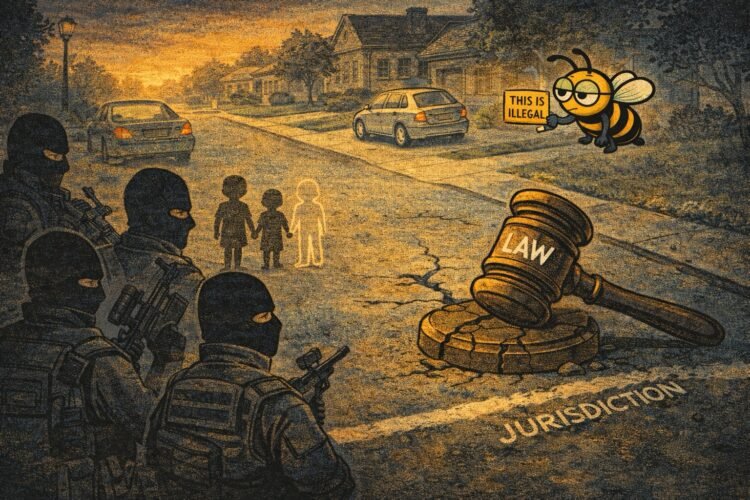
The story of Renee Good has been rushed through the public bloodstream as a tragic misunderstanding, a split second decision, an unavoidable outcome of chaos. That framing is not just wrong. It is a strategy. It exists to dull outrage, to compress accountability, and to normalize a level of state violence that should stop the heart of any functioning republic.
What happened to Renee Good was not a misunderstanding. It was the predictable result of a system that has taught armed agents they can treat irritation as justification and flight as execution-worthy defiance.
Reconstructing the encounter matters, because euphemism is doing the killing twice.
According to video footage and eyewitness accounts circulated in the aftermath, Renee Good was confronted by masked, armed ICE agents operating without visible identification. She was in her vehicle. They were in the street. There was no marked police stop, no clear verbal identification, no warrant presented, no allegation that she had committed a federal crime. What there was, captured on video, was confusion, fear, and an unmistakable attempt to disengage.
Renee initially tried to wave the agents past. Not lunge. Not accelerate toward them. Not threaten. Wave. The universal gesture of go around me, I’m leaving. When that did not end the confrontation, she turned her steering wheel to the right. The vehicle moved away from the cluster of armed men. The path was clear. The space was open.
An agent positioned toward the front of the vehicle had time and distance to step aside. The video shows he was already off the vehicle’s path. Renee drove around him. She did not strike anyone. She did not threaten anyone. She did not brandish a weapon. She did not attempt to ram or pin or corner.
She succeeded in leaving.
And then she was shot.
This is the detail the justifications cannot survive. The shot was not fired to prevent imminent harm. It was not fired to stop an attack. It was fired after she had already escaped the immediate encounter. The use of lethal force did not interrupt danger. It ended a life.
Under ordinary policing standards, that alone would raise immediate red flags. Deadly force may not be used merely to prevent flight. This is not a controversial principle. It is black letter law. The Supreme Court has been clear that lethal force is justified only when there is an immediate threat of serious harm. Running away does not qualify. Disrespect does not qualify. Confusion does not qualify.
The situation becomes more egregious when you consider jurisdiction.
ICE agents do not possess general authority to stop, search, or arrest U.S. citizens absent probable cause of specific federal crimes. None were alleged here. Renee Good was not accused of immigration violations. She was not suspected of federal criminal conduct. She was a U.S. citizen confronted by unidentified armed men.
In that scenario, the law does not demand compliance. It recognizes the right to escape a perceived threat.
If you are surrounded by masked, armed individuals who do not clearly identify themselves as lawful authorities, you are not obligated to wait and hope they mean well. You are not required to submit to confusion at gunpoint. The right to retreat from danger is not forfeited because the danger later claims a badge.
This is not radical. It is foundational.
Which is why the immediate response from those in power was not legal analysis, but narrative control.
The aftermath unfolded not as an investigation, but as a coordinated justification campaign. Before facts could settle, before accountability could even be discussed, the killing was laundered through language designed to preempt empathy.
President Trump labeled Renee Good a domestic terrorist. The accusation was false, unsupported, and grotesque. It was not meant to be accurate. It was meant to flip the moral polarity. Terrorists are not mourned. Terrorists do not deserve process. Terrorists can be killed without remorse.
Senior officials echoed the line. Kristi Noem and JD Vance advanced claims contradicted by the video evidence, insisting the agent was in danger, insisting the vehicle was a weapon, insisting that Renee’s death was the natural consequence of disrespecting authority. The facts did not matter. The frame did.
Online, the cruelty metastasized.
Elon Musk mocked the death. Andrew Tate mocked the death. Influencers with massive followings treated the killing of a woman as content, as fodder, as proof that compliance is the only acceptable posture in a country that once prided itself on liberty. Their message was simple. If you question authority, if you flee fear, if you inconvenience power, you deserve what happens next.
This is how doctrine is built. Not through law, but through repetition.
The most chilling aspect of the response was not the lies themselves. It was how quickly they were embraced. Commentators rushed to excuse murder as a reasonable response to disrespect. Not violence. Disrespect. The idea that irritation justifies execution was not whispered. It was broadcast.
This is not about one agent’s decision in a chaotic moment. It is about a system that has erased restraint and replaced it with loyalty. A system that rewards aggression and punishes hesitation. A system that equips unqualified, unaccountable agents with lethal power and tells them they will be defended no matter what.
When agents know the narrative will be managed for them, the trigger gets lighter.
The legal reality remains stubbornly inconvenient to the story being sold.
Deadly force cannot be used to punish noncompliance. It cannot be used to enforce obedience. It cannot be used to avenge wounded pride. ICE agents, unlike local police, do not have general law enforcement authority over citizens. Their mandate is narrow. Their jurisdiction is limited. Their use of force must be even more constrained.
None of that survived the talking points.
Instead, the country was invited to accept a new rule. That authority is self-justifying. That identification is optional. That fear belongs only to the state. That citizens must submit instantly to any armed person claiming power, or accept death as the cost of hesitation.
That rule is incompatible with a free society.
The video evidence does not show a woman attempting to kill anyone. It shows a woman trying to leave. The eyewitness accounts do not describe an attack. They describe confusion and withdrawal. The physical facts do not support imminent danger. They support space, time, and choice.
The choice was made anyway.
And then it was defended with a fervor that should alarm anyone who believes law is supposed to restrain power, not excuse it.
Three children lost their mother. That fact has been treated as an inconvenience. It does not fit the narrative of righteous force. It does not fit the fantasy of deserved death. It does not fit the meme economy that thrives on dehumanization.
So it has been sidelined.
This is how moral collapse happens. Not with declarations, but with shrugs. With the quiet agreement that some lives are expendable if the right people are annoyed. With the acceptance that the state’s ego deserves protection even when the law does not.
The killing of Renee Good sits at the intersection of all our failures. The militarization of immigration enforcement. The erosion of constitutional literacy. The elevation of loyalty over legality. The celebration of cruelty as strength. The insistence that order matters more than justice.
When a woman can be killed for trying to leave a threatening situation, and the response is to call her a terrorist, the crisis is no longer partisan. It is moral.
This is the line.
If disrespect becomes a death sentence, then rights are conditional. If lies are deployed to cover a killing caught on video, then truth is negotiable. If children can be orphaned and the response is mockery, then empathy has been fully privatized.
America has survived many things. It has not survived the normalization of state murder disguised as discipline.
What happens next matters more than the talking points. Independent investigations matter. Jurisdictional clarity matters. Consequences matter. Not because they will bring Renee Good back, but because they will tell the next agent whether the law still exists.
Accepting this logic marks the end of something essential. Not a party. Not an election. A principle.
That no one is above the law.
That fear does not cancel rights.
That authority must explain itself.
That life is not the price of inconvenience.
Renee Good deserved those principles. So do the rest of us.