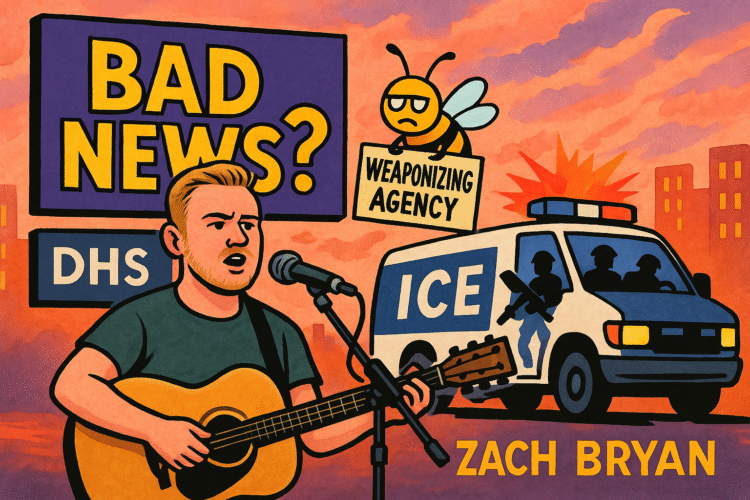
Country music has always had a rebellious streak—train lines, stolen kisses, dusty roads, heartbreak. But when your protest song provokes the Department of Homeland Security to scrap together a montage of ICE raids and set them to your chorus, you’ve officially crossed from troubadour to target. On October 8, 2025, Axios dropped a story that catapulted country star and veteran Zach Bryan into the center of an immigration culture war: a teaser of a forthcoming song (nicknamed “Bad News”) included lines about “ICE… bust[ing] down your door.” The Department of Homeland Security responded with an unholy music video remix, while Secretary Kristi Noem and DHS officials publicly scolded Bryan for tarnishing the valor of federal officers.
Bryan pushed back gently, posting that the full verse “hits on both sides of the aisle,” that he loves America, and that people should stop weaponizing his art. But in this shutdown era of spectacle-over-policy, phrases like “fading of the red white and blue” couldn’t stay quiet for long. The story ballooned as conservative influencers amplified clips, the White House piled on, and fans and critics wondered: can an artist be apolitical when their lyrics name ICE, kids, fear, and flawed patriotism all in one breath?
Let’s unpack the firestorm.
The Tease That Triggered SWATPR: Lyrics, Leak, Reaction
On October 3, Bryan dropped a snippet on Instagram—just a clip, a tease—but it was enough. In it, you hear lines about “ICE busting down your door,” a reference that stings harder now as the federal crackdown on immigration grows more public, more militarized, and more performative. The caption under the clip was equally freighted: “the fading of the red white and blue.”
That fragment, a few seconds long, triggered the kind of institutional reflex usually reserved for national security threats. DHS scrambled to respond—not with policy memos or listening sessions, but with content warfare. They cut together a montage of raids and operations, overlaid Bryan’s own early song “Revival,” and published it with messages warning artists not to misrepresent law enforcement.
In other words: Bryan’s snippet provoked a federal counterattack. His own chorus became their ad jingle. And the message to artists and citizens was clear: punch ICE at your peril.
The Coordinates of the Brushfire
To understand how sharp this fight cut, you need the terrain:
- Snippet posted October 3: Bryan drops the teaser clip with lyrical references to ICE door-kicking and a country poet’s lament of rubbled patriotism.
- DHS montage & pushback: Using Bryan’s earlier catalog (not the upcoming track), DHS assembles a recruitment-style reel to counter the teaser, framing their enforcement as duty and loyalty.
- Officials scold: Secretary Noem and DHS spokespeople publicly admonish Bryan, accusing him of disrespecting federal officers and undermining morale.
- Bryan’s response: He posts that the lyric “hits both sides of the aisle,” affirms his love for country, claims he doesn’t want a culture war, and asks folks not to politicize his music.
- Amplification: Conservative media streams show the teaser looping. White House communications adopt talking points about “respect for our men and women in uniform.” Analysts begin parsing radio reaction inside country music playlists.
What’s notable is how the federal machine treated this like a battlefield. The artist’s verse is a challenge, and the government responded with visuals, message discipline, and public rebuke—all before the full song even hit the airwaves.
The Fight Over Narrative, Not Just Lyrics
This isn’t just a spat over poetic license. It’s a question of who gets to frame the moral grammar of dissent. Bryan’s object is not anarchy—he names specifics (ICE, kids, fear, broken doors). He holds up a mirror. And the mirror pissed off DHS.
In a week when immigration crackdowns are visible—raids in cities, riverboat patrols, federal presence in border states—the lyric hits a nerve. Are artists free to call out enforcement abuses? Can lyricists reference suffering at the hands of law enforcement, or does that cross some invisible line of acceptable criticism?
The federal response argues there is such a line. In their montage, they implicitly say: you can’t question the tactics of ICE. You can’t use their tools as your canvas. If you do, we will remix your art into propaganda and lecture you about respect.
Bryan’s Tightrope: Apolitical with a Protest Wire
Bryan publicly insisted he loves America, that he’s not attacking all officers, and that his song “hits both sides.” That posture is deliberate. In a polarized moment, saying something critical riskily balances between protest and provocation, especially in country music’s backroads demographic.
He’s trying to have it both ways: sing about repression and fear while resisting the label of protest singer. In a week where federal actors are flexing power, that posture may be his best guardrail against being tarred as “radical.” But that posture also lets critics frame him as soft or ambiguous. In the face of DHS montage, his subtlety feels like semantic self-defense.
The Stakes: Music, Power, and Who Gets to Sing
What’s at stake here goes beyond one track. A few lines of whispery country verse have unleashed a fight over content control. Here’s what’s at risk:
- Artist freedom: If DHS can remix your earlier catalog as counterprogramming, they can control how dissenting art is reframed.
- Precedent for intimidation: If an artist gets federal pushback for naming ICE tactics, other creatives may self-censor.
- Streaming & radio pressure: Country stations may drop the song early. Streaming services may flag it. Fans may be asked to choose sides.
- Public perception of enforcement: A rapper or singer naming real abuses holds weight; governments try to preempt that weight by controlling narrative rails.
- Release dynamics: When Bryan releases the full song, will DHS respond again? Will the remix war escalate into legal claims, cease-and-desists, or takedown notices?
The entire contest is now a gauntlet: lyrical rights vs federal monologue.
When Enforcement Becomes Messaging Warfare
The inversion here is tragicomic: a protest lyric about ICE door-kicking becomes an enforcement recruiting video. The tools of the state roll against the critic with his own chorus as artillery. The very system Bryan critiques reuses his music to try to invalidate him. That is appropriation as power tactic.
And the risks go deeper. What if artists across genres realize the government has a playlist? What if lyrics about police and ICE are preemptively red-flagged? The space for dissent contracts not by law but by intimidation.
Bryan’s moment is a test: can cultural power confront federal power, or will the remix win again?
Closing: When the Song Outlasts Their Montage
Zach Bryan’s “Bad News” leak may or may not become a chart-topper—or a flashpoint in federal media warfare. But the significance is not just the final track. It’s that an artist dared to name ICE and fear, and the state answered by turning repression into soundtrack.
If we let the so-called defenders of order respond to art with force-multiplied clips, we slide into a world where critique is branded suspect, where artists become second-guessers of their own verses, where dissent must carry disclaimers of respectability.
Bryan did not ask for this fight; the federal apparatus decided to escalate. The irony is rich: his own chorus becomes their messaging drum. His protest becomes their PR. And now the question is no longer about whether he should have sung about federal door-kicking. The question is whether an artist can say anything about power at all.
If they revoke the right to sing about ICE, the next target will be the next voice—and the next. That is a collision of music and state. And in that ring, any lyric that names abuse is a protest. Any protest that draws federal response is an admission that art still matters.
So drop the full track, Bryan. Let the remix war begin. Because if your voice can’t survive a montage, we may already be too quiet to hear.