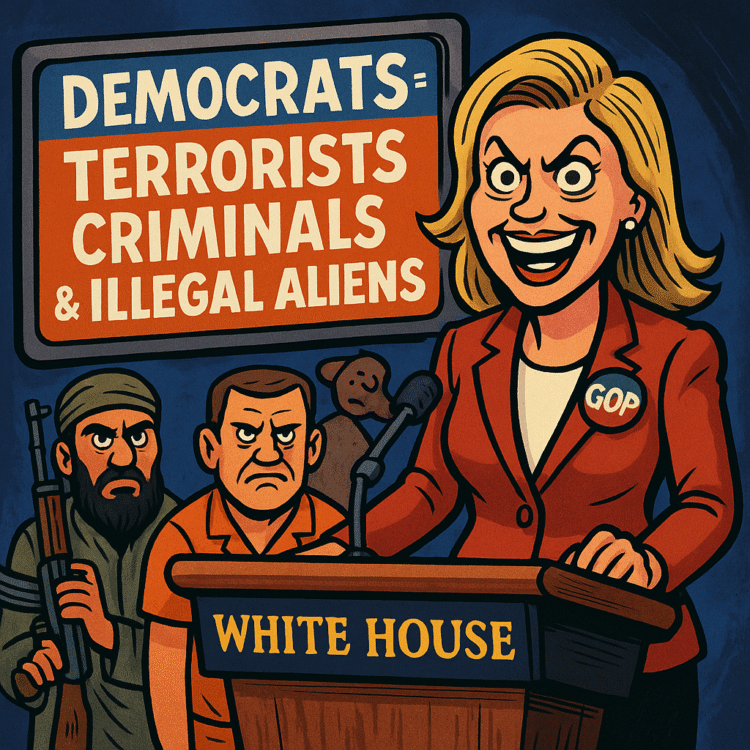
In the new normal of American politics, dehumanization is no longer a slip—it’s a strategy. White House Press Secretary Karoline Leavitt recently told Fox News, and amplified across social platforms, that the Democratic Party’s “main constituency” is made up of “Hamas terrorists, illegal aliens, and violent criminals.” The line exploded across headlines and digital chaos, drawing condemnation from civil rights groups, Democratic officials, and media critics alike, who saw it as a dangerous escalation of election-year smear tactics.
Her rhetoric arrived in the context of discussions over Gaza, where the White House claims credit for ceasefire mediation even while critics point out the fragile scaffolding supporting that deal. Leavitt’s claim that Trump “freed Palestine” became part of her attack, used to suggest Democrats oppose peace itself. Smears, amplified by friendly media pipelines, quickly shifted from fringe to official script.
What’s at stake is more than insult. When a press secretary brands a major party’s base as terrorists and criminals, she weaponizes fear. The move invites extraordinary policy logic: extraordinary policies to “defend” against the enemy within. It lays the groundwork for surveillance, crackdowns, and the transformation of ordinary political opposition into open warfare.
From the start, the moment was theatrical. Leavitt was reacting to a clip from an interview with Zohran Mamdani, a New York City mayoral frontrunner, in which he declined to call for Hamas to disarm outright — instead emphasizing justice, safety, and adherence to international law. That ambiguity became a license. The Fox hosts used it to demand a more definitive condemnation; Leavitt responded by collapsing nuance entirely. She accused the Party Mamdani represents of being fundamentally aligned with terrorists and criminals, as though any failure of categorical denunciation is evidence of complicity.
Once the quote landed, the media wildfire began. Outlets from The Independent to Yahoo News and beyond reprinted her words. Social media churned. Republican allies echoed the smear: Democrats, the spin went, are not political adversaries—they are national threats. The line transformed into a meme, then a talking point, then a pretext for public policy.
Democratic officials pushed back hard. From state party chairs to congressional leaders, the message was consistent: this isn’t disagreement, it’s delegitimization. Civil rights groups sounded familiar alarms: this is the kind of rhetoric that historically precedes surveillance, mass targeting, and the crowning of dissent as treason. Media critics warned that the press cannot treat this as political hyperbole the way pundits often do — it has consequence. When the press secretary shows contempt for millions of citizens, institutions must treat it as corruption of the public sphere, not just another soundbite.
The political logic driving Leavitt’s rhetoric is brutal in its efficiency. If opponents can be recast as violent, unlawful, and outside the bounds of legitimate political parties, then extraordinary powers seem necessary — and censorship, detention, or repression become reasonable. If a party might harbor terrorists, then surveillance and law enforcement intrusion into that party become defensible. If dissent is criminal, then the machinery of repression can be spun as saving democracy.
This logic is eerily in sync with the administration’s broader posture: press access is only earned through loyalty, dissent is redefined as sedition, Gaza policy is folded into base-mobilization, and opposition becomes a plot. The White House is not merely spinning narratives; it’s folding identities into narratives, making political alternatives pre-criminal in the framework of fear.
Meanwhile, the ceasefire being touted as proof of strength rests on delicate scaffolding. The administration claims credit for mediating Gaza deals, but critics remind us that much of the framework comes from diplomatic work begun under previous administrations. Leavitt’s rhetorical flourish — “Trump freed Palestine, literally” — collapses the reality of continuity into the fiction of unilateral heroism. It is a rhetorical flourish meant to render the peace deal inseparable from her party’s legitimacy.
Yet reality intervenes. The Gaza situation remains fragile: aid is limited, military pullbacks are partial, enforcement is contested. In that fragile space, Leavitt’s smear functions like a moral perimeter: if Democrats protest or criticize, they are not defending rights — they are siding with violence.
The near-term stakes are clear. Will the White House double down on Leavitt’s line or quietly disclaim it? Already, some Republicans have echoed it; others have tried to pivot to softer language. Will broadcast outlets reprint it without pushback, or will they treat it as disqualifying slander? Will civic institutions — parties, commissions, legal associations — treat this as a rhetorical boundary violation or just another partisan bombshell?
But the deeper danger isn’t in this incident alone. It’s what it signals: the normalization of dehumanizing political language by official voices, the collapse of ordinary dissent into suspect conspiracism, and the framing of entire constituencies as internal enemies. When that becomes acceptable, democracy itself becomes perimeter defense.
The real test will be whether voters shrugged or rose. Because once you accept that a party’s base can be described as terrorists, the next step is repressive logic. Surveillance becomes policing; protest becomes riot; belonging becomes suspicion.
In the end, Karoline Leavitt’s words were not an accident. They sit at the crossroads of rhetoric and repression. If institutions don’t resist, the next administration may read them as a roadmap, not an aberration.