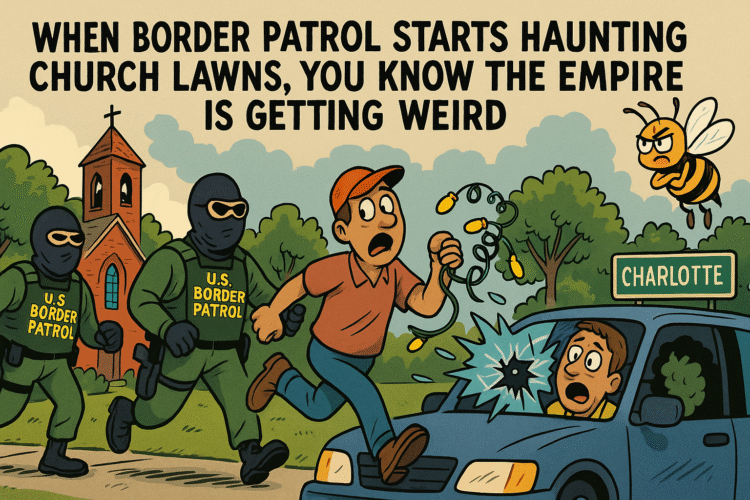
Interior enforcement turns Charlotte into a stage set for federal theater, complete with smashed windows, masked agents, and a government insisting the chaos is for your own good.
Charlotte is not a border town. Charlotte is not even near a border town. Charlotte is the sort of place where church volunteers trim hedges in the quiet hum of a weekday afternoon, where contractors hang Christmas lights without expecting to be flash mobbed by federal agents, and where U.S. citizens typically assume they can sit in their cars without being dragged out by masked men who refuse to give their names. Yet here we are, watching a major American city hundreds of miles from any international boundary transform into the latest arena for a Homeland Security immigration “surge,” as if the Queen City were secretly harboring desert canyons, cartel tunnels, and a rogue stretch of the Rio Grande no one previously noticed.
According to reporting from the New York Times, The Guardian, and The Washington Post, Border Patrol officers and Homeland Security agents have descended on Charlotte like a touring production of fear. They grabbed a parishioner doing yard work outside an east Charlotte church. They startled workers who were simply hanging Christmas lights in a quiet neighborhood. They twice detained Honduran born U.S. citizen Willy Aceituno, allegedly smashing his car window, pinning him to the pavement, and hauling him into a Border Patrol vehicle, only to release him when he produced documentation proving he belongs here as much as the people throwing him onto the ground.
Welcome to the new era of interior enforcement. Where the border is wherever the government wants it to be, and citizenship is something you prove after the arrest, not before.
The official line from federal leadership is familiar. Tricia McLaughlin, assistant homeland security secretary, says the sweeps are necessary to protect Americans from “violent criminal illegal aliens.” That language, polished with the same rhetorical varnish that has justified countless abuses, implies that these masked officers are swooping in with surgical precision to stop active threats. But the reporting tells a different story, one in which the only thing being targeted with consistency is the confidence of immigrant neighborhoods simply trying to survive the week.
Charlotte’s Democratic mayor Vi Lyles is sounding alarms. Mecklenburg County sheriff Garry McFadden is furious. North Carolina governor Josh Stein is warning that this is not merely overreach but calculated destabilization. These are not fringe voices. These are the people who have to manage the fallout of heavily armed federal officers suddenly treating churchyards like checkpoints and residents like enemy combatants. And they all agree on the same point: this is not about public safety. It is about political theater.
The Biden era once promised sharper oversight of interior immigration raids. The Trump era, of course, pioneered their spectacle. Now the lines blur. What’s unfolding in Charlotte is the kind of enforcement surge usually staged for cameras in border towns, now imported deep inside the country where far more people have no expectation that Border Patrol might appear behind them as they rake leaves.
The official justification is always the same. Violent criminals. Public danger. National security. But the facts of who’s being stopped tell a story stripped of its costume. The people being grabbed are yard workers. Christmas light installers. Commuters sitting in their cars. And in Aceituno’s case, a citizen whose only mistake was existing within the blast radius of this latest DHS performance piece.
His experience reads like dystopian slapstick. First time: detained, grilled, released when authorities discovered they had just abducted an American citizen. Second time: they escalate, allegedly smash his window, throw him to the ground, and haul him into a vehicle like they’re auditioning for a reboot of Cops. Again, he proves his citizenship. Again, they let him go. If this is how carefully these agents verify identity, one wonders what their threshold is for declaring someone a threat. Breathing? Driving while brown? Being outdoors?
A federal judge, ruling in a related case, described immigration agents as “terrorizing” communities. Terrorizing. Not “overzealous.” Not “aggressive.” Not “vigorous in enforcement.” Terrorizing. It is an extraordinary word for a federal judge to use, the kind of language normally reserved for rogue militias or abusive police departments, not the people tasked with protecting the country.
And still, DHS continues to frame these raids as vital and necessary, even as the collateral damage piles up. Neighborhoods grow frightened. Children hide when they see green uniforms. Churches—the supposed sanctuary spaces—have to worry about worshippers being grabbed mid volunteer shift. Charlotte becomes a proving ground for an expanded federal authority that treats constitutional rights like optional accessories.
What makes this moment uniquely sinister is the balancing act Homeland Security is performing. Courts are forcing National Guard troops out of Chicago and Portland, so the federal government is leaning on border agents instead, moving them around the country like chess pieces on a board no one voted for. They’re using the muscle of the Department of Homeland Security to get around local pushback and court rulings. They’re deploying masked units equipped for border interdiction into cities where the only thing migrating is people driving to work.
You do not need to squint to see the broader implications. If border agents can operate anywhere, then the border exists everywhere. And if the border exists everywhere, then no place is protected. Not your driveway. Not your church. Not the neighborhood where someone is strapping Santa Claus and a string of lights onto their porch.
It also raises the question that DHS prefers you not ask: What happens when the public gets used to this? What happens when America begins to accept unidentified agents grabbing people without explanation in the name of public safety? What happens when residents of a city like Charlotte start internalizing the idea that citizenship must be proven on demand, like a transit ticket?
The quiet risk is normalization. And the government knows it.
Charlotte is not random. Charlotte is a test. If the public here accepts these raids, if political resistance can be drowned by federal messaging about criminal aliens, then the model will spread. To Atlanta. To Raleigh. To Indianapolis. To Tampa. To anywhere that fits the political moment or the week’s national security script. The border becomes portable. Enforcement becomes performative. And local leaders lose their ability to push back against federal incursions that look less like protection and more like intimidation.
That’s what terrifies Charlotte’s mayor and sheriff. That’s why the governor is speaking out. Because once you allow a federal agency to grab a church volunteer without identifying themselves, you have quietly accepted the existence of a second police force—one answerable not to the community, but to the political whims of Washington.
There is no world where masked officers detaining citizens, smashing windows, and refusing to give names is compatible with the concept of civil liberties. None. That’s the kind of policing North Carolina politicians used to condemn when they saw it on the news in authoritarian regimes. Now they’re watching it unfold in their own neighborhoods, narrated by DHS officials who speak about public safety the way a magician speaks about misdirection.
Meanwhile, the immigrant communities themselves are living in a constant state of suspended fear. Kids afraid to go to school. Parents afraid to get groceries. Workers afraid to step outside because the people who show up might not be police, might not explain themselves, might not even pretend to check paperwork before dragging someone into a van. There’s a reason the judge called it terrorizing. Terror is not just violence. It is unpredictability. It is the knowledge that the state may act against you at any moment for reasons it refuses to articulate.
This is the shape of modern enforcement. Not transparency. Not due process. Not targeted investigation based on evidence. But suddenness. Surprise. Ambiguity. A deliberate strategy to keep communities disoriented enough that resistance feels futile.
And we cannot pretend it’s accidental. The deployment is deliberate. The timing is deliberate. The messaging is deliberate. The fear is deliberate. In a country where immigration theater has replaced immigration policy, this is what “getting tough” has become: a performance designed to look impressive and feel intimidating.
The Homeland Security playbook is no longer about removing dangerous individuals. If it were, they would not be accidentally detaining citizens. It is about constructing a spectacle large enough to signal dominance, wide enough to spread fear, and flashy enough to drive a news cycle.
Charlotte is now the stage. Its residents are now the audience. And the federal agents are the performers, masked, armed, and unwilling to break character long enough to identify themselves.
It forces an uncomfortable question: What exactly are we being conditioned to accept?
Because every overreach begins with a justification that sounds familiar. Crime. Safety. Security. Order. And every erosion of liberty begins with a shrug from people who assume the government will never target them.
But it will. If it can grab a U.S. citizen from his car twice, it can grab anyone. If it can smash a window in Charlotte, it can smash a window in Denver. If it can treat a churchyard like a border crossing, it can treat any place as a zone of suspicion.
This is not a border surge. It is a boundary test. And the boundary is not geography. It is compliance.
The Part They Expect You to Accept
In Charlotte, federal agents are performing the future. A future where interior enforcement is indistinguishable from street level intimidation. A future where citizenship is provisional until proven. A future where local leaders get overruled by federal muscle. A future where churchyards become checkpoints and neighborhoods become staging grounds. The government insists this is safety. But safety does not look like masked men pulling citizens from cars. Safety does not look like smashed windows and terrified communities. Safety does not knock you to the ground and ask questions later. This is not safety. It is the soft launch of something far more dangerous, and Charlotte is only the beginning.