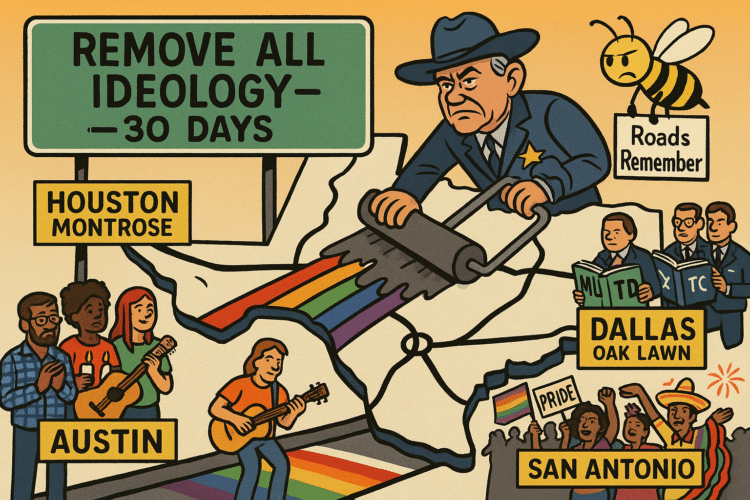
In Texas, the fight for highways has become a battleground for identity. On October 8, 2025, Governor Greg Abbott issued a sweeping order: purge “political ideologies” from state and local roadways. He threatened to freeze city and state transportation funds and suspend TxDOT agreements if municipalities didn’t obliterate all nonstandard pavement — a threat directed squarely at rainbow crosswalks.
This is not a municipal aesthetic adjustment. It is a politically charged erasure of community voice.
The Rainbow Crosswalks at Risk
Every Texan city with a pride crosswalk or symbolic street marking is now in Abbott’s crosshairs. Here is a map of the threatened terrain:
- Houston (Montrose, Westheimer & Taft): The most visible and politically prominent target. The rainbow stripes were temporarily removed during METRO construction in September, then restored October 1.
- Austin: Downtown crosswalks and neighborhood stretches painted with pride colors, particularly around the LGBTQ-oriented districts.
- Dallas (Oak Lawn): Since 2019, Oak Lawn has sported rainbow crosswalks as a visible symbol of LGBTQ identity and inclusion in the neighborhood.
- San Antonio: Certain streets and pedestrian zones with decorative crosswalks honoring community and diversity.
- Other Texas municipalities: Smaller towns and neighborhoods across the state had adopted rainbow crosswalks, community murals, or decorative art in sidewalks and streets.
By targeting nonstandard markings statewide — mural-esque crosswalks, symbolic street art, memorial paint — Abbott’s order threatens to erase expression from public infrastructure everywhere, not just in Houston.
The Abbott Directive & Its Threats
Abbott authorized the Texas Department of Transportation (TxDOT) to demand the removal of “symbols, flags, or other markings conveying social or ideological messages” that do not serve direct traffic control functions. Municipalities now have roughly 30 days to comply or risk losing state and federal transportation funding. TxDOT also threatens to suspend highway agreements and contracts with noncompliant cities.
The directive rests on the claim that rainbow stripes and other decorative markings violate federal roadway standards. These standards, codified in the Manual on Uniform Traffic Control Devices (MUTCD), restrict markings that do not “directly control” traffic flow. Abbott and TxDOT argue rainbow crosswalks fall outside permissible signage or markings.
It is a test case: federal conformity versus municipal expression.
Cities Resist and Push Back
City officials across Texas are bracing for the purge. In Austin, city leaders argue that crosswalk design — not merely functionality — falls under local authority. They intend to examine legal recourse under home-rule powers. Similarly in Dallas, local councilmembers are validating that symbolic crosswalks are legitimate expressions of community identity and should not be subject to state censorship. San Antonio’s civic leaders are evaluating how to balance DOT compliance demands with preserving local heritage and identity.
In Houston, Council Member Abbie Kamin declared Abbott’s threat a power grab: the governor cannot micromanage how cities paint their own streets. METRO — under pressure — signaled willingness to re-stripe crosswalks back into “federal standard” design to avoid funding penalties, even while lamenting the forced erasure of community symbolism.
The tension is escalating. Municipalities must decide: obey the purge or risk losing millions of dollars in transportation funding and delayed infrastructure projects that depend on state cooperation.
The Political Calculus
Why launch this assault now? October is synonymous with LGBTQ+ visibility. Pride Month follow-ons, community events, and public commemorations still loom. Abbott’s move is an ideological blow, a show of dominance: he wants to dictate what public spaces can or cannot say visually about identity.
The optics are stark: targeting rainbow crosswalks in national LGBTQ+ reckoning lands as symbolic aggression. The message to municipalities: express your diversity at the risk of your budget.
Infrastructure or Ideology?
On one level, this is about technical conformity to federal road standards. But in practice, it is about who gets to shape public space. When streets become ideologically sterile at the stroke of an executive pen, we lose the ability of communities to inscribe themselves on the map.
If Abbott succeeds, Texas roads will be not mere conduits for cars—but blank canvases under state control. The cultural patchwork of neighborhoods will fade into uniform gray.
The Stakes Are Legal, Financial, and Symbolic
Legal Battlelines: Cities may demand that the purge is unconstitutional or inconsistent with municipal home-rule powers. They may challenge the state’s conditioning of infrastructure funding on erasure of symbolic speech. Courts may have to decide whether Texas’ threat constitutes coercive appropriation of municipal authority.
Financial Leverage: Cities that refuse risk losing critical funds. Major highway contracts, local road maintenance, transit grants—all depend on state approvals and matching dollars. If TxDOT suspends agreements, those projects stall indefinitely.
Symbolic Erosion: Pride crosswalks were not mere decoration; they were literal statements — memorials, identity markers, affirmations of community. If they vanish, we lose memory and message.
Political Optics: The state targeting its LGBTQ+ citizens during visible months makes the purge a public spectacle of erasure.
What Cities Should Watch and Do
- Map all nonstandard markings under threat: rainbow crosswalks, neighborhood murals, decorative streets.
- Evaluate which ones may be defensible under prior installations (grandfather clauses).
- Create legal opinions on whether the state’s funding threats cross coercion thresholds under constitutional principles.
- Coordinate statewide municipal coalitions—Dallas, Austin, Houston, San Antonio—to resist together, share legal strategy, share media narratives.
- Quantify the potential funds at risk and the costs of forced re-stripping, public backlash, and project delays.
- Mobilize public awareness: frame the battle as erasure of identity, not mere paint.
Closing: Roads as Memory, Not Monochrome
When the governor orders the rainbow’s removal, he does more than ban color. He bans assertion. He bans the voices of communities from speaking in the most public of mediums: our streets.
This is not a crack-down on traffic; it’s a purge of presence. It is telling Texans that in visual public space, their stories, identities, memorials are only valid if the state allows them.
If Abbott gets his way, every city in Texas with a pride crosswalk — Houston, Austin, Dallas, San Antonio — will face a choice: repaint their identities into invisibility or watch their infrastructure die. He is not demanding standardization of roads; he is demanding submission.
The rainbow was never about rain. It was about a struggle lit in color. And in Texas, that struggle is now a war on paint.