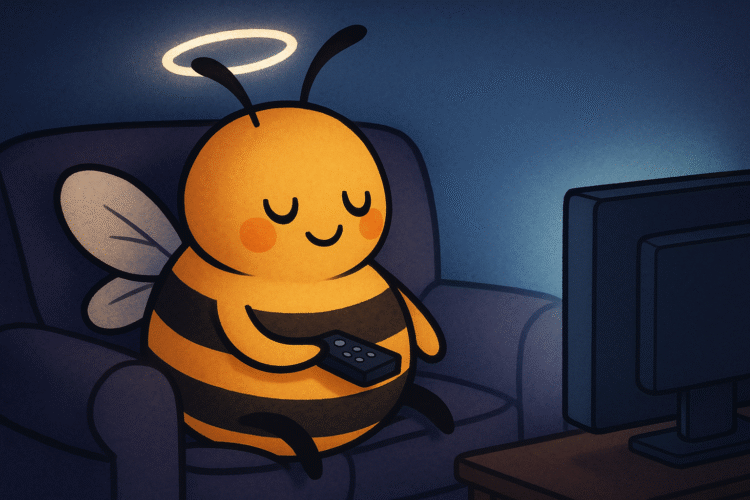
I spent the first chunk of my life being told that truth lived between two leather-bound covers: The Holy Bible. I was taught that everything worth knowing—morality, love, justice, salvation—had already been figured out, footnoted, and translated into King James English. Questioning it wasn’t curiosity; it was rebellion. And rebellion got you exactly one ticket to hell, do not pass Go, do not collect grace.
But somewhere along the way—between being kicked out at sixteen for being gay and surviving a “pray-the-gay-away” camp that was more trauma circus than spiritual retreat—I stopped looking for truth in pews and started finding it in pixels. That’s right. While the pulpit condemned me, television invited me in. Turns out, Netflix, HBO, and even a few raunchy network sitcoms had more to say about being human than any Sunday sermon I ever sat through.
TV taught me nuance. It taught me gray areas. It taught me empathy. But more than anything, it taught me I wasn’t alone.
TV Let Me See People Like Me—Even Before I Was Ready to Admit It
I will never forget the first time I saw a gay character on TV who wasn’t a punchline or a tragedy. I was still deep in denial, living a double life so convincing I could have won an Emmy for Best Performance in a Heteronormative Disguise. And then Will & Grace came along. Suddenly there was this guy on screen—smart, funny, neurotic, tender—who was gay and loved, not in spite of it, but around it. It was revolutionary.
Religion told me I was broken. TV said, “Here’s a mirror, babe. And guess what? You’re not the only one.”
And it wasn’t just queer characters. It was Black families like the Bankses on Fresh Prince, who showed complexity and joy beyond the tired stereotypes I’d grown up seeing. It was My So-Called Life, where teenage angst was art and feelings weren’t sins. It was Buffy the Vampire Slayer, where girls didn’t wait to be rescued—they did the slaying themselves.
TV Showed Me That Doubt Isn’t Weakness—It’s Wisdom
In church, doubt was something to be beaten out of you—preferably through prayer, fasting, or a solid youth group guilt trip. But on shows like The West Wing, The Good Place, or even The Leftovers, doubt was the beginning of wisdom. Characters wrestled with big questions: What does it mean to be good? What happens when your faith fails you? Is there a point to all this?
TV made room for that wrestling match. It didn’t rush to offer answers wrapped in parables or platitudes. It just said: “Yeah, we’re confused too. Let’s sit with that.”
TV Taught Me That Redemption Is Messy—But Always Possible
Religion framed redemption like a light switch: one prayer and boom, you’re cleansed. But TV showed me it’s not that easy. Redemption is incremental, clumsy, and often starts with screwing up repeatedly. Think BoJack Horseman—a deeply flawed, often unlikable character who keeps trying anyway. Or Fleabag, who breaks the fourth wall and your heart at the same time.
These stories didn’t ask me to be perfect. They asked me to be honest. They said, “Your mess doesn’t disqualify you. In fact, it makes you human.”
TV Taught Me the Power of Found Family
Religion kept trying to sell me blood loyalty and traditional family values—never mind that my own family had thrown me out like expired milk. But shows like Pose, Schitt’s Creek, and Sense8 reminded me that family isn’t who raised you. It’s who chooses you. It’s who shows up when the world doesn’t. It’s the friends who become your support group, your emergency contact, your holiday table.
TV gave me permission to build my own community when religion slammed the doors shut.
TV Taught Me Joy as Resistance
You know what sermons never taught me? That laughter can be holy. That drag queens can be prophets. That dancing in your living room to a Mariah Carey song after a terrible week can be a sacred act. But TV? TV handed me a glittery, lip-synced gospel.
Shows like RuPaul’s Drag Race, Broad City, and even Parks and Rec reminded me that joy, especially in the face of pain, is an act of rebellion. Especially for people like us—queer, brown, chronically underestimated—joy becomes defiance.
TV Gave Me the Words When I Had None
When you grow up silenced, seeing someone speak truth on screen hits different. I learned how to advocate for myself from Shonda Rhimes characters. I learned how to set boundaries (and monologue with flair) from Insecure. I learned that saying “I deserve better” isn’t arrogance. It’s survival.
Religion had told me to be humble, quiet, obedient. TV said, “Use your voice. Hell, use someone else’s voice until yours comes back. Just don’t stay silent.”
TV Showed Me a Godless World Full of Grace
I’m an atheist. That didn’t come easily. It came after years of trying to bend my body, my soul, my love into the shape of a cross that never fit. And yet, I still believe in goodness. I believe in compassion. In truth. In justice.
And it was TV—not church—that showed me that grace exists without the need for divinity. That people can be kind without a commandment. That love doesn’t require salvation, just presence. That “I’m here,” “I see you,” and “You matter” can be holy phrases even if they’re spoken by fictional characters on a screen.
So No, Religion Didn’t Save Me—But TV Might’ve Helped
TV didn’t give me all the answers. But it gave me space to ask better questions. It gave me language when I had none. Representation when I felt invisible. Comfort when I was alone. It stitched together laughter and catharsis and heartbreak and hope into something sacred. Something real.
And if I ever have to choose between the fire and brimstone of my past or a quiet evening with a rerun of Grey’s Anatomy and a glass of wine in Matthew’s lap, I know exactly where grace lives.
On my screen. In my story. In the freedom to choose it for myself.