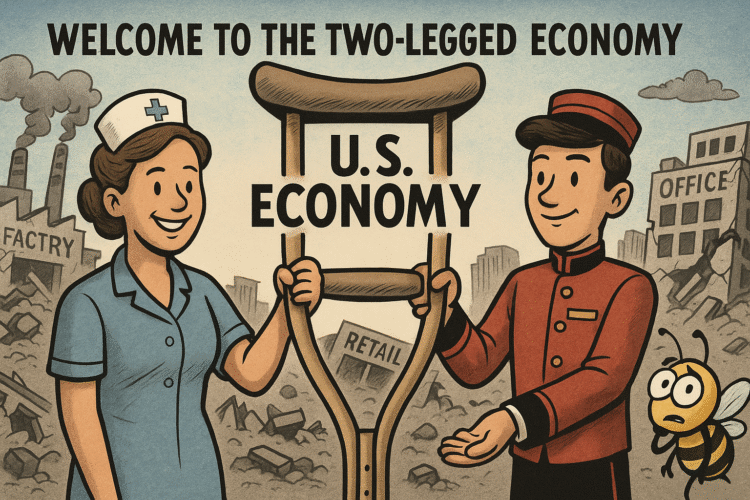
America’s economy has always been a circus, but lately it feels like the trapeze act is down to two ropes. On September 7, 2025, after the latest jobs report limped across the stage, the spotlight revealed a recovery balanced precariously on just two legs: health care and hospitality. Everything else—manufacturing, construction, retail, logistics, white-collar offices—is sprawled on the floor, holding an ice pack, waiting for HR to return its call.
August payrolls rose a paltry 22,000. Unemployment ticked up to 4.3%, the highest in nearly four years. And yet, like a Broadway understudy, health care and leisure & hospitality saved the show: +46,800 jobs in health care/social assistance, +28,000 in hotels, bars, and restaurants. Without them, the jobs number wouldn’t just have been weak; it would have been negative.
Mark Zandi of Moody’s even gave it a name: a “jobs recession” hiding inside still-positive GDP. Picture an athlete who insists she’s winning because she can still crawl across the finish line.
The Two-Legged Recovery
Let’s call it what it is: a lopsided economy propped up by nurses and bartenders. Without them, we’d already be in recession. The U.S. job market is basically your drunk uncle at Thanksgiving, carried out of the house by the two cousins strong enough to lift him while everyone else stands around pretending this is fine.
Health care keeps adding jobs not because of policy genius but because we have an aging population with chronic illness and a child care system in freefall. Hospitals, nursing homes, home health aides, daycare centers—this is the “growth sector.” It’s not innovation, it’s triage.
Hospitality is the other “pillar.” Translation: Americans are broke, but they’ll still max out a credit card for brunch. Travel, dining, and concerts are keeping payrolls alive, which means the economy’s entire weight is being borne by the people pouring mimosas and changing hotel sheets. If the brunch crowd decides to cut back, the floor caves in.
Manufacturing, Dead on Arrival
Meanwhile, manufacturing is gasping for air. Tariffs—Trump’s favorite trade cosplay—have jacked up costs on everything from steel to semiconductors. Supply chains are snarled, foreign-born labor is shrinking thanks to immigration crackdowns, and the only thing moving through factories at speed is the layoff notice.
The irony is that AI is supposed to be the new industrial revolution. Instead, it’s the new Pink Slip Generator. Companies brag about “AI efficiency” while workers brag about the free time they didn’t ask for.
Construction: Building Nothing But Excuses
Construction, the other classic jobs engine, has stalled. High interest rates have frozen housing markets, commercial real estate is a graveyard of empty towers, and infrastructure projects move slower than a Senate hearing. Builders can’t find workers because the immigration clampdown has gutted the labor force. Elder care, agriculture, construction—entire sectors once powered by immigrant workers are now running on fumes.
And yet policymakers act surprised. Who could have guessed that deporting the people who pick crops, build houses, and care for the elderly would make it harder to pick crops, build houses, and care for the elderly?
Retail and Logistics: Ghost Malls and Empty Trucks
Retail has gone from “help wanted” signs to “store closing” banners. Consumers are tapped out, real spending has flatlined, and e-commerce is no longer growing fast enough to offset the carnage. Warehouses and trucking firms, which ballooned during the pandemic, are now laying off in droves. Logistics is the new mall: once a booming backbone, now a liability.
Hours worked fell to 34.2 per week in August—the lowest since 2010. That’s not “part-time flexibility.” That’s “we can’t afford you full-time, so good luck making rent.”
Wages: Running in Place
Wage gains clocked in at +0.3% month over month, +3.7% year over year. On paper, that sounds decent. In real life, rent rose 6%, groceries 5%, and insurance premiums jumped double digits. Workers are running in place on a treadmill that’s tilted uphill.
The “soft landing” narrative—this idea that the Fed can slow inflation without crashing the economy—depends on whether you consider running in place a success. Yes, GDP is technically positive. But when broad hiring has flatlined since spring, revisions are trending downward, and real wages trail basic living costs, the landing feels less “soft” and more “face-first.”
AI: The Phantom Limb
Corporate America’s answer to the jobs slowdown is the same answer it’s had for forty years: fire workers, buy software, call it innovation.
AI is the new scapegoat. Companies brag about reducing headcount by “leveraging generative models,” which is corporate for “we replaced you with a chatbot that forgets your order halfway through.”
Productivity isn’t up because of AI. Profits are up because workers are down. Shareholders get the gains, while former employees get the thrill of applying for jobs that don’t exist.
The Policy Vacuum
Here’s the kicker: this isn’t inevitable. It’s policy. High interest rates are still choking investment. Tariffs are still taxing consumers and employers. Immigration is still treated as a threat instead of the labor force lifeline it actually is. And social spending—child care, elder care, state/local services—remains underfunded.
The “soft landing” could be real if policymakers stopped tripping over their own shoelaces. Rate relief, unwinding the tariff wars, fixing the labor shortage with immigration reform, and investing in the sectors that actually hire people—that’s how you build stability. Instead, we get vibes.
The Hospitality-Health Care Empire
So here we are: an economy carried by health care and hospitality. America has turned into a giant waiting room and a hotel lobby. If you’re not tending bar or tending wounds, good luck.
It’s a grim satire of our values. We don’t invest in building things, we invest in recovering from the injuries sustained by not building things. We don’t fund public goods, we fund private brunch. We don’t expand opportunity, we expand waitlists.
And when the Bureau of Labor Statistics crunches the numbers, we call it growth.
The Liberal Bottom Line
The economy is one bad month away from recession. And the difference between a stumble and a collapse depends entirely on whether policymakers choose reality or ideology.
Rate relief would unfreeze construction. Immigration reform would rescue elder care, agriculture, and building trades. Child care and elder care investments would unlock labor force participation. State and local services would absorb slack labor and stabilize communities. Housing policy could prevent construction from collapsing.
But instead, the White House clings to tariffs, the Fed clings to rate hikes, and Congress clings to performative nonsense. The result is an economy held up by two sectors while everyone else drowns.
The truth is simple, and it’s ugly: an economy balanced on two legs is not walking, it’s wobbling. Health care and hospitality are strong, but they’re not Atlas. They can’t carry the weight of every other collapsing sector indefinitely.
When historians write about this moment, they won’t marvel at the resilience of nurses or the grit of waiters. They’ll marvel that a nation with every resource chose to hobble itself. That America mistook survival for stability, brunch for growth, triage for progress.
The haunting truth is this: if your economy depends on sick people and hangovers to stay afloat, you don’t have a recovery. You have a waiting room with a bar tab.