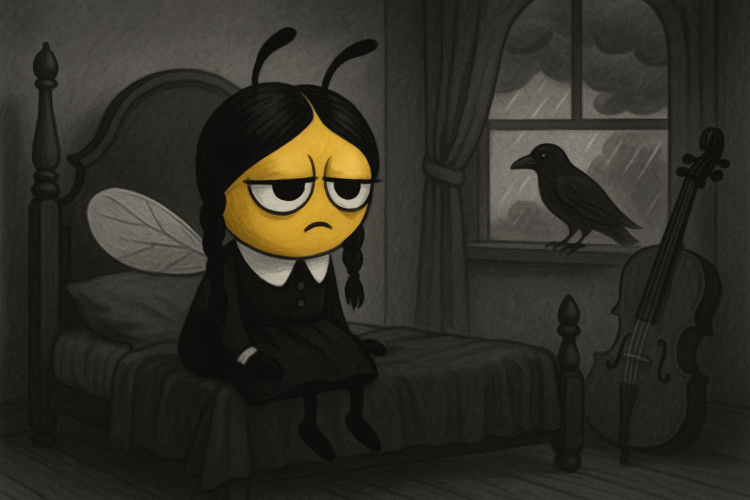
When Netflix announced the return of Wednesday, I blacked out briefly and awoke standing in the living room holding an unopened umbrella indoors, whispering, “Finally, a role model.”
Let’s be clear: I have always considered myself a Wednesday Addams.
Not in the Hot Topic, spiked choker kind of way—but in the existential malaise in Mary Janes kind of way. The kind of child who wrote poems about famine in cursive. The kind of adult who still asks, “What’s your trauma language?” on first dates. I wasn’t goth, I was prepared. For disappointment. For human inconsistency. For cheerful birthday parties with knife-shaped confetti.
So imagine my joy—my bone-deep, deadpan joy—when Netflix took the original doom daughter of America and gave her a streaming budget, a cello, and a murder subplot.
And then cast Jenna Ortega.
Jenna Ortega is not just playing Wednesday. She’s channeling her.
She doesn’t blink. She doesn’t smile. She doesn’t emote the way other humans do—she smirks from within, like someone who knows your browser history and will use it in court.
She moves like a chess piece with vendettas.
She delivers lines like she’s filing paperwork for your eventual disappearance.
I love her.
Not in a creepy way (though that would be on-brand), but in the way one haunted mirror loves another.
Jenna Ortega took Wednesday from caricature to canon. She didn’t just play dark—she made darkness a coping strategy. She made vengeance look efficient. And she wore the same outfit every day like a woman who refuses to be manipulated by color psychology.
People like to say Wednesday is for misfits. But they’re wrong.
Wednesday is for the observant.
For those of us who flinch at small talk.
For those who cry in locked bathrooms and come out saying, “Everything’s fine,” with the same expression used to identify bodies.
She’s for the kids who were told to “smile more” and instead developed an internal filing system of who to haunt first.
She’s for people who watched Disney princesses talk to birds and thought, “You know they’re spying for someone, right?”
She is not a rebel.
She is a realist.
With a knife. And perfect bangs.
The beauty of Netflix’s Wednesday is that it lets her be brilliant, dark, emotionally complex—and still hilariously petty. She’s a feminist icon not because she fights like a boy, but because she solves murder while disrespecting authority and refusing to participate in group activities.
She is what we all wish we could be:
- Unbothered.
- Dressed for revenge.
- And always ten steps ahead of the headmaster.
She’s queer-coded in the way we all were before we knew what it meant: emotionally avoidant, allergic to sincerity, and visibly annoyed by romantic subplots unless they involved poison.
And let’s talk about the writing.
There’s an art to making death feel cozy. To making black-and-white stripes feel aspirational. To crafting a show where the lead girl is emotionally unavailable and yet everyone still orbits her like moths to a spooky chandelier.
It works because Wednesday isn’t trying to be likable.
She’s just trying to survive a world full of people who confuse “nice” with “good.”
And that, dear reader, is the most relatable thing I’ve ever seen.
As a child, I didn’t want to be Cinderella.
I wanted to be the girl who set the clock back so she could escape the ball early.
I wanted to be someone who said “I told you so” at a funeral.
I wanted to be left alone and worshipped, ideally by a sentient disembodied hand.
Wednesday was that for me.
She made it okay to be still. To be sharp. To not perform joy on demand.
She made my interior world feel inhabited.
And now she’s back.
With new murders. New outfits. New opportunities to say, “I don’t believe in heaven—but if it exists, I hope they keep my enemies out.”
There’s a particular joy in seeing a character so rooted in cynicism treated with care.
The show doesn’t ask her to change.
It doesn’t hand her a love interest and say, “Here, soften.”
It lets her be her: skeptical, sharp, emotionally armored—but slowly, very slowly, forming attachments she would die for.
Which, in Wednesday-speak, is love.
Final Thought:
I’ve always been a Wednesday Addams.
Not because I dress in black or enjoy taxidermy, but because I was a child who never quite understood why we clap after singing “Happy Birthday.”
Because I grew up expecting disappointment and making jokes about it before anyone else could.
Because I learned early that being too much is safer than being too soft.
She’s not just a character.
She’s a survival strategy.
And I’m so glad she’s still here.
Carving her initials into the pop culture tombstone, one deadpan at a time.