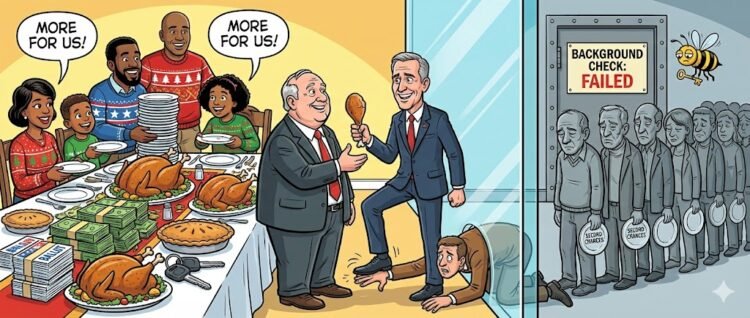
The defining ritual of the American Thanksgiving is the gluttonous pivot. It is that precise, lubricated moment when the belt is loosened, the first plate is cleared, and a collective, national decision is made that excess is not a sin but a patriotic duty. We pile the mashed potatoes high enough to require zoning permits. We drown the turkey in gravy until it forgets it was ever a bird. We look at the pumpkin pie and say, with the unearned confidence of a superpower, “Yes, there is room for one more.” We are a people of the second helping. We believe in the refill. We believe in the overflow. We believe that if something was good the first time, it will be even better the second time, and if you leave the table hungry, it is a failure of imagination rather than a biological reality.
Yet this performative generosity, this annual pageant of “more,” exists in a jarring, dissonant harmony with a legal and cultural reality that is fundamentally anorexic when it comes to mercy. We proudly call ourselves “the land of second chances,” a slogan we print on bumper stickers and shout in stump speeches, but we live in a country that has constructed the most elaborate, expensive, and ruthless machinery in human history to ensure that for millions of our neighbors, there is no second helping. There is barely a first one. We are a nation that will forgive a calorie count but never a conviction. We believe in stuffing our faces, but we do not believe in clearing the record.
The hypocrisy sits at the center of the table like a centerpiece made of barbed wire. We pass the rolls to the uncle who insists that “he did the crime, he can do the time,” ignoring the fact that in America, the “time” never actually ends. We have built a carceral state that functions as a flytrap. Once you touch the sticky paper of the criminal justice system, you are caught forever. A single conviction, a youthful indiscretion, a moment of desperation, or a plea deal taken because you couldn’t afford a lawyer who knew your name, becomes a tattoo on your soul that no amount of penance can scrub away.
This is not an accident. It is the architectural legacy of forty years of “tough on crime” politics, a bipartisan fever dream where Democrats and Republicans competed to see who could lock up more people for longer periods of time for smaller infractions. We invented mandatory minimums, turning judges into fleshy rubber stamps. We expanded the definition of a felony until it covered everything from drug possession to looking at a police officer with the wrong tone of voice. We created a digital panopticon where arrest records and low-level charges follow a person forever, preserved in amber in private background check databases that monetize stigma and sell it to every landlord and HR manager with a subscription.
The result is a caste system that is invisible to those at the head of the table and insurmountable to those at the bottom. We have created a class of internal exiles, citizens in name only, who are systematically barred from the basic building blocks of a life. They cannot rent an apartment because the background check flags a ten-year-old charge. They cannot get a job because the application asks them to check a box that sends their resume directly into the shredder. They cannot vote in many states, silencing their voice in the very democracy that punished them. They cannot coach their kid’s soccer team. They cannot get a license to cut hair, drive a truck, or sell insurance. We tell them to “reintegrate,” to “become productive members of society,” and then we burn the bridge they are supposed to walk across.
It is a stark contrast to the redemption arcs we hand out like candy to the people who can afford to buy the factory that makes the candy. If you are a celebrity abuser, a white-collar fraudster, a failed tech bro who evaporated billions of dollars, or a politician who “finds Jesus” after being caught with a lobbyist, America is indeed the land of second chances. You get the rehabilitation tour. You get the tearful interview. You get the book deal. You get the consulting gig. You get to go to a “facility” that looks like a spa, not a cage.
But for the guy who got caught with a dime bag in 2004? He gets a lifetime sentence of economic insecurity. He gets to explain to every potential boss why he is a “risk.” He gets to wait in line behind a bureaucracy designed to lose his forms.
The clemency power, the constitutional fail-safe designed to inject mercy into a rigid system, has been atrophied into a political stunt. Presidents and governors treat pardons and commutations as rare favors to be dispensed to donors, cronies, and ideological allies on their way out the door. They are golden tickets for the connected, not relief for the masses. Millions of ordinary people with old, nonviolent charges wait in a queue that moves with the speed of continental drift, hoping that a politician might accidentally notice their humanity between fundraisers.
If you try to do it the “right” way, if you try to navigate the maze of expungement and record sealing, you discover that the system is means-tested for wealth. It is a labyrinth of filing fees, lawyers, waiting periods, and paperwork that varies wildly by state and county. “Clean slate” laws are the exception, not the rule. In most of the country, clearing your name requires a level of administrative stamina and disposable income that the people who need it most simply do not have. You have to pay to prove you have paid your debt.
This barrier is not colorblind. It is targeted. The racial and class disparities in policing and sentencing mean that Black and brown defendants are over-policed, over-charged, and over-punished from the moment the handcuffs click. A white teenager in the suburbs gets a “diversion program” and a lecture about his bright future. A Black teenager in the city gets a record and a lecture about being a super-predator. The second chance is often a privilege of pigmentation. It is a resource hoarded by the white and the wealthy, who are allowed to have “youthful indiscretions” while everyone else has “criminal histories.”
Even those who make it out of the physical prison find themselves trapped in the invisible one. Parole and probation regimes, sold to the public as a way to help people transition, function in practice as tripwires. They are systems of surveillance that criminalize poverty and anxiety. Miss an appointment because your bus was late? Go back to prison. Fail a drug test because you smoked a joint to deal with the stress of being unemployable? Go back to prison. Cross a county line to see a dying relative without permission? Go back to prison. We dangle freedom in front of people and then yank it away for technical violations that have nothing to do with public safety and everything to do with social control.
And yet, on Thanksgiving, we will sit in our pews and listen to sermons about forgiveness. We will nod along as the pastor talks about the prodigal son. We will revel in the spiritual aesthetic of mercy while supporting policies that are Old Testament in their cruelty. Politicians on both sides of the aisle will pose for photos with formerly incarcerated people, using them as props to prove their benevolence, while refusing to pass legislation that would actually empower them. They will talk about “banning the box” while expanding the funding for the police who fill the box.
The ritual of passing the plate is a lie if we do not extend it to the people standing outside the window. When we say “there is always room for one more” at the table, we are lying if we vote for “three strikes” statutes. We are lying if we support lifetime registries that turn human beings into pariahs. We are lying if we accept a background check industry that has turned the permanent destruction of reputation into a publicly traded commodity.
If we really believed in second chances the way we believe in second helpings, our world would look completely different. Our laws would prioritize restoration over retribution. Our courts would look at the whole person, not just the worst moment of their life. Our prisons would be places of rehabilitation, not warehouses for the unwanted. Our HR departments would view a criminal record not as a red flag, but as a history that has been resolved.
We would recognize that human beings are malleable, that people change, that growth is possible. We would understand that a society that refuses to let people move on is a society that is slowly suffocating itself with its own past.
But that requires a level of moral courage that is harder to summon than the appetite for another slice of pie. It requires us to look at the “criminal” and see a neighbor. It requires us to dismantle the structures that make us feel safe by making others suffer. It requires us to admit that the “land of second chances” is a marketing slogan for a country that prefers to throw people away.
So this Thanksgiving, as you stack the turkey and the stuffing and the cranberry sauce into a tower of gluttony, take a moment to think about who isn’t at the table. Think about the millions of people who are hungry not for food, but for a chance. Think about the people who are locked out of the economy, locked out of democracy, and locked out of the future because we decided that one mistake is enough to cancel a life.
The measure of our gratitude is not how much food we can consume. It is how much mercy we can afford. And right now, in the United States of America, the cupboard is bare. We are stuffing ourselves with myths while our neighbors starve for justice. And until we fix that, until we make the second chance as readily available as the second helping, we are just a nation of hypocrites with gravy on our chins.
Fine Print for Grownups
The statistics are not just numbers on a page; they are the dimensions of the cage. The United States incarcerates more people per capita than almost any other nation. We have roughly 5 percent of the world’s population and nearly 20 percent of its prisoners. The recidivism rate is high not because people are inherently bad, but because we make it mathematically impossible for them to be good. When you cannot work, live, or vote, crime becomes a survival strategy. The “revolving door” is not a failure of the individual; it is a feature of the design. We built the door to spin. We greased the hinges with prejudice and profit. And we act surprised when people keep getting hit by it.