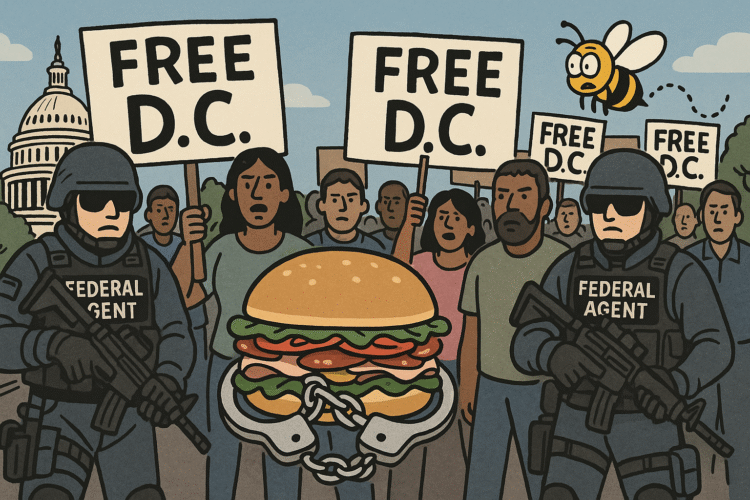
The nation’s capital looked less like the seat of democracy and more like the set of a dystopian reboot of COPS. Thousands of residents packed Meridian Hill—also known as Malcolm X—Park, then marched down 16th Street to Freedom Plaza for the “We Are All D.C.” rally. The name was both poetic and desperate: a reminder that Washington’s residents are still treated as second-class citizens in a city that makes laws for everyone but itself.
They were protesting what began on August 11, when President Trump declared a “crime emergency” and seized control of D.C.’s police department. National Guard troops and roving FBI and ICE agents now patrol the city in a spectacle of federal muscle. On paper, it was about crime. In practice, it was about power.
Crime Emergency, Democracy Emergency
Trump’s “crime emergency” sounded like a B-movie plot. Crime statistics didn’t justify it—violent crime was trending down, property crime was steady, and most residents agreed the biggest emergencies in D.C. are housing costs and Metro delays. But those don’t come with good optics. National Guard trucks rolling past the monuments? That’s cinematic. That’s power staged for cameras.
So the President put the capital under federal control, claiming safety. What residents got was roving patrols, mass arrests, and a creeping sense that democracy doesn’t live here anymore.
The Rally as Counter-Narrative
The “We Are All D.C.” rally wasn’t just about crime stats. It was about sovereignty.
The coalition leading the charge—Free DC, the ACLU, and a patchwork of local activists—marched under banners that read “Free D.C.” and “Statehood Now.” Their message was blunt: no taxation without representation, no militarization without resistance. The crowd looked like D.C. itself—Black residents, immigrant families, young professionals, elders who had lived through earlier crackdowns—all chanting the same thing: whose city, our city.
The Flashpoints
Protests have a way of elevating absurdities into symbols. This time it was the “sandwich toss.” A roving patrol allegedly tackled and arrested a resident for throwing half a turkey sandwich into a trash can “too aggressively.” The video, naturally, went viral.
There it was: armored agents surrounding a man whose biggest crime was wasting mayonnaise. A literal sandwich became the metaphor for federal overreach—innocuous, tossed aside, then treated like contraband. If America ever needed a visual for the absurdity of militarized policing, it wasn’t a raid or a shootout. It was a hoagie in handcuffs.
Data vs. Reality
Supporters of the federal surge point to one metric: crime is down. MPD data show violent and property crime dipped 23–25% in the first two weeks of the takeover.
But criminologists caution that reporting lags can make short-term dips look larger than they are. Civil-rights lawyers argue that mass arrests don’t equal safety. Residents point out the obvious: a decrease in crime is meaningless if the cost is civil liberties trampled, communities terrorized, and sandwiches prosecuted.
Crime stats are the fig leaf. The naked truth is control.
Suing the Feds
D.C.’s attorney general has sued to halt troop deployments, arguing they violate constitutional protections. It’s a case both obvious and uphill. D.C. is not a state. It does not have sovereignty in the same way. It is perpetually at the mercy of whichever administration wants to flex.
Congress, meanwhile, signals it may let the 30-day federal takeover lapse. Which means the fate of the city rests not with its residents or elected officials, but with politicians from Idaho and Kentucky who couldn’t find Anacostia on a map if you gave them a GPS.
Governing by Fear
The irony is that this protest happened in the shadow of institutions built to symbolize democracy. Residents marched down 16th Street, past the White House, toward Freedom Plaza—slogans about liberty echoing in a city governed by fear.
This is what federal control looks like: National Guard trucks by playgrounds, ICE agents in neighborhoods where immigrants already live in precarity, FBI jackets more visible than school uniforms. A city turned into a stage for presidential strongman fantasies.
The Satirical Core
The satire here is merciless:
- A city denied statehood is now denied its own policing.
- A sandwich toss becomes a case file in the War on Crime Theater.
- A “crime emergency” justified by dipping statistics is extended because the optics are good.
- Protesters chant for freedom under the gaze of monuments built to symbolize it.
- The President governs by meme, the Congress by neglect, the residents by resistance.
The absurdity is structural: Washington, D.C.—the capital of democracy—remains a colony in practice.
We Are All D.C.
The rally’s name—“We Are All D.C.”—was meant to forge solidarity. But the cruel truth is that most Americans don’t think about D.C. as a place where people live. To them, it’s marble buildings, monuments, lobbyists, and gridlock. The residents are invisible until they march.
But they are the canary in the coal mine. If D.C. can be federalized overnight, so can anywhere. If the President can seize control of policing with no oversight, so can successors. If civil liberties can be suspended with the stroke of an emergency declaration, then the emergency isn’t crime—it’s the Constitution.
On September 6, thousands marched to remind America that democracy doesn’t just happen in marble chambers. It happens in neighborhoods, in city councils, in the right to police your own streets.
The haunting truth is this: D.C. has always been the test lab for American democracy. And right now, the experiment is failing. A president governs by federalization and fear. Congress dithers. Residents resist.
The sandwich toss will fade into meme history. The data will be revised. The lawsuits will drag on. But the precedent remains: that the nation’s capital can be seized, branded a crime scene, and patrolled by troops for the sake of optics.
We are all D.C., whether we want to admit it or not. And if we ignore what happens here, we’ll wake up one day to find that the capital didn’t just lose control of its streets. It lost control of democracy itself.