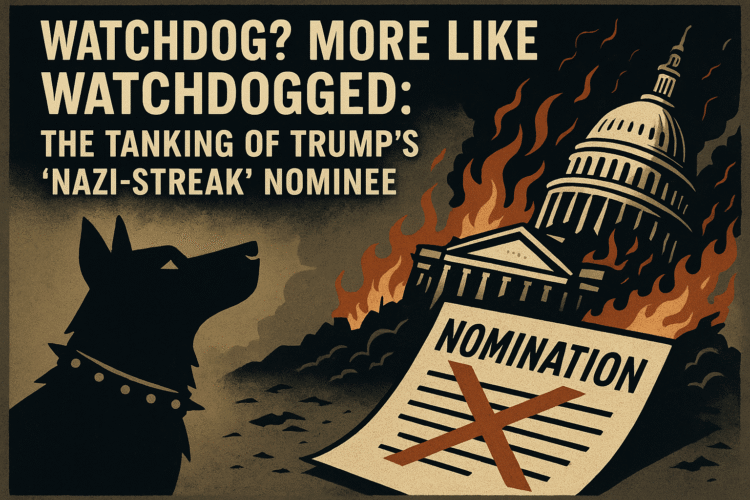
You’d think after a year of government face-plants, someone in Trump’s orbit might nominate a watchdog who didn’t actively bite democracy. Instead, the White House delivered Paul Ingrassia—a 30-year-old law school graduate with the résumé depth of a TikTok bio—to run the Office of Special Counsel, the federal agency designed to protect whistleblowers and keep civil service neutral. Within days, group chats leaked showing him bragging about his “Nazi streak,” mocking Martin Luther King Jr. Day, and tossing racial epithets around like party favors.
Cue one of Washington’s rare bipartisan miracles: disgust. Republicans—actual Republicans—started backing away from the nomination like it was on fire. Senator John Thune said, in translation, “good God, no.” By midweek, Ingrassia had yanked himself from the Senate schedule via social-media statement, his lawyer floating the all-time hall-of-fame defense that the texts were either “AI-generated” or “satire.”
That line landed about as well as a swastika in a civics textbook.
How It Crashed Before Takeoff
The timeline is pure tragicomedy. Trump announces the pick: a guy barely admitted to the bar, whose most notable work experience was at DHS and a podcast about “American decline.”
Then—within days—Politico drops screenshots. There’s the “Nazi streak” brag. There’s the MLK Day sneer. There’s the racism buffet. Within hours, the White House press team was in “we’re reviewing the situation” mode, which is Beltway for we’re scrubbing his socials before breakfast.
By the time Ingrassia’s statement hit X (“With respect for the president, I’m withdrawing”), even Fox producers were practicing how to pronounce Schadenfreude. His lawyer’s “AI-manipulated or satirical” spin achieved something rare in crisis PR: it insulted both intelligence and irony.
The Spin Cycle and the Smell of Burnt Reputation
Imagine being paid to argue that Nazi banter was misunderstood performance art. That’s where the campaign’s legal defense landed. The White House tried to test “he’s young” as a trial balloon, but the balloon burst when the Senate started counting votes—and realized there weren’t any.
Even MAGA loyalists privately admitted the optics were radioactive. The Office of Special Counsel is supposed to shield whistleblowers, not make them nostalgic for HR. Putting a thirty-year-old ideologue with fascist memes at its helm was less “drain the swamp” than “stock it with piranhas.”
The Real Warning Isn’t the Texts
This wasn’t about one man’s bad sense of humor; it was about a vetting system so broken it could hand a loaded weapon to a toddler and call it leadership. The OSC is meant to protect civil servants from political retaliation. Appointing someone who openly mocks equality doesn’t just shatter optics—it signals a moral vacancy in the hiring process itself.
Here’s the résumé, such as it is: law degree, DHS liaison, self-styled commentator, right-wing podcast guest, loud Twitter presence. That’s it. No oversight experience. No labor background. No management record. But yes, a verified taste for edgelord provocation.
In short: Trump nominated a man allergic to guardrails to run an agency made of them.
The Senate Said the Quiet Part Out Loud
Senators who usually vote for anyone wearing a red tie suddenly remembered what shame feels like. One aide told reporters, “This guy made it impossible to defend himself.”
Translation: We’ve confirmed judges accused of witchcraft, but even we have limits.
The hearing room, once prepped for polite partisan theater, turned into a bipartisan panic drill. Staffers shredded briefing folders. Committee chairs cancelled appearances. The official OSC nameplate reportedly sat in its box, unclaimed, like the world’s saddest participation trophy.
The Vacancy Becomes the Story
Now that Ingrassia has been memory-holed, the Office of Special Counsel sits leaderless while retaliation complaints stack up like unfiled taxes. Whistleblowers who might’ve stepped forward are watching the circus and thinking, why bother?
The vacancy doesn’t just delay accountability—it corrodes it. When a watchdog post becomes a culture-war toy, the people inside the system stop trusting that the system still works. And that trust is harder to rebuild than any résumé.
The Real Cost: Faith, Not Optics
This saga costs more than an embarrassing news cycle. It costs civic muscle. The bureaucrats who quietly keep the lights on now know their own protection agency was almost run by someone who joked about erasing them.
The Senate may have killed this nomination, but it didn’t repair the damage. You can’t “both-sides” competence. You either believe government deserves grown-ups—or you believe it’s a stage for trolls.
Trump’s team chose the latter. Again.
The Pattern Is the Point
Let’s not treat this like a one-off. It’s a symptom of a governing philosophy that confuses rebellion with recruitment. Appoint the chaos agent, call it disruption, and wait for the outrage to fade.
It’s efficient, in its way: by the time the scandal crests, the base has already absorbed the lesson—loyalty is the only qualification that matters.
But governance isn’t a meme account. When your hiring filter is “would this person trend,” you end up with a cabinet that looks like a group chat that escaped.
The Ingrassia nomination was the logical endpoint of that thinking: appoint someone who sees professional ethics as punchlines, and watch the guardrails collapse in real time.
What Happens When the Watchdog Is the Joke
If the OSC was built to be a firewall, this was the arsonist appointment. The man tasked with defending public employees from political abuse openly parodied the very idea of equality. It’s not ideology—it’s inversion.
Worse, it set a new calibration for absurdity: the only line that stops a nomination now is self-published fascism. Everything else—from conspiracy theorists to election deniers—is still fair game.
The next nominee won’t have to clear the bar. They’ll just have to avoid leaving a digital paper trail. Congratulations, the floor is now lava.
And Yet, A Strange Kind of Hope
Here’s the twist: the system did blink. Senators said no. A rare collective immune response fired. Even in a post-truth capital, the words “Nazi streak” were still too radioactive to sanitize. That’s the faintest pulse of civic health—a reminder that the line between “free speech” and “disqualifying contempt” still exists, if only barely.
Maybe that’s the lesson. Democracy doesn’t die in darkness; it dies in HR. But this week, at least, HR fought back.
Final Reflection: The Vetting Machine That Ate Itself
Every administration eventually reveals its soul through its appointments. This one’s soul seems to live in Telegram chats. The Ingrassia implosion wasn’t a glitch—it was a mirror. It showed us a government that’s forgotten what seriousness looks like.
Because at the end of the day, a president’s watchdog shouldn’t need to explain away racist jokes, AI deepfakes, or Nazi cosplay. The job requires moral literacy, not meme fluency. And until the hiring pool reflects that, we’ll keep replaying the same farce: power without competence, authority without ethics, noise without function.
The Office of Special Counsel was meant to protect the system from political predators. Instead, it just auditioned one.