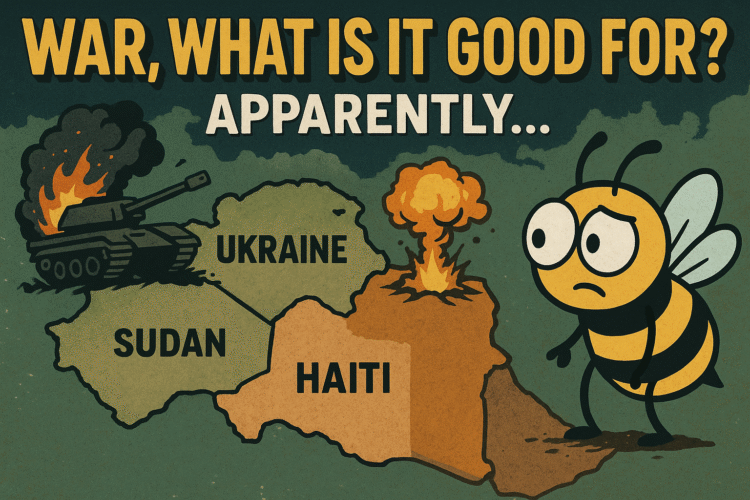
If you’ve felt a strange global vibration lately, no, it’s not Mercury in retrograde or your ex trying to manifest you back through a dream journal. It’s the reverberation of yet another season of Earth: Total War, now streaming live from Ukraine, Sudan, Haiti, and anywhere else with two opposing factions, dwindling hope, and a United Nations resolution still pending approval.
Let’s start with Russia’s ongoing remake of Risk: Eastern Europe Edition. In the war criminal fever dream known as Putin’s invasion of Ukraine, what began as a “special military operation” has evolved into the geopolitical equivalent of your grandpa trying to reboot the Soviet Union using a Nokia flip phone and a bottle of vodka. Russia insists it’s defending its borders, which now apparently includes Ukraine’s grain, power grids, and occasionally, its children. Meanwhile, the West is playing the world’s most expensive game of Venmo Tag: “You send HIM $400 million this week, I’ll send HIM a drone. Fair?” Spoiler: There is no fair in war. Only F-16s and fluctuating approval ratings.
But let’s pivot to Sudan, where a bloody power struggle between military factions has created the kind of humanitarian catastrophe that would break the internet—if it weren’t already too busy breaking down over Threads vs. X. The Rapid Support Forces and Sudanese Armed Forces are treating civilians like collateral confetti while aid groups scream into the void. The U.S. responded by officially condemning the violence, which is State Department speak for “we’re tweeting about it and calling that diplomacy.”
Meanwhile, Haiti—sweet, battered Haiti—is embroiled in yet another crisis that colonialism laid the groundwork for and the world refuses to clean up. Armed gangs have filled the vacuum left by decades of political corruption, foreign meddling, and humanitarian fatigue. It’s giving Lord of the Flies: IMF Edition. The international community has responded with all the urgency of a DMV clerk on their lunch break. Kenya offered to send peacekeeping forces, and the U.S. tossed in some funding—basically a DoorDash tip for democracy.
Let’s not forget Yemen. Or Palestine. Or Ethiopia. Or Myanmar. Or the half-dozen places not trending because they don’t have enough oil, white people, or World Bank leverage to stay in the Western media cycle longer than a celebrity rehab stay.
Here’s the part where we zoom out.
Global conflict is no longer about ideology. It’s about optics. Resources. Control. And occasionally, it’s about masking a domestic dumpster fire with the scent of international warfare. “Don’t look at our economic collapse,” say the governments. “Look at that OTHER country collapsing instead.”
The human cost? Millions displaced. Tens of thousands dead. Trauma rendered permanent across generations. And the real kicker? These people don’t even get Netflix specials or Oscar-nominated documentaries. They just get forgotten—until someone decides they’re strategically useful again.
And where are the international actors? Mostly on Twitter, retweeting solidarity while selling weapons backstage. The UN convenes panels. NATO throws shade. And the U.S.—well, the U.S. is busy deciding whether banning TikTok counts as a national security strategy.
But don’t worry. We’re told hope is alive. It’s just currently being vetted for asylum.
Until then, peace talks will resume after this brief, decades-long intermission.