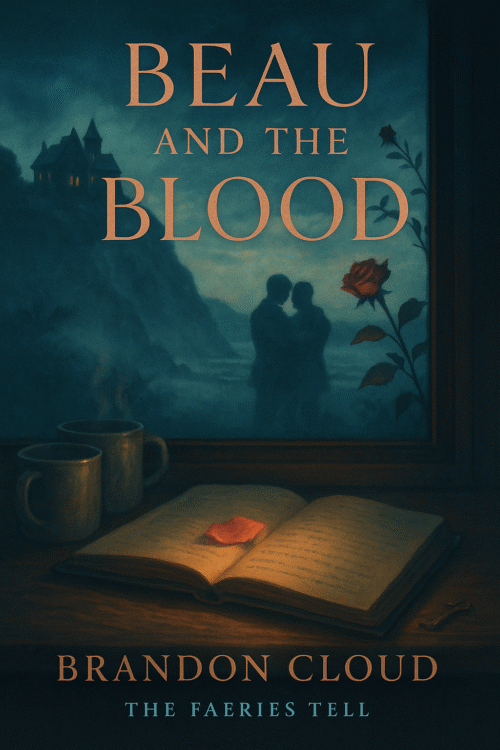
Read Beau and the Blood and visit my Amazon author page.
I didn’t set out to write a “vampire book.” I set out to write a story where two adults choose each other without spectacle—where consent isn’t just a checkbox, it’s the heat. Where magic behaves like physics and community behaves like weather. Where a queer love story isn’t a lesson or a headline; it’s breakfast, a borrowed chair, and a promise that holds.
Beau and the Blood grew from that desire. It’s a Beauty & the Beast–inspired queer romance about an ethical vampire, a human archivist with more spine than swagger, and a haunted house that keeps its promises. The town wants a show. They choose a life.

Why I Write (and Why Queerness Is the Wallpaper, Not the Plot)
I write because stories taught me how to breathe when the room felt tight. Because the right line at the right moment can make someone feel seen instead of categorized. Queerness is part of my lens—present, persistent, and ordinary. In my work, it isn’t the twist or the trauma; it’s the wallpaper and the paint. It informs everything and performs nothing.
That’s the energy I carried into Beau and the Blood. Yes, the leads are queer. But the engine of the book is not “being queer.” The engine is care: the kind that asks, listens, and stops by choice. The kind that turns monstrous optics into human practice. I wanted readers—queer, straight, whoever—to feel what it’s like when love is negotiated with tenderness and maintained like a craft.
Real Characters, Not Aesthetic Mood Boards
I love gothic atmosphere as much as anyone, but I’m allergic to cardboard people posed in pretty fog. My characters are stubbornly real:
- Beau, a working artist who squares stacks, gets the right page by touch, and stands up to optics with receipts instead of speeches.
- Lycan, a centuries-old collector who believes his love is dangerous until another person insists it’s not—and proves it, meal by meal, boundary by boundary.
- A town that doesn’t function as a faceless mob. It’s people—Rita with her lemon bars and rules about exits; Amy with her camera and ethics; a docent who rewrites her script when truth arrives.
Even the house is a character, but not a carnival trick. In Beau and the Blood, the manor responds the way a good house would: floorboards release when someone tells the truth; a lamp steadies when shame loosens its grip. Not fireworks—physics. Not spectacle—structure.
Trauma Isn’t a Plot Twist. It’s a Foundation You Build On Carefully.
I don’t believe in trauma as seasoning. I believe in naming the wound and then showing how people practice living anyway. The vampire shame in this book isn’t romantic suffering; it’s a habit of starving as penance. The human wound isn’t martyrdom; it’s the temptation to turn love into proof.
So the book insists on aftercare, in every sense. Feeding is planned, bounded, stoppable. The most intimate sentence is often “That’s enough.” When someone says “Wait,” the other person hears it as love, not rejection. These are adult skills. The thesis of Beau and the Blood is simple: wanting doesn’t make you a monster. Hiding does.
Beauty & the Beast—Without the Problematic Parts
The fairy tale we inherit is powerful—and messy. Captivity framed as courtship. Coercion softened by a ballgown. A “beast” in need of reform and a “beauty” who gets rewarded for endurance.
This reimagining keeps the ache and discards the rot. In Beau and the Blood:
- There’s no captivity. Beau is a contractor, not a prisoner. He can leave; he chooses to stay.
- There’s no reform-by-love. Lycan isn’t “fixed” by romance. He does the work: telling himself the truth, eating regularly, breaking the habit of starving as a virtue.
- Consent drives the heat. They plan a near-feeding the way adults plan anything risky: with a time, a word that ends it, and a promise to stop if the room stops feeling safe.
- The magic isn’t punishment. The house isn’t a judge. It’s a mirror for honesty. Tell the truth and the floor stops bracing. Lie to yourself and the roses dim. The rules are consistent and fair.
It’s still a fairy tale; it’s just built for grown-ups who want love to be sustainable.
Why Queer People Belong in Fairy Tales
Because we’ve always been there. Because “once upon a time” belongs to everyone who needs a map out of the dark. Because seeing a queer couple negotiate care with clarity is its own kind of enchantment. Because the happily-ever-after isn’t heteronormativity in a cape; it’s daily practice—coffee, keys on the hook, returns stamped neatly, and a partner who looks you in the eye and says, “Tell me if I’m too much. I’ll stop.”
Representation matters at the story level, but it matters even more at the rule level. In Beau and the Blood, the rules insist that truth has consequences and care has architecture. That’s not “a queer lesson.” That’s a human one.
What the Book Is About (Without Spoilers)
Set on a fog-shaped stretch of the Pacific Northwest coast, Beau and the Blood follows Beau D’Alba, a young artist and archivist hired to catalog a reclusive collector’s library. The collector is Lycan Valerius—an immortal who treats wanting like a weapon and hoards fragile things the way some people hoard apologies.
There’s an easement fight and a town myth about a cliff creature. There’s a sardonic house familiar who tells the truth with a pencil behind his ear. There are rules: salt slows healing, iron stings, moving water disorients. There is the ethics of feeding, negotiated carefully. There are neighbors with opinions and, crucially, manners.
What there isn’t: glamour compulsion, “fated mates,” or love purchased with pain. The romance scales by craft: hands, then a wrist kiss, then a planned feed, then the domestic ease of leaving the porch light on because someone asked you to. The tension isn’t “Will they?” It’s “How will they build a life that can hold them?”
The Heartline: Consent Is the Heat
If you’ve ever felt that desire and danger got braided together in you so tightly you couldn’t tell them apart, this book is an unbraiding. The hottest thing in Beau and the Blood is two lines:
- “Tell me where.”
- “That’s enough.”
When Lycan stops because he chooses to, not because he’s forced, trust increases. When Beau says “later” and is respected, intimacy deepens. When either of them says “I’m hungry,” the other doesn’t panic—they plan. That’s sexier than compulsion. That’s love with a spine.
Cozy-Gothic Vibes (Bring a Blanket, Not a Stake)
I love the mood of old mansions and sea-weathered towns. I also love warmth. So yes: there’s fog, a bioluminescent rose grove, and a mirror that tells on people who lie to themselves. But there are also lemon bars, borrowed paperbacks, a green chair that looks like it has opinions, and a lending shelf with a sign that reads, “Borrow / Bring Back / Confess.”
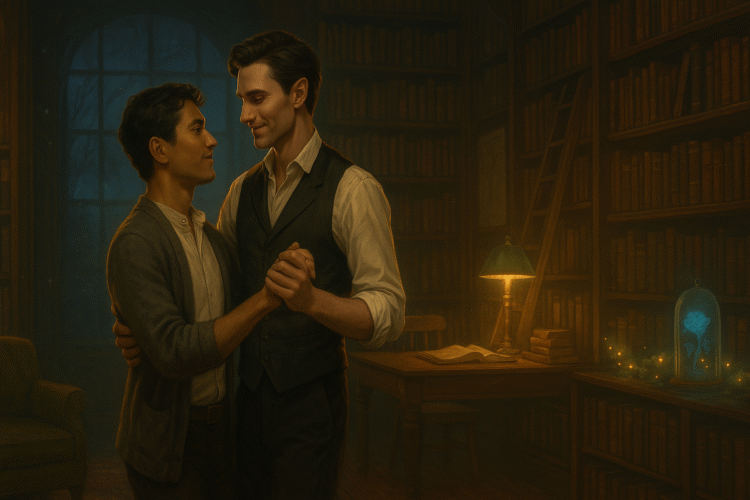
The coziness isn’t a filter; it’s a choice. It says the house is safer when people tell the truth in it. It says a community can adjust its story when given receipts. It says that the most radical magic might be two men dancing in a bookstore after close, then turning off the lights and going to bed like it’s the point.
What Readers Will Find Between the Covers
- A slow-burn, negotiated forever. Longing that matures into daily practice.
- An ethical vampire. Not a brooding cosplay, but a man learning to stop hurting himself in the name of virtue.
- A human with boundaries. Beau refuses to be optics-managed or rescued. He chooses. He stays because he wants to, not because he has to.
- A house with rules. Magic as cause-and-effect, not as mood lighting.
- A town that learns. From gossip to stewardship, with jokes and snacks along the way.
- Humor that releases pressure. Dry, warm, and never at the expense of the stakes.
If that’s your flavor—if you want tenderness with teeth, and a fairy tale where grown people act like grown people—Beau and the Blood is waiting.
Why This Story, Now
We live in an age of performance, where optics sometimes outrun truth. I wanted to write a romance that chooses truth even when it isn’t glamorous, and chooses the daily work of care over the theatrics of grand gestures. I wanted a vampire story that treats the body as a place where consent is practiced, not punished. I wanted a fairy tale where the curse breaks not because someone obeyed a rule, but because they stopped lying to their own reflection.
That felt worth my time, and I hope it’s worth yours.
If You Read It, Read It Like This
Make tea. Silence your phone. Read the first chapter with the porch light on, then let the house darken around you. Notice how the rooms respond—not with jump scares, but with a quiet leveling when someone says a true thing out loud. Watch two men ask each other for what they need and hear yes or no like music. When you hit the last page, take a breath. Then go do something ordinary and kind. That’s the book finishing its job in the world.
If you want a Beauty & the Beast retelling that throws out the cage, keeps the candlestick, and replaces compulsion with consent, pick up Beau and the Blood. And if you want to see what I write next, follow me on my Amazon author page.
Come for the fangs, stay for the tenderness.