A corporate efficiency makeover that looks suspiciously like a disappearing act.
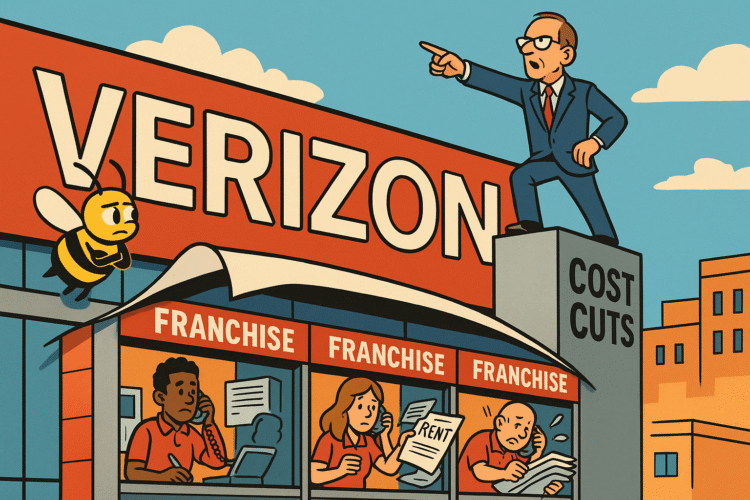
The thing about telecom giants is that they love to talk about connection, yet the real connective tissue of their business is the quiet thrum of payroll software calculating who will still have health insurance by the time quarterly earnings hit the wire. Verizon, now under the freshly installed leadership of Dan Schulman, has decided that nothing says “reclaiming market share” like preparing to send up to one fifth of its workforce into the great American job churn. Instead of hiking consumer prices, Schulman has reached for a more classic instrument, one that never seems to gather dust in the glass cabinet of corporate strategy: thinning the herd. Bloomberg, the Wall Street Journal, and regional outlets all nodded together in a rare harmony as they reported that Verizon is weighing fifteen to twenty thousand layoffs. It is not every day that an entire industry agrees on something, but nothing unifies a room like the smell of layoffs drifting in from the conference floor.
For those keeping score, this is roughly twenty percent of Verizon’s workforce, a population large enough to fill a mid sized city or at least several competitive Minecraft servers. The announcements, according to the well timed leaks that always seem to arrive before the first HR email, are expected next week. The timing is impeccable, perfectly designed to land before year end so the accounting department can close the books cleanly and payroll can shed the bodies before holiday bonuses introduce awkward arithmetic. The company has endured at least three straight quarters of subscriber losses and a stock line that trails AT&T and T Mobile with the tired persistence of a late filing high school senior. Schulman believes the path forward lies in “aggressive transformation,” a phrase that promises muscle and vision but usually serves as a gentle euphemism for restructuring that dissolves entire departments and relocates decision making to a single spreadsheet.
The core of the plan is not subtle. Verizon will carve through multiple layers of the business, particularly non union management roles, a group often praised for their strategic leadership until the moment someone decides there is too much of it. Retail staff, support teams, and back office workers sit squarely in the potential blast radius. And then comes the pièce de resistance of the modern corporate turnaround, the franchising move. Verizon is set to convert one hundred eighty to two hundred company owned retail locations into franchised operations. This is the sort of maneuver that publicly maintains the brand’s familiar glow while privately ensuring that the newly labeled “owners” pay the wages, handle the benefits, and absorb the cost of human labor. It is a strategy so elegant you can hear investors unclenching one vertebra at a time.
For customers walking into these soon to be franchised outlets, very little will look different other than perhaps an atmosphere of heightened urgency. The shirts will still be red, the lighting will still be bright enough to sanitize wounds, and the posters will still promise faster speeds everywhere except your living room. Behind the scenes, however, a core shift is taking place. Those employees will no longer be on Verizon’s payroll. They will be the responsibility of small business owners who will face the fascinating arithmetic of running a retail telecom shop in a saturated wireless market where customer acquisition has the charm of trench warfare. This clever outsourcing preserves Verizon’s national footprint while minimizing one of the largest costs any corporation bears. The math writes itself, tidy and self satisfied.
The geography of the changes is notable. States with heavy staffing footprints like New Jersey, Texas, Florida, and New York are poised for the deepest tremors. Smaller offices may go dark entirely. PowerPoint decks will describe these closures as part of a modernizing initiative, but the effect will feel more like a sudden evacuation. Some employees will relocate, others will begin the scavenger hunt of job searching in a marketplace where layoffs have become the background music of American capitalism. Worker advocates have already warned that thousands of front line and support employees will shoulder the weight of shareholder friendly efficiency plans. Telecom layoffs may not trend in quite the same theatrical way as tech industry bloodbaths, but they ripple through local economies with the same unerring physics.
It is impossible to separate Schulman’s entrance from this moment. Replacing Hans Vestberg after subscriber declines and underperformance, the new CEO has attempted to frame this pivot as a generational rethink. He promises not to lean on consumer price hikes, a refreshing if limited vow in a sector that reflexively hikes fees the way most people check social media. Instead he will transform the company’s culture, its structure, and its cost profile. The ambition is sizable. But what is remarkable is how quickly culture seems to shrink to headcount decisions, as though the spirit of an enterprise were kept in the administrative offices and not across the conversations of a hundred thousand workers who wake up every morning to keep a telecom titan upright.
The broader context is essential. Telecom and tech layoffs have been rolling like distant thunder throughout the year. Companies once praised for bold risk taking are now adored for the ability to shrink. Analysts describe this as part of the natural innovation cycle, a cleaner, leaner industry emerging from the haze of overspending. This is the myth we swallow to reassure ourselves that austerity is enlightenment. But underneath the reassuring language lies an uncomfortable truth. Telecom has matured into an industry where growth battles physics, spectrum, and customer fatigue. When your market is saturated and churn rises, the easiest variable to adjust is payroll. Investments in 5G and broadband infrastructure are expensive, and the appetite for pleasing investors is insatiable. Efficiency, in this genre of capitalism, almost always means people.
Yet the tension is not just economic. It is also cultural. Schulman’s background at PayPal suggests a fondness for rapid transformation, digital fluency, and cost discipline. He arrives at a moment when Verizon’s internal culture likely feels like a mix of exhaustion and guarded hope. Employees at every level will soon be forced to interpret the meaning behind the phrases being offered, the careful optimism about reclaiming market share, the soothing guarantees about long term value creation, the polite insistence that transformation is the only real path forward. These messages ripple differently when you are the person tapping your badge at an office entrance that may not exist next month.
The franchising decision in particular carries symbolic weight. It mirrors a broader national trend in which corporations seek to preserve brand influence while distancing themselves from the legal and financial obligations of employment. Franchising, by design, creates layers between the parent company and the workforce. It offers plausible deniability when labor disputes arise and keeps the corporation’s hands clean when wage issues or staffing shortages appear. It is a way to enjoy the fruits of a retail footprint without the pesky costs of nurturing the roots. Verizon is not alone in this. Fast food giants, hospitality chains, and logistics conglomerates have all embraced this approach. But in the telecom world, where retail stores serve as the literal face of customer service, this shift is particularly delicate.
What makes this moment worthy of satire is the predictability of the script. When companies announce a desire to transform culture, they rarely mean they want more unfiltered communication or richer collaboration. They usually mean someone spent a week with consultants and discovered that labor costs form a meaningful slice of the expense pie chart. When executives vow to reinvest in innovation, they rarely mention the number of people who will leave under opaque circumstances, escorted out by digital access revocations rather than hallway conversations. When companies promise bold, forward looking change, they never quite explain why it must be paired with the quiet shuffling of thousands of livelihoods into uncertainty.
The irony is baked directly into the structure of the industry. Telecom relies on trust, on loyalty, on millions of customers who need their signals to behave in something resembling a stable manner. Yet internally, the loyalty is transactional. Employees are expected to absorb instability with a flexibility and dignity that the company itself refuses to offer them in return. There is a disconnect between the gleaming commercials celebrating connection and the behind the scenes maneuvering that dismantles the communities that make that connection possible. The very people who troubleshoot the network are now preparing to troubleshoot their own careers.
Inside Verizon’s boardrooms, the mood is probably focused, determined, even triumphant. The path is clear. The spreadsheets align. The cost savings glimmer. There may even be a sense of overdue cleanup, a belief that this moment is not cruel but practical. That may be true from a distance. But from the ground, where employees stack boxes, glance at their phones for HR updates, or wait for the meeting invite that never arrives, practicality looks like a polite disguise for something older and simpler. It looks like the ancient act of reducing the workforce to rightsize the company.
Schulman’s arrival is a story of corporate reinvention playing out in a marketplace weary from upheaval. Verizon’s competitors will watch closely, eager to see whether aggressive restructuring leads to a rebound or merely advertises vulnerability. Analysts will frame the move as disciplined, investors will applaud, and consumers may not notice much at all other than a slightly different name on a retail store lease. But the employees, especially those in retail and support roles, will understand exactly what happened. They will see it not as a radical transformation, but as a familiar ritual, one that begins with a vision statement and ends with a severance packet.
Even so, this moment contains its own uneasy symbolism. In a year when major corporations have sharpened their layoff instincts, when efficiency has become code for contraction, Verizon’s move sits comfortably within the broader pattern. It is a road paved by tech giants, logistics firms, and entertainment conglomerates. In every case, companies reduce their workforce to satisfy shareholders, then point proudly to their new agility. Culture, we are told, will thrive once the hard choices are made. But to the people living through the consequences, culture feels less like a promise and more like the echo of what used to exist.
It is worth noting the peculiar optimism with which these transitions are often described. Executives frame layoffs as the first step toward a stronger future. They insist that the decisions are difficult but necessary. They describe restructuring as a strategic evolution, not a contraction. But the employees who endure these scenes recognize the choreography. They know that transformation is the corporate way of saying the company has missed its targets and now needs bodies to place on the altar of efficiency. They know that when franchising arrives, stability departs.
What is striking is how the idea of responsibility gets rearranged. Verizon will keep its name, its colors, its retail presence, and its national reputation. Franchise owners will inherit the responsibility for staffing, wages, and performance. Employees will shoulder the stress and uncertainty. And the corporation will enjoy the flexibility to adjust its strategy with the ease of closing a slide deck. It is a system designed to diffuse accountability while preserving benefit, a balancing act made possible by the sheer scale of the brand.
This restructuring is not merely a business decision. It is a reflection of a cultural moment in which large corporations are celebrated for discipline yet rarely held accountable for the human cost of their actions. It is a snapshot of an economy that rewards contraction more quickly than it rewards risk taking. It is a reminder that the phrase aggressive transformation usually hides a softer truth, one about people whose names will never appear in a press release.
The Part They Hope You Forget
The story that will endure is not the one found in investor calls or the platitudes of strategic realignment. It is the quieter narrative happening at desks and retail counters, in parking lots where employees wait to see if their badges still blink green, in living rooms where families recalculate budgets. Verizon will speak confidently about the future, about culture, about innovation. But the people leaving those buildings will carry a different insight. They will understand that efficiency is rarely just an economic principle. It is often a carefully managed erasure, one that trims costs by pruning the people who once held the company together.