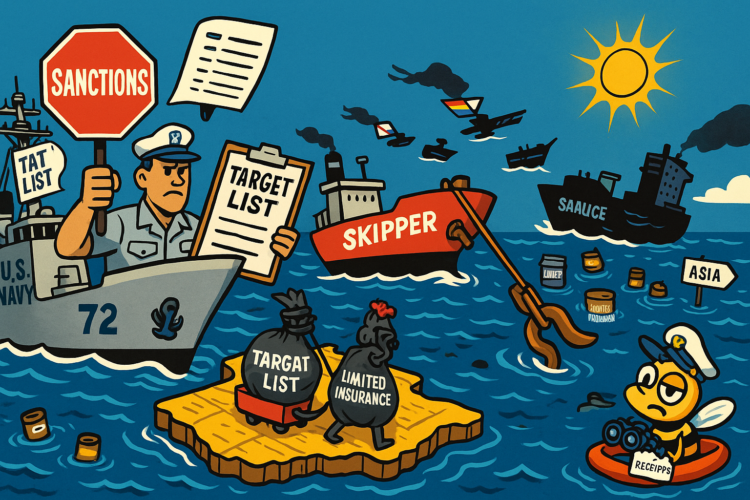
One part maritime choke point, one part reality show, and one part global oil market swallowing hard.
The Trump administration is preparing more at-sea seizures of oil tankers near Venezuela, and it is doing it with the kind of confident swagger that usually shows up right before someone asks, quietly, what the exit plan is. The first known U.S. seizure of a Venezuelan-linked tanker, the Skipper, reportedly unfolded off Venezuela’s coast in a military-style operation, which is a careful phrase that sounds like “law enforcement” until you picture the hardware. Washington is now compiling a target list of already sanctioned vessels, tracking tankers anchored in Venezuelan ports or operating in nearby waters, and pairing the seizures with a stepped-up U.S. naval presence in the southern Caribbean. The stated goal is to choke off Nicolas Maduro’s main revenue stream by enforcing sanctions on the shadow fleet that moves crude for sanctioned producers using opaque ownership, flag changes, and insurance arrangements so thin they might as well be drawn in pencil.
In other words, the U.S. is taking the sanctions spreadsheet, sliding it across the table, and then standing up with a boat.
There is a certain kind of American confidence that believes a problem can be solved by putting it on a list and then sending a vessel toward it. It is the same confidence that treats the ocean like an office hallway, where you can walk up to someone’s cubicle, tap their monitor, and say, “This ends today.” But oceans are not hallways. They are floating markets, floating laws, floating risk, and floating misunderstandings. When you start grabbing tankers at sea, you are not just making a point to Caracas. You are making a point to everyone who insures, charters, brokers, flags, finances, and buys crude. You are telling them that the margins between “sanctions evasion” and “sanctions enforcement” now include the possibility of a boarding ladder.
That message travels faster than any tanker.
The Shadow Fleet Is a Feature, Not a Glitch
Washington keeps describing the shadow fleet as if it is a weird loophole created by bad actors who hate rules. In reality, the shadow fleet exists because sanctions are a system that produces incentives, and markets are a system that responds to incentives. When you sanction a country’s oil exports but oil remains in global demand, the trade does not evaporate, it mutates. It becomes a game of mirrors where ownership is opaque, flags change like outfits, and insurance is either limited or creatively arranged. A tanker becomes less a ship and more a moving riddle.
Sanctions are often sold as clean moral tools, but they operate in the same messy world as everything else. They create parallel channels, middlemen, and new risks that someone will always decide are worth the profit. The shadow fleet is not a bug in the sanctions regime, it is the byproduct. If the U.S. wants to choke off that byproduct, it has to escalate from paper to steel. That is what is happening here, and it is why people in shipping, insurance, and commodity markets are already doing what they always do when governments start grabbing assets: pausing, rerouting, and calling lawyers.
The administration frames the campaign as blocking black-market oil sales that fund destabilizing regimes. The rhetoric is familiar. It paints the seizures as a kind of righteous interception, a way to cut off the money stream that keeps bad governments afloat. Caracas, predictably, denounces the first seizure as theft or piracy. That word choice is also familiar, because every government that gets its assets taken calls it piracy, and every government doing the taking calls it law.
The difference now is that the United States appears willing to turn that argument into a repeated pattern, not a one-off. This is a campaign, not a stunt, and campaigns create new realities.
Six Million Barrels Is Not a Footnote
The disruption is already rippling through the trade. Operators are reportedly delaying or canceling voyages. Cargoes headed for Asia are affected, including close to six million barrels of Venezuela’s heavy Merey export crude. That is not just an accounting figure, it is a set of refineries and supply chains making quick calculations about risk. Heavy crude like Merey is not interchangeable with every other barrel. Refineries set up to process it do not casually swap it out like a coffee order. If those barrels get delayed, seized, or rerouted, buyers scramble, prices adjust, and someone pays.
Markets hate uncertainty more than they hate cost. A known cost can be priced in. Uncertainty is a wildcard. When the risk includes U.S. naval interdiction, the uncertainty becomes a physical object, and physical objects tend to make finance people sweat through their nice shirts.
This is the part where the administration’s message lands beyond Venezuela. It lands on traders in Singapore, insurers in London, shipowners in Greece, and every buyer in Asia who was counting on those barrels arriving without a geopolitical wrestling match. It lands on the entire ecosystem that makes sanctioned oil move anyway, because sanctions are rarely total, and enforcement is rarely perfectly predictable.
The administration is also signaling that more seizures could follow quickly, in tandem with parallel Treasury actions that recently added multiple crude carriers and Venezuela-linked figures to sanctions lists. That is the full-spectrum approach: name the vessels, name the people, increase enforcement, and then add the at-sea element that turns sanctions compliance into a question of whether your ship might be stopped in open water.
If you are in the business of moving crude, that is the kind of signal you do not ignore. You either stop, reroute, change paperwork, or get more creative, which is exactly how the shadow fleet will adapt.
A Military-Style Operation and the Myth of Clean Enforcement
The phrase “military-style operation” carries its own warning label. It suggests planning, coordination, and force posture, and it also suggests that what is being done is not merely administrative. When you seize a tanker at sea, you create a chain of consequences that does not end when the ship is secured. Who takes custody. Where does it go. What happens to the cargo. What legal process follows. What does the flag state say. What do allies say. What does Venezuela do in response. And what precedent does it set.
The U.S. has a long history of maritime interdictions tied to sanctions and counter-narcotics operations, so the concept is not new. The escalation here is the focus and the intensity, particularly near Venezuela’s coast, which makes the action feel more like a blockade-adjacent posture than a distant enforcement action. “Choke off revenue” is a phrase that belongs to siege logic. It is not always wrong, but it is never clean.
Sanctions enforcement at sea also raises the question of what counts as legitimate interdiction versus coercion. The U.S. will argue that these vessels are already sanctioned and that enforcement is lawful. Venezuela will argue that the seizures are piracy. Other countries will watch and quietly update their own playbooks, because one of the most underrated features of international politics is that everyone learns from everyone else’s bold moves. When the U.S. normalizes at-sea seizures tied to sanctions, it increases the odds that other powers will feel more comfortable doing similar things under their own legal narratives.
The world does not need more countries deciding the ocean is their personal enforcement zone.
The Buyers Are the Real Audience
The administration says the goal is to choke off Maduro’s main revenue stream. That is part of it. But the real leverage in oil is not just the producer, it is the buyer. If buyers believe the risk is too high, the trade collapses regardless of how many tankers Venezuela can load. That is why the target list matters. It is not just about catching ships, it is about making the entire network feel hunted.
The shadow fleet thrives on plausible deniability. It thrives on the idea that everyone can shrug and say, “We did not know.” It thrives on complexity. At-sea seizures simplify the picture. They make the risk visible. They tell buyers that even if you can hide behind layers of ownership and flags, the ship itself is still a physical object that can be stopped.
This is why operators are delaying voyages. This is why cargoes are being rerouted. The enforcement campaign is already functioning as a deterrent, and deterrence is often the point. You do not need to seize every ship. You need to make enough examples that the network starts self-censoring.
But deterrence has limits. When the money is big and the demand is persistent, the network will adapt. It will switch routes, use new intermediaries, change timing, find new flags, and operate with more caution. The cat-and-mouse game at sea can go on for a long time, and the mouse has a lot of friends.
Venezuela’s Options Are Not Great, But They Exist
The near-term decision points include how Venezuela responds. Retaliation does not have to be direct naval confrontation to be disruptive. Venezuela can escalate diplomatically, rally sympathetic governments, or use international forums to frame the seizures as piracy and illegal coercion. It can threaten legal action. It can also signal operational risks by making shipping near its coast more complicated. Even small disruptions can spook insurers and shippers, and spooked insurers are an underrated geopolitical force.
Venezuela can also lean further into alternative markets and alternative routes. If the U.S. is targeting vessels anchored in Venezuelan ports or operating nearby, traders may attempt to minimize time spent in predictable zones, shift loading practices, or use ship-to-ship transfers farther out. The shadow fleet is already built around such adaptations. Increased enforcement will accelerate them.
There is also the broader geopolitical backdrop: Venezuela is not operating in a vacuum. It is part of a wider sanctions landscape that includes Iran and Russia. The shadow fleet is not one country’s trick, it is a global sub-economy. By escalating interdictions near Venezuela, the U.S. is also sending a signal to other sanctioned producers and to the actors who enable them.
That may be the point. It may also be the risk.
This Is What It Looks Like When Sanctions Become a Naval Policy
The administration’s approach is effectively turning sanctions enforcement into a maritime campaign, with a stepped-up naval presence in the southern Caribbean and a willingness to seize ships. That is a shift in posture. It suggests that the U.S. is no longer content to rely primarily on financial enforcement, port denials, and corporate compliance. It is willing to reach into the ocean and physically interrupt trade.
This is the kind of move that can produce quick disruption. It can also produce unintended consequences. If insurers pull back, shipping costs rise. If buyers hesitate, supply tightens. If supply tightens, prices move. If prices move, domestic politics gets louder, because nothing makes Americans rediscover geography faster than a spike at the pump. And if Venezuela responds in a way that increases regional tension, you have created a new flashpoint in a part of the world that already has enough reasons to feel unstable.
Meanwhile, the legal narrative becomes a battlefield of its own. Washington will frame seizures as lawful enforcement against sanctioned vessels. Caracas will frame it as piracy. Both will push those narratives, and the rest of the world will treat the truth as whatever best fits their interests.
In the background, the Treasury sanctions lists will keep expanding, because bureaucracies love lists. Every new designation is another signal to the market. Combined with at-sea seizures, the designations become more than paper, they become something with teeth. That is the point of enforcement. The question is what the teeth bite, and who ends up bleeding besides the target.
Receipt Time The Ocean Is Not a Filing Cabinet
The administration is preparing more at-sea seizures of oil tankers near Venezuela after a military-style seizure of the Skipper, building a target list of already sanctioned vessels and backing it with increased naval presence to squeeze Maduro’s revenue while the shadow fleet, built on opaque ownership, flag swaps, and thin insurance, scrambles to reroute and delay cargoes, including millions of barrels of heavy crude headed for Asia, as Caracas denounces the action as piracy and the real immediate test becomes how many more ships Washington grabs, how quickly insurers and shippers freeze or adapt, and whether Venezuela answers with diplomacy, disruption, or something that makes the Caribbean feel less like water and more like a message.