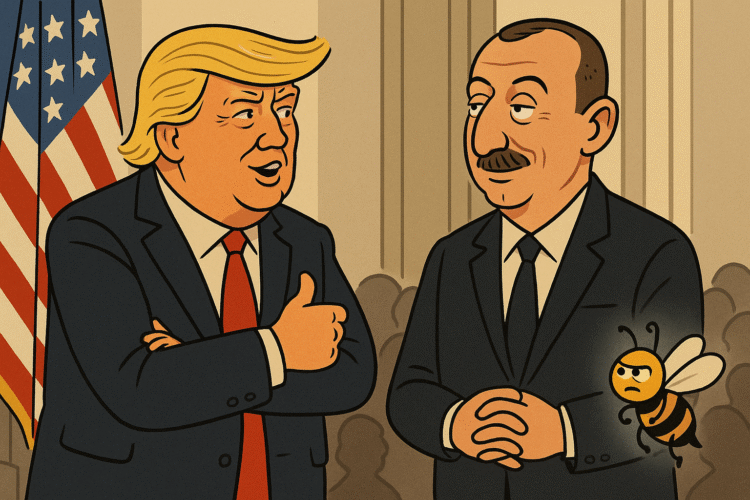
If you ever wondered what a state dinner might look like when it’s catered by the International Association of Autocrats, you didn’t have to look far last week. At a White House event, Donald Trump—America’s most enthusiastic audition tape for a history channel documentary called When Democracies Collapse—asked Azerbaijani President Ilham Aliyev how long he’d been in power.
“Twenty-two years,” Aliyev replied, with the casual confidence of a man who knows election results are more of a mood board than a binding process.
Trump, visibly impressed, leaned in as if Aliyev had just revealed the secret ingredient to immortality. “Twenty-two years, that’s pretty good,” he said. Then, turning to the room like a late-night comic hitting the punchline, added: “That means he’s tough and smart.”
Somewhere in the audience, democracy coughed nervously.
Admiring the Blueprint, Not the Building
It’s worth noting that when Trump praises a long political tenure, he isn’t admiring the tenacity of public service or the sacrifices of leadership. He’s admiring the sheer audacity of refusing to leave the room—like congratulating someone for still sitting at the same restaurant table after 12 hours, not because they’re savoring the meal, but because they’ve padlocked the doors.
For most world leaders, two decades in power raises questions about succession planning, public trust, and the health of civic institutions. For Trump, it raises only one question: How do I get in on that?
It’s not that he admires dictators despite their despotism—he admires them precisely because of it. This isn’t a man who sees democracy as a fragile, imperfect miracle. This is a man who sees democracy as a starter home, to be gutted and rebuilt into something with fewer windows, fewer exits, and a moat.
The Authoritarian Starter Pack
This week alone, Trump has ticked several boxes from the Authoritarian Starter Pack:
- Militarize the capital. Done.
- Seize control of local police forces. Check.
- Float the idea of circumventing Congress. That’s practically a hobby at this point.
- Exert control over cultural institutions. Because nothing says “law and order” like putting your thumb on the nation’s museums.
When challenged, he doesn’t deny the authoritarian impulse—he reframes it as civic virtue. At a recent press conference, Trump bristled at accusations of dictatorial behavior, saying critics should “join him and make Washington safe” instead of whining.
It’s an old trick: turn dissent into disloyalty, and suddenly anyone not clapping is a threat. It’s not that you’re opposed to his policies—you’re opposed to safety, order, and apple pie. You’re the problem.
The Charm of the Iron Fist
What’s striking about Trump’s delivery is that he truly seems baffled by the criticism. To him, deploying the National Guard and taking over the D.C. police is a no-brainer. Why wouldn’t people be grateful? Why wouldn’t they stand up and applaud a leader who’s willing to “do what needs to be done”?
This is where the overlap between Trump and his favorite strongmen becomes obvious. They share a conviction that centralizing power is not just efficient but inherently moral. They see resistance as both irrational and vaguely insulting—like refusing to eat the burnt casserole they cooked “for your own good.”
It’s a style of leadership that confuses fear with respect and equates compliance with consensus. And it works best when the leader in question is surrounded by people willing to clap on cue, whether they believe in the performance or not.
The Dictator’s Fan Club
Trump’s admiration for figures like Aliyev is more than just diplomatic courtesy. It’s aspirational. He sees in them a kind of freedom that democratic leaders can only dream about—the freedom from term limits, from independent courts, from opposition that can’t be jailed or bankrupted into silence.
When he calls Aliyev “tough and smart,” he’s not just complimenting the man. He’s endorsing the method. He’s signaling that he, too, values the consolidation of power over the messy unpredictability of shared governance.
And while most Americans would prefer not to import the Azerbaijani model of political longevity, Trump’s base seems unfazed. In their eyes, his willingness to “cut through the red tape” is a sign of strength, not a warning.
The Overreach Olympics
This is not a one-off moment of Trump letting his authoritarian id slip. This is part of a larger pattern in which he treats federal power like a private collection of chess pieces to be moved at will.
Local autonomy? Optional. Institutional checks? Annoyances. Public consent? Negotiable.
From police forces to cultural venues, Trump has been steadily testing the limits of what he can commandeer without provoking a full-blown revolt. Each success becomes precedent, each precedent becomes normalized, and before long, the idea that federal authority can override local control “for the greater good” stops feeling like an emergency measure and starts feeling like business as usual.
When “Safety” Becomes the Sales Pitch
The danger here is not just the power grab itself—it’s the sales pitch. By framing authoritarian moves as acts of protection, Trump shifts the burden of proof onto his critics. If you oppose his measures, you’re not defending democratic norms; you’re endangering the public.
It’s a false binary that’s as old as politics: safety versus freedom, security versus autonomy. In reality, it’s rarely that simple. Authoritarian leaders often offer safety as a down payment, with the fine print that the interest rate is your civil liberties.
Once people buy into the idea that the only way to be safe is to be governed more tightly, the rest is just contract law.
The Global Echo
The comparison to Gaza might feel like a stretch at first—different contexts, different stakes—but the underlying dynamic is eerily similar. In both cases, central authorities impose control on local populations under the guise of restoring order, and in both cases, the people on the receiving end have little say in the matter.
Whether it’s a city under federal occupation or a territory under military control, the message is the same: we know better than you how to govern you.
The Long Game
If Trump has learned anything from his favorite autocrats, it’s that authoritarianism is not a sprint—it’s a marathon. You don’t seize all the power at once. You normalize the idea of seizing it, one “emergency” at a time.
One day it’s the capital’s police force. Next, it’s a “temporary” measure to extend control over state National Guards. After that, maybe the courts need “streamlining” to handle cases more efficiently. Before long, the scaffolding of democracy is still there, but the building it was meant to hold up has been quietly replaced.
Applause on Demand
The most chilling part of Trump’s recent comments wasn’t the policy itself—it was the applause. That moment when he reframed dictatorial behavior as civic duty and the room responded with claps says more about the state of American politics than any policy paper ever could.
Authoritarianism doesn’t just need a leader—it needs an audience. And last week’s audience seemed more than happy to play their part.
The Bee’s Closing Sting
Trump’s admiration for Aliyev isn’t an isolated gaffe or a harmless bit of flattery. It’s a window into a worldview where longevity in power is proof of merit, where central control is synonymous with good governance, and where dissent is a branding problem, not a democratic right.
The lesson here isn’t that Trump wants to be a dictator—it’s that he’s already rehearsing the part. And as long as enough people are willing to clap on cue, the performance will go on.