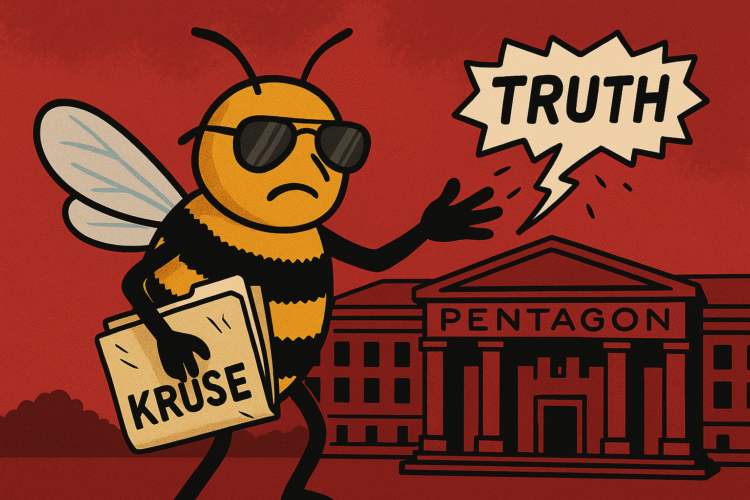
On August 21, 2025, Defense Secretary Pete Hegseth sent Lt. Gen. Jeffrey Kruse packing. Kruse, director of the Defense Intelligence Agency (DIA), was dismissed following a leaked preliminary assessment of June U.S. strikes on Iranian nuclear facilities—which estimated those strikes set Iran’s program back only a few months. That detail, little more than an inconvenient truth, contradicted President Trump’s public claim that the nuclear sites were “completely obliterated,” and infuriated the White House. Hegseth explained that Kruse had suffered a “loss of confidence.” Also shown the door: two senior Navy leaders, marking another purge in the administration’s wide-sweeping campaign to replace inconvenient facts with loyalty. Critics, including Sen. Mark Warner, warned this was more proof of intelligence politicization.
Welcome to the Pentagon’s version of The Purge: Intelligence Edition—where truth is not only unwelcome, it’s an offense.
Chapter 1: The Intelligence That Dared to Whisper Truth
Lt. Gen. Jeffrey Kruse wasn’t a Watson-Burke personality. His DIA was all facts, satellites, cables, and sober assessments. In June, analysts quietly concluded: “Iran’s program isn’t destroyed—just delayed by a few months.” Not sexy. Not bombastic. Not worthy of a press release. But correct. This whisper of honesty collided with post-strike euphoria crafted on cable news. Trump cheers “completely obliterated,” Netanyahu echoes, leading to a cognitive dissonance for the ages. Kruse’s assessment was as close to nuance and accuracy as the intelligence community dares, and for that—he was toast.
Chapter 2: “Confidence” as Code for Compliance
When Hegseth cited “loss of confidence,” he wasn’t protecting secrets—he was protecting spectacle. Administration doctrine is clear: leadership must echo the public messaging, not contradict it. Intelligence that fails to sing from the political hymnal risks being stripped of duty, not because competence faltered, but because loyalty diverged. Kruse had the audacity to be true. That, in this era, is a career-ender.
Chapter 3: The Pentagon Talent Show—Now Featuring Truth’s Exit
Kruse’s departure is not an isolated reassignment—it’s a choreographed stair-step performance in trust realignment. Earlier this year, NSA head Timothy Haugh was shown the door; days ago, DNI Tulsi Gabbard revoked dozens of security clearances. The message echoes through DoD hallways: Think what we want, or pack your duffel. Truth isn’t protected—it’s assessed for political alignment.
Chapter 4: When Intelligence Becomes Political Theater
The leak and fallout reveal the Pentagon has turned into a theater where intelligence doesn’t inform policy; policy dictates intelligence. This is performance art, not national security. A soldier who reads maps becomes disposable. A projection of Iran’s nuclear resilience becomes a rift, and not allowed to slide. That rift was too large to ignore—so they cut its source.
Chapter 5: Kruse, Public Trust, and the Price of Accuracy
Kruse wasn’t the kind of leader who went viral. His value was credibility. Senators like Warner warned that purging such figures wounds trust. How can the public trust a Pentagon that preaches veracity, then dumps its fact-teller? In this administration, the last thing you want defending our secrets is someone who believes secrets matter more than applause.
Chapter 6: The Irony of Loyalty Firing Truth
News reports say Kruse was asked to step down because he “angered the president.” Let that sink in. It’s ironic: a defense secretary fired a general for giving the exact kind of intelligence brief he was valued for. Because when heroes don’t repeat the messaging watermark, they become enemies. Kruse was caught between war realities and political optics. He chose reality—and that’s heresy now.
Chapter 7: The Faerie’s Winged Observation
The stinger? When intelligence ends, competence collapses. A chain of command is only as strong as the truth we trust. If loyalty is the benchmark, what we build is only a palace of propaganda. Kruse didn’t fail intelligence—intelligence failed him. And by extension, it failed the public.
Final Word
This administration doesn’t just slope upward on a wave of narrative; it pushes truth off the cliff. The Kruse firing reads as a turning point—not in defense strategy, but in American moral direction. When truth cannot survive, only illusion remains. And illusions may fly on flags, but they fall on consequences.
Would you like a banner image to accompany this? Imagine a bee wearing aviator sunglasses, crumpled KRUSE file in one hand, truth cartoon bubble vanishing into the wind, Pentagon backdrop turning red.