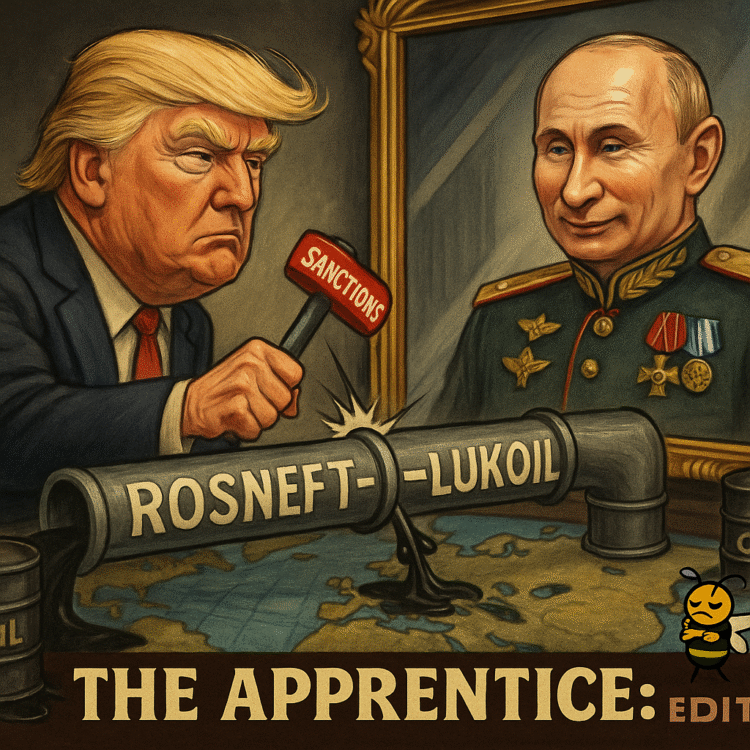
It took three years, two wars, and one canceled summit for America’s Strongman-in-Chief to finally pretend to stand up to his idol—and even now, it looks more like performance art than policy. The White House has slapped sanctions on Rosneft and Lukoil, Russia’s two biggest oil arteries and the bankroll of Vladimir Putin’s imperial cosplay. Treasury Secretary Scott Bessent called it “a bold step toward peace.” Everyone else called it what it is: theater.
Because if there’s one thing Donald Trump loves more than money, it’s the mirror.
The Sanctions Heard Round the Spin Room
Let’s start with the headline: the United States, at long last, has “blacklisted” Rosneft and Lukoil. It’s the kind of move that makes State Department lawyers pop champagne and autocrats shrug. Officially, the sanctions freeze dollar transactions, choke off insurance, and send oil traders scurrying into compliance panic. Unofficially, they mark the first time Trump has let his name appear next to the word sanctions in a sentence about Russia without immediately adding, “It’s very unfair to Putin.”
But don’t mistake this for courage. Trump didn’t wake up one morning and decide to punish Moscow. He woke up and decided to look tough while maintaining the plausible deniability of a man auditioning for a history book he’ll never read.
His relationship with Putin has always been less geopolitical than psychological. Trump doesn’t serve Putin so much as studies him. The former KGB officer rules by fear and propaganda; Trump rules by imitation. Putin jails journalists; Trump just bans them from press briefings. Putin changes constitutions; Trump prefers the shortcut—just denying election results.
So when Bessent announced these new sanctions as a “decisive escalation,” what he really meant was “the boss wants to look presidential while keeping the fan club in the Kremlin.”
The Trump–Putin Pas de Deux
Remember, this isn’t Trump’s first flirtation with authoritarian foreplay. He’s spent his political career genuflecting before strongmen. Kim Jong Un got “beautiful letters.” Xi Jinping got trade flattery wrapped in tariffs. But Putin—Putin got devotion.
Trump has bowed to him in Helsinki, blamed America for Russian hacking, and described him as a “genius” for invading a neighboring democracy. Every time Putin flexes, Trump swoons. Every time Putin kills an opponent, Trump admires the efficiency. Every time Putin violates international law, Trump takes notes.
It’s not loyalty born of leverage—it’s envy. Trump doesn’t dream of Moscow’s money; he dreams of Moscow’s impunity.
The Summit That Never Was
The supposed trigger for this “bold action” was the abrupt cancellation of a Trump–Putin summit. The White House claimed “scheduling conflicts.” Translation: even Fox News couldn’t spin another Mar-a-Lago meet-and-greet between the “President of the Free World” and his favorite autocrat.
Instead, the administration needed a gesture—something to show America wasn’t fully a subsidiary of the Russian Federation. Enter the sanctions package, stage right.
Rosneft and Lukoil, the twin pillars of Russia’s oil empire, became the perfect props. Bessent stood at a podium, straightened his tie, and declared that America was “holding Russia accountable.” Meanwhile, Trump reportedly told aides he didn’t want to “go too far.”
That’s Trumpian foreign policy in a nutshell: swing a hammer with one hand, send a valentine with the other.
The Fine Print of “Toughness”
OFAC (the Treasury’s sanctions arm) dutifully announced the new restrictions: dollar transactions frozen, U.S. persons banned from dealings, assets locked in the digital vault. But then came the fine print—“narrow general licenses” to allow “orderly wind-downs.”
In English: “You can keep doing business with these guys, just call it something else.”
It’s the same Trumpian compromise he’s always struck with power. Condemn the act, enable the actor. Punch with one hand, wink with the other. It’s the foreign-policy equivalent of a non-disclosure agreement—strict on paper, meaningless in practice.
So while the markets panicked and oil prices spiked, the real players—the brokers, insurers, and shippers—found their loopholes faster than Trump finds a microphone.
Putin’s Favorite Puppet Show
Putin’s reaction was predictably muted. Why bother getting angry when your apprentice is performing the role you wrote?
In Moscow, the sanctions were met with eye-rolls and accounting adjustments. The Kremlin has seen this movie before: big talk, little teeth. They know the Trump White House better than most Americans do. They understand that his “America First” nationalism always seems to involve Russia first in line.
When Trump says he’s being “tough on Putin,” what he means is he’s staging a little domestic theater to quiet the Senate hawks while leaving the back channels open for flattery, favors, and future deals.
Putin doesn’t fear Trump’s sanctions. He fears Trump’s attention span running out.
The Psychology of Submission
This isn’t about kompromat or secret wire transfers in the night. It’s about mimicry. Trump sees in Putin a distilled version of everything he wishes he were: disciplined, ruthless, immune to shame.
Where Putin conquered his system, Trump only ever rented his.
Putin reshaped the Russian state around his ego. Trump tried to do the same with the United States, only to discover that our institutions, though battered, still occasionally function. It must infuriate him that Putin never needs to ask permission, never faces prosecutors, never loses a court case.
So every bow, every deferential phrase—“He’s a strong leader,” “He loves his country,” “Wouldn’t it be nice if we got along?”—isn’t weakness. It’s aspiration.
Trump doesn’t want to beat Putin. He wants to be Putin, just with better resorts and worse spelling.
The Stagecraft of Sanctions
Which brings us back to the great announcement: a “major escalation,” a “turning point,” a “bold step.” The White House lit the press room like a Broadway revival of The Man Who Found His Spine.
Bessent played the role of the reasonable technocrat, explaining how the sanctions would “pressure Russia toward a ceasefire.” Trump, meanwhile, treated the whole thing like a casting call. “We’re doing big things,” he said. “No one’s ever sanctioned like this before.”
It’s a familiar pattern: declare victory before doing anything, then hope the headlines last longer than the impact.
Meanwhile, in Reality
Markets reacted instantly. Oil traders freaked out, insurers pulled coverage, freight rates spiked, and the “shadow fleet” of ghost tankers—those untraceable ships with fake transponders—grew bolder.
In other words, chaos.
But chaos isn’t a side effect; it’s the point. Trump thrives on it. For him, unpredictability isn’t a flaw—it’s a marketing strategy. The global energy market is just another episode of The Apprentice: Geopolitics Edition.
Some analysts tried to praise the sanctions as a “real pivot.” Others noted the obvious: that this is the first Russia-related policy of Trump’s presidency that wasn’t designed to help Moscow.
And even then, you can see the fingerprints of restraint. The licenses. The loopholes. The carefully phrased “wind-downs.” Every escape hatch big enough for a tanker to sail through.
Trump’s foreign policy always has a backdoor—and it always leads to the same destination: Vladimir Putin’s approval.
The Imitation Game
You can track the imitation in their rhetoric. Putin rails against “decadent Western elites.” Trump does the same, just with fewer syllables. Putin frames democracy as weakness; Trump calls it “rigged.” Putin weaponizes nostalgia for empire; Trump merchandises nostalgia for a past that never existed.
Both men preach grievance as gospel and wrap it in flags. Both despise journalists, courts, and experts. Both equate their personal interests with national destiny.
The difference is competence. Putin turned his cult of personality into a functioning autocracy. Trump turned his into a newsletter and a line of NFTs.
But you can see the yearning. When Trump looks at Putin, he sees what he might have been if America had no guardrails—and no Congress, courts, or comedians to tell him no.
The World Watches the Bromance Falter
European allies are playing along with the sanctions theater, mostly out of exhaustion. “We welcome the U.S. leadership,” said one EU official, carefully avoiding eye contact with history.
Brussels is tightening its own shipping and insurance bans, Germany is recalibrating LNG timelines, and France is practicing its diplomatic shrug. The choreography is perfect—everyone pretending Trump just did something heroic instead of something overdue and half-hearted.
The real applause is coming from Kyiv, where officials are smart enough to cheer every Western gesture, however hollow. “At least he didn’t call Putin a genius this week,” one Ukrainian diplomat quipped. “That’s progress.”
Ghost Ships, Ghost Spines
As the sanctions roll out, the pattern is clear. Oil prices surge. Banks retreat. Traders panic. Ghost ships multiply. The global economy becomes a hall of mirrors—each reflection a little darker, a little faker.
And through it all, Trump watches cable news coverage of his “decisive action” like a man grading his own reality show. He doesn’t care whether the sanctions work. He cares whether they trend.
Because to Trump, the presidency isn’t an institution. It’s a brand. And Putin is the only other man alive who’s managed to turn tyranny into a lifestyle.
Ceasefire or Selfie?
Bessent insists this is all about leverage—a push toward peace. But when Trump talks about peace, he means photo ops. He doesn’t want to broker an end to war; he wants to host one. He wants a handshake, a camera flash, and a crowd that chants his name while the missiles keep falling somewhere off-camera.
Putin understands that perfectly. It’s why he’s never really feared Trump—only admired his showmanship. Theirs is a symbiotic relationship built on projection. Putin performs power; Trump performs the performance of power.
Closing Section: The Mirror and the Mask
The new sanctions won’t end Russia’s war, but they will extend Trump’s illusion—that he’s a strongman among strongmen, a dealmaker among tyrants, a ruler unbound by the rules he once swore to uphold.
He isn’t Putin’s puppet. He’s his understudy.
Every bow, every deferential nod, every performative sanction is an act of flattery disguised as statecraft. It’s not treason—it’s theater. The tragedy is that the stage is the world, and the ticket price is measured in lives and barrels.
When the cameras cut, Putin counts his profits, and Trump counts his clicks.
The sanctions hammer has finally dropped, but like everything else in the Trump era, it’s made of papier-mâché and aimed at the mirror.