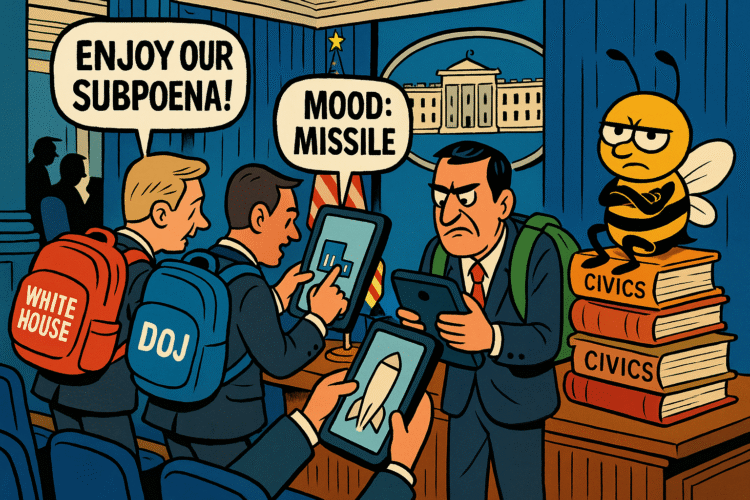
Somewhere between the press briefing room and a Fortnite lobby, the machinery of American governance appears to have been replaced by a collection of preteens armed with official seals, a ring light, and an unhealthy relationship with social media validation. The official feeds of the White House, DOJ, Pentagon, and assorted Cabinet offices now read less like instruments of a global superpower and more like a thread from the cafeteria table where hall monitors trade insults and screenshots. They have the badges, but not the gravitas. They have the followers, but not the sense.
It is a strange new era when the institutions designed to preserve democracy’s solemn rituals have decided to cosplay as Twitter comedians, flinging “enjoy your subpoena” barbs at reporters and ratioing constituents from verified .gov accounts. If the Founders had foreseen this, they might have included an Article in the Constitution explicitly prohibiting “thirstposting in uniform.” Instead, they left us the Hatch Act, which—if the latest posts are any indication—now serves primarily as the nation’s most ignored Terms of Service.
The Typology of Troll Governance
Let us begin the autopsy with the six archetypes of this meme-industrial complex. First comes Meme-Governance, the new lingua franca of the state. Agencies now communicate with reaction GIFs, photoshopped rivals in diapers, and “ratio achieved” self-congratulations. Policy debates are replaced by SpongeBob memes. Diplomacy by WWE smack talk. One Defense account recently quote-tweeted a journalist with a looping GIF of a missile launch captioned “Mood.” The message was clear: the nation’s warfighting apparatus has a content strategy.
Second, Playground Legal Threats. Where attorneys once issued statements, we now get tweet-length tantrums. “Enjoy your subpoena,” one Justice official snarled at a watchdog organization. It was not satire, merely civic puberty. The power of the state condensed into a reply-guy flex, mistaking a court order for a mic drop. Never before has prosecutorial discretion been so heavily filtered through the temperament of someone who still draws S’s on their notebook covers.
Third, Stochastic Smear Campaigns. The modern agency account functions as a bully pulpit in the most literal sense. Quote-tweet pylons are launched against journalists, whistleblowers, even civil servants who dare question the line. The mob forms, the mentions fill, and suddenly the machinery of government has become a weaponized fandom. “Transparency,” it seems, now means posting your enemies for sport.
Fourth, Clerical Nihilism. Posts vanish faster than press freedom in an autocracy. One moment, the Pentagon’s official account calls a critic a “loser.” The next, it’s deleted and replaced with a new one—edgier, more defiant. The Federal Records Act, which requires preservation of official communications, has apparently been reinterpreted as “if it doesn’t vibe, it doesn’t survive.”
Fifth, Fake Macho National-Security Banter. Gone are the days of dignified restraint; in their place stand posts that sound like a Mountain Dew commercial written by a teenager who just discovered geopolitics. Official Defense accounts now refer to foreign leaders with playground nicknames and respond to crises with “let’s roll” memes. One might think the nukes are armed with hashtags.
Finally, Authoritarian Cosplay, where visuals of the “Leader as King” or “Savior Warrior” are pushed through taxpayer-funded channels. Posts drenched in sepia filters depict the President staring into the horizon while “Ave Maria” swells in the background. Others feature vomit-emoji “policy” toward entire communities. It’s not governance; it’s a mood board for a dictatorship run by marketing interns.
The Norms They’re Torching
All of this might be funny if it weren’t metastasizing through the veins of institutions meant to outlive personality cults. The Hatch Act, the quaint old rule that forbids political activity on the taxpayer’s dime, has been reduced to a trivia question. The Department of Justice’s media-contact guidelines, which once required communication to flow only through official filings, now function as a dare. “Speak through court documents,” the policy says; “speak through memes,” the practice replies.
The Department of Defense’s nonpartisanship rules—designed to keep the military out of politics—are treated like optional DLC. The Federal Records Act and Presidential Records Act, both mandating the preservation of official communication, are quietly shredded each time a post disappears without archival trace. And the basic expectation that government communications exist to inform the public, not harvest engagement, has been replaced by the same algorithmic hunger that drives influencer culture. Public service has become public relations by other means.
The Civics Harm
The civic rot from this transformation is not theoretical. When official accounts mock citizens, it chills speech. Who wants to ask a hard question when the next “ratio” might feature your name? When the Pentagon trades barbs with journalists, it corrodes the fragile wall between civil and military spheres. When the DOJ’s verified feed dunks on defendants mid-trial, it poisons juries and invites sanctions. When agencies treat litigation like content, they don’t just undermine their cases—they compromise the rule of law itself.
Imagine being a career civil servant trying to explain to a federal judge why your agency’s verified account just posted an AI mashup of the opposing counsel in clown makeup. The affidavit would read like satire until it didn’t.
Receipts: The X Files
For those keeping score at home, here are the new civic red flags to watch for on the digital playground.
Officials using slurs or demeaning stereotypes about protected classes? Check.
Taunting litigants while cases are pending? Routine.
Posting manipulated media from official accounts? Practically policy.
Threatening budget cuts to critics? Tuesday.
And the fallback when cornered? “It was a joke.”
The “it was a joke” defense has become the duct tape of governance—a quick patch on the crumbling dam of professionalism. Never mind that every joke comes with a target, and in this case, the target is often the public itself.
The Structural Why
Why does this keep happening? Because qualification has become optional. The governing philosophy of the moment can be summed up as “loyalty over literacy.” Appointees are chosen not for competence but for their ability to mimic the President’s digital bravado. The result: agencies run by people whose only management experience is moderating a Facebook group.
Add to this the oxygen of the attention economy, where cruelty trends faster than clarity, and you get a bureaucracy addicted to humiliation theater. A presidential brand that prizes chaos over competence has transformed once-neutral agencies into engagement farms. The reward structure of virality has replaced the ethics of governance.
Aides who used to prepare talking points now prepare meme templates. Briefing books are replaced by follower analytics. The arc of the moral universe may bend toward justice, but the arc of the algorithm bends toward outrage.
The Rulebook They Pretend Doesn’t Exist
Every few weeks, an Inspector General reminds them that yes, a rulebook still exists. There are Standards of Conduct that prohibit officials from using government resources for personal attacks. There are Ethics Pledges signed upon appointment. There is Inspector General jurisdiction over communications abuses. There are agency social-media policies outlining tone, accuracy, and record retention. There are the Presidential and Federal Records Acts, binding even when a post lasts only ten minutes. There are even ancient statutes like the Logan Act and Smith–Mundt Act, which warn against domestic propaganda disguised as official communication.
But those reminders are quickly drowned out by the dopamine rush of engagement. Compliance is boring; trolling gets numbers. The irony is that while these officials perform defiance, they remain terrified of irrelevance—the true mortal sin in a culture built on visibility.
The Consequences (So Far)
Already, the cleanup crews are forming. FOIA offices now field requests for “deleted memes.” Whistleblowers document politicized comms. Judges cite prejudicial statements when sanctioning agencies. Inspector Generals issue quiet referrals. And career staff—those who once believed in the dignity of public service—pack up and leave, unwilling to work in a government that thinks governance is just another content pillar.
Each deleted post becomes a ghost in the record, a sign of how unserious the stewards of power have become. The federal archive used to tell the story of a nation’s deliberation; now it reads like a Tumblr feed with executive privilege.
Toward Adult Supervision
It doesn’t have to stay this way. Imagine a government that behaved like it believed its job mattered. One with career Public Affairs Officers reviewing posts before they went live. One where counsel sign-off was required for any content referencing litigation. One where every appointee attended a civics boot camp called “This Is What a Record Is.” One where archived audits tracked official feeds for compliance. One with a bright-line ban on personal attacks from .gov accounts. One simple rule could guide them all: if you wouldn’t say it under oath or in a filing, don’t post it with a seal.
It’s a modest proposal for a government that seems allergic to modesty. If the republic must communicate through memes, at least let them be grammatically correct and legally compliant.
The Final Irony
The joke, as always, writes itself. If a bunch of 12-year-olds really did run these feeds, the grammar might improve. They’d know the difference between a meme and an affidavit. They might even spell-check before launching an international incident. But the deeper punchline lands harder: when a government adopts the voice of the troll, it inherits the troll’s audience, not the citizen’s trust.
A republic’s tone is a public good. When its highest offices treat communication as combat and discourse as content, they stop governing and start performing. And while they farm ratios, the country pays the price. The comment section may cheer, but the institutions decay quietly underneath, another casualty of the algorithm that promised connection and delivered corrosion instead.
SECTION TITLE: The Silence of the Adults
The tragedy of this moment is not the noise but the absence. The adults who should intervene are silent, drowned out by the feed. The lawyers who know better look away. The generals shrug. The civil servants hide in locked drafts. And the public, overwhelmed, stops expecting dignity altogether.
This is how decline feels—not as collapse but as constant posting. The institutions that once upheld restraint now chase engagement metrics like influencers at a brand retreat. Every ratio celebrated is a wound to legitimacy. Every taunt leaves the Constitution a little thinner.
If governance has become performance, then citizenship becomes spectatorship. We watch our government meme itself into irrelevance, laughing until the laughter curdles into exhaustion. Because somewhere beneath the noise, the real work—justice, policy, diplomacy—waits like an unread message. And nobody’s checking notifications anymore.