Privately funded, process-dodging, and Rose Garden–erasing: a donor-built venue turning the people’s house into a pay-to-play stage while democracy waits behind the construction fence.
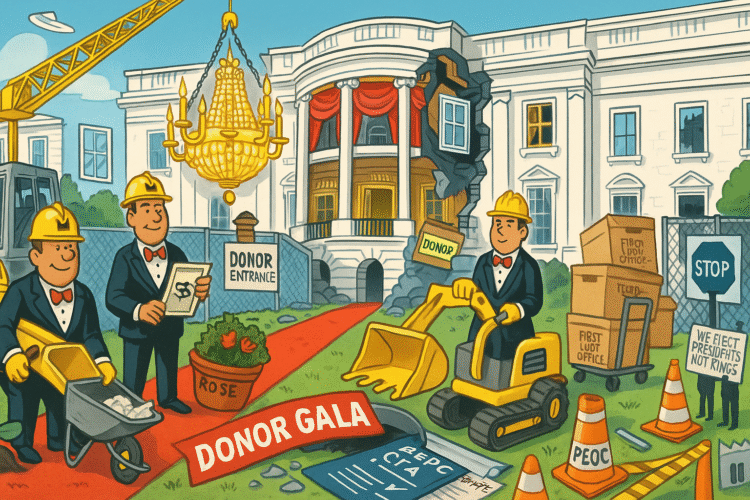
The White House is supposed to be a workplace. Not a logo. Not a set. Not a gold-plated stage for a man who buys property and slaps his ugly name on it like a sticker you cannot peel. The East Wing is the modest half of that workplace, the place that holds the visitor entrance where schoolkids press palms to railings, the theater where memory gets framed, the social office that turns hospitality into statecraft, and the hardened rooms beneath that exist because the world is not kind. It is not a blank space. It is a map of functions that make a republic run without a drumroll.
We are told to admire demolition as if demolition were vision. Crews are ripping out facade sections and windows while the federal design process is still looking for its seat. The National Capital Planning Commission and the Commission of Fine Arts have not finished the review that exists to slow the impulse of any temporary king. Yet the sledgehammers hum. We are handed talking points about a privately financed ballroom near ninety thousand square feet, a quarter billion dollars of donor oxygen, a showpiece with capacity that creeps toward a thousand. We are told the First Lady’s offices will be displaced only for a moment and then modernized, a word that always sounds like progress when you are not the one packing boxes.
This is not modernization. It is desecration in a tuxedo. A bulldozer is not tasteful because the check cleared.
The donor story is a fog bank rolling in on purpose. The press is fed hints about corporate titans and defense-tech magnates. The public is told to be grateful for generosity that arrives without a ledger. In any other civic project of this scale, names would be etched in stone by lunch. In this building, at this time, the names matter more. Not for applause. For the audit of influence. A ballroom is a magnet for access. A chandelier is a down payment on a conversation that should never be for sale. If the people who fund that magnet do not want their names said out loud, they should not be hanging lights in a house that belongs to the people.
The timing is an insult that wears a grin. There is a shutdown mood. There are wages that stagger. There are federal families that do math at kitchen tables while politicians treat paychecks like poker chips. Into that room walks an announcement that a privately bankrolled palace wing will rise where a working building stands. The phrase no taxpayer dollars is floated like a lily pad that can carry the weight of this project. It cannot. Not when the cost is paid in precedent, process, and the conversion of public space into a donor salon. The bill will arrive as a weaker norm the next time any president with rich friends wants to renovate the soul of the place.
Preservationists are not being precious. The East Wing is not a vanity shelf. It is the front door the country uses. It is the theater that makes ritual possible without turning it into farce. It is the social office that knows which handshake prevents which embarrassment. It sits over a bunker because the building has a memory that includes sirens. You cannot carve a ballroom out of that envelope without convincing the country that history and security will not be traded for spectacle. No one has done that convincing. They have said modernize and usable and very white, the same vocabulary that defended paving a garden into a limestone deck because heels sink and protocols sweat.
Now say the quiet part out loud about that garden. The Rose Garden is not decoration. It is lineage. The bones of it trace back to Ellen Wilson’s early twentieth century plan for a West Garden and were reimagined in 1962 when President Kennedy asked Rachel “Bunny” Mellon to design a formal space that married European geometry to American light. It has been a green anteroom to history ever since. Treaties have been sketched in the shade there. Supreme Court nominees have introduced themselves there. Teachers of the year and championship teams have stood with a nation there while the wind made confetti out of leaves. Its beauty was not a luxury. It was a statement that power could share a lawn with weather and that ceremony could coexist with living things that refuse to obey a script.
When the lawn was traded for limestone and the familiar parterres pared down into a gleaming event deck, the official explanation was comfort and usability. No more soaked hems. No more prayers for dry turf. The photographs brightened. The temperature of the place rose. Protocol officers exhaled and gardeners mourned. We were told the essence remained. But essence is carried in small facts. The sound of shoes on grass. The moment a bee drifts through the frame and a child on a tour remembers the building lives outside as well as in. The garden taught presidents to share their backdrop with something they did not control. That lesson matters. Replacing the conversation with certainty was the first hint that someone had mistaken a living room for a showroom.
Defenders love to say that the United States deserves rooms that reflect its stature. Diplomatic theater requires scale. State dinners require comfort and light. The East Room chafes. The guest list grew with the century. We should not be eating diplomacy in a room that feels like a hallway. All of that could be persuasive if the people making the case respected the rules that bind their appetites. They do not. Demolition has started while review bodies are still clearing their throats. The message is simple and violent. Process is decorative when money is private and the man in charge wants a bigger room.
This is how palaces behave. A republic speaks differently. A republic begins with drawings in daylight and waits for the referees we hired to finish their work. A republic knows that beauty without law is vandalism with better lighting.
Numbers are not innocent here. Two hundred to two hundred fifty million dollars is not pocket change, even if the pockets are deep. That sum would build a small hospital wing, fix roofs on a dozen schools, or fund case adjudicators so asylum applicants are not turned into a backlog with names. Ninety thousand square feet is not a touch up. It is an annex that swallows the scale of a wing built for work. Seating that nudges toward a thousand converts a workplace into a venue. The aspirational timeline that teases ribbon cuttings long before the semiquincentennial arch leaves the model shop reads less like confidence and more like contempt for oversight.
The operational cost is not glamorous, which is what makes it so revealing. East Wing staff scatter into temporary billets. Anyone who has ever managed a team understands what that means. Work disappears without leaving. Files move and lose fidelity. Protocol becomes improvisation. Aides become commuters inside their own building. Contractors thread demolition around a complex where every bolt has a backstory. Security officers juggle new choke points. Preservationists triage. Procurement lawyers write memos that will be ignored by the people already pulling up floors. It is a circus where the elephants insist they are gentle.
Washington’s most important costs are cultural. If private checks can sprint past process once, they will try again. If disclosure can trail behind bulldozers once, it will be treated as a courtesy, not a requirement. If commissions charged with planning and aesthetics look ornamental while the teeth do their work, they will become ornamental. The precedent here is not a ballroom. It is the practice of saying our friends will pay and therefore you will wait while we take.
We are also owed a reckoning with the obvious conflict. A privately funded grand room inside the most symbolic workplace in America will be a magnet for fundraising. You can scold the suggestion if you enjoy pretending. You cannot deny physics. The chandeliers will attract donors who want proximity and the White House social apparatus will provide it. The old sentence that tried to guard us from this exact moment is simple. Appearances matter. They are not a court joke. They are how the public learns what is allowed.
The counterargument says no law forbids a philanthropic ballroom. The answer is older than law. Stewardship is the duty that keeps power from using sacred space to serve private glamour. If a president wants to build a venue with donor money for private splendor, there are hotel ballrooms with ceilings high enough to hold his vanity and floors sturdy enough to carry his name without cracking the meaning of the place where he works.
People ask why this matters when there are wars and storms. It matters because symbolism is not decoration. It is instruction. The White House teaches as much as it governs. It tells visitors what belongs in a republic and what does not. A palace aesthetic tells a rotten story. It says size and shine are virtues in themselves. It says the public is an audience. It says history is furniture to be rearranged whenever the host changes. It says process is something small men hide behind and large men stride past. A lesson like that does not stay in the building. It leaks into the agencies and the streets.
There is another building under this one. The bunker exists because the presidency is not a pageant. It is responsibility in a dangerous world. A White House that forgets that truth becomes a costume department. A president who buys property and brands it like luggage is the last person who should be allowed near the bone of this place. He loves rooms that flatter him and hates rooms that constrain him. He tears out guardrails and calls it renovation. He treats rules like tacky drapes that block his light. He wants a ballroom because he wants a mirror large enough to mistake for a nation.
The law will try to keep up. Oversight committees will tug at donor lists. Preservation boards will demand drawings and guarantees. Security professionals will ask about blast lines and havens and the way a heavy roof sits above a hardened space. Watchdogs will map a tangle of permits and ask why the tractors were already idling when signatures were still wet. Some of that pressure will slow steel. Some will be swatted away by the same phrase that keeps getting repeated. No taxpayer dollars. Every time you hear it, translate it correctly. No public money. Significant public cost.
Here is what a sane path would look like. Pause demolition. Publish the donors. Insist on full review by the commissions we created to protect this capital from gusts of ego. Commit to safeguarding every heritage function of the East Wing, including the visit that turns civilians into citizens and the theater that makes a nation feel like itself. Show the plans. Let a cross-branch panel inspect them for security and stewardship. Prove that modernization is more than a mood. If the case is persuasive, build a room that serves the whole country. If it is not persuasive, rescind the invitation to vanity and keep the building honest.
The current path is not sane. It is a flex disguised as philanthropy. The excuse is a stack of checks from human beings who want their fingerprints on the most visible ceiling in America. Some will want nothing more than a plaque. Some will want the oxygen of proximity. All will be written into a story about how a republic allowed its most charged workplace to become a set. That story will not end where the ribbon is cut. It will ripple forward, into the next administration that decides the Oval would look better if it were oval plus. Into the next donor class that decides the Cabinet Room should seat four times as many while the public is told to clap because elegance has arrived.
I will not clap. The White House is not a hotel. The East Wing is not a mall. The presidency is not a brand that needs a brighter launch. The public is not lucky to be allowed near a chandelier. When a leader with a history of buying buildings and sticking his unattractive name on them decides to remake the one building that does not belong to him, the only correct response is refusal. Refuse the logic. Refuse the speed. Refuse the lie that private money is a disinfectant. Refuse the suggestion that history can be bulldozed if the check is large enough and the stone is pale enough to hide the bruise.
If you want a test that fits on an index card, here it is. Does the project increase public ownership, public access, public safety, and public trust. Or does it increase private access, executive theater, donor leverage, and presidential vanity. The answer decides whether you are stewarding a country or redecorating a throne room.
Plenty of renovations have respected that line. They improved security. They repaired structure. They updated systems that could fail. They honored rooms that teach us who we are. This is not that. This is a man who never met a surface he did not want to sign trying to convert a workplace into a stage he can own with other people’s money and a city’s compliance.
There will be ribbon cuttings in this story. There will be speeches about elegance and stature. There will be statements that insist the commissions were respected and the staff are thrilled and the history is alive and the donors are patriots. None of that will change the first principle that a republic ignores at its peril. The people are the owners. The building is the instrument. The government is the tenant. The tenant does not rip out the walls to impress his guests. The tenant does not skip the lease terms because his friends brought champagne.
We do not need a palace to be taken seriously. We need institutions that prefer boring honesty to impressive lies. We need a White House that remembers a child’s hand on a rail and a staffer’s eyes in a hallway and a bunker that exists because gravity is real. We need the East Wing to remain what it was built to be. A place to host a public, not to hide it under crystal.
If the bulldozers keep moving, if the names stay hidden, if the ballroom rises on process that was treated like an inconvenience rather than a covenant, then the country will learn what it costs to let a builder of gaudy monuments redecorate a democracy. The bill will come due in rooms that are easier to enter with a check than with a vote. The bill will come due in a precedent that tells future presidents to think of the White House as a canvas for their taste and a funnel for their friends. The bill will come due when we realize too late that no taxpayer dollars did not mean no public debt.
It is not too late to stop this. It is not too late to say the name on the tower does not get to carve itself into the house. The answer is simple. Follow the process that protects us from appetite. Publish the names. Protect the history. Respect the function. If that feels unglamorous, good. Democracy is an unglamorous craft. Palaces are for people who need to be large. The White House is for work. The East Wing is for the public. Keep it that way.