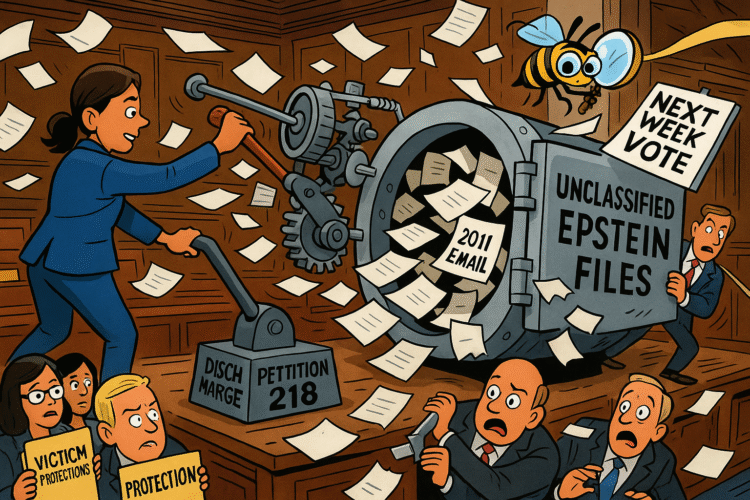
Congress rarely moves with speed unless it is the speed of decay. But once in a generation, the planets align, a freshman gets sworn in on a Friday night, and the House of Representatives actually does something explosive by accident. This week, that accident arrived in the form of newly sworn in Representative Adelita Grijalva, whose oath had been delayed so long by Speaker Mike Johnson’s recess schedule that she might as well have taken it by candlelight during a seance. Instead, the moment she placed her hand on the Bible, she became signature number 218 on a bipartisan discharge petition, triggering the congressional equivalent of a fire alarm you cannot unpull.
The alarm in question demands that the Justice Department hand over unclassified Epstein records within a defined window, with guardrails to protect victims. Congress, having spent decades insisting it has no idea how anything works, suddenly discovered Rule XV and realized it can bypass leadership with enough signatures. It was like watching a mall Santa remember he technically has the nuclear codes.
The announcement hit the Hill within minutes. Johnson had no choice but to schedule a vote, because discharge petitions are Congress’s one form of self respect. You get the signatures, you get the vote. The Founders did not foresee social media, universal background checks, or the phrase “Trump-era unclassified Epstein tranche,” but they did anticipate that sooner or later the House would need a button that leadership could not tape over.
Once Johnson confirmed that the vote would come next week, lawmakers hurried to perform their best shocked faces, as if none of them had signed the petition themselves. Democrats declared victory. Republicans looked like they had just been told the C-SPAN cameras are now motion-activated. Meanwhile, victims’ advocates, who have been living in reality the longest, quietly asked for audit trails, chain of custody, and an assurance that the documents would not arrive blacked out with the verve of a teenage diary.
All of this unfolded at the same time that newly surfaced 2011 emails showed Jeffrey Epstein telling Ghislaine Maxwell that Donald Trump was “the dog that hasn’t barked,” that Trump “spent hours” at his home with a redacted victim, and that Trump “knew about the girls.” These were followed by 2019 comments Epstein made to Michael Wolff, again noting that Trump “knew.” The emails arrived with the kind of timing known in politics as “deeply inconvenient.” The very same week the House accidentally forced itself to act on Epstein records, the universe delivered a tranche of Epstein’s own assessments that Donald Trump was less of a bystander and more of a looming subplot.
Democrats read the emails and reached for highlighters. Republicans read them and reached for spiritual amnesia. The White House denied everything with the speed of a parent insisting their child does not bite while the child is actively biting.
The interplay between the discharge petition and the emails created the rare political moment where Washington behaved like a functional institution. Not a moral one, but a procedurally competent one. For the first time in months, members of Congress had to answer questions with verbs. They could not hide behind “ongoing negotiations,” “the Senate must act,” or “I have not read the bill,” because the bill was ten pages long and the petition was public. Anyone who had signed it had to own it.
That is the magic of discharge petitions. They are the congressional equivalent of a sobriety test. You either voted to open the trunk of the car or you did not. Once the signatures hit the magic number, leadership loses the wheel. There is no parliamentary hedge, no secret side deal, no hastily inserted amendment to stuff the genie back into the bottle. It is democracy’s version of a forced confession.
The timing was its own plot twist. Grijalva’s delayed swearing in meant she became the deciding signature only after days of Republican document dumps that tried to get ahead of the petition’s impact. Some GOP members released emails, timelines, and memos that looked less like transparency and more like pre litigation damage control. You could practically hear the staffer energy behind them, the kind produced by three cans of Monster Energy and a supervisor yelling “post it now or we are all subpoenaed.”
Once the Epstein comments about Trump surfaced, conservative influencers declared them smears while progressive lawyers requested authentication logs. Nothing in the emails has yet been debunked, which is why they terrify everyone professionally adjacent to them. Epstein was many things, but he was not known for inventing new vocabulary words. When he wrote that Trump was the dog that had not barked, he described something he believed to be strategically important, not a flourish. In 2011, he thought Trump was keeping quiet in a way that mattered. In 2019, he thought Trump knew the nature of his operation. It is the kind of consistency that makes lawyers sweat in their sleep.
Against this backdrop, the House is now preparing to vote on whether to compel the Justice Department to turn over unclassified Epstein documents within a set number of days. The authority is not unlimited. Congress cannot unmask victims or direct prosecutors to reveal privileged material. But it can demand unclassified files, redacted only to protect survivor identities, and require status reports on compliance. It can also force the executive branch to say in writing what it has, where it is stored, and whether anything has been quietly shifted to avoid sunlight.
This is where civics intrudes on vibes. The House has real power here, but not infinite power. It can order. It cannot enforce. That is the attorney general’s job. The courts sit between them like exhausted chaperones at a school dance, deciding whether the executive needs to comply with legislative curiosity or whether Congress has overstepped into prosecutorial space.
The petition itself is a roadmap. It triggers the clock. It bypasses the Speaker’s preference not to schedule awkward votes. It also binds the floor to hold the vote next week, even if members flee to avoid it. You cannot outrun a discharge petition. It is the legislative version of GPS ankle monitoring.
Reactions on Capitol Hill landed along predictable fault lines. Democrats celebrated the chance to force transparency, especially after years of watching investigations stall, fracture, or disappear into sealed dockets. Progressives viewed the moment as overdue. Moderates viewed it as unavoidable. Republicans split down the middle, with some demanding full acceleration and others insisting that this is all a political hit orchestrated by Democrats, the media, and possibly the ghost of Robert Mueller.
Victims’ advocates, long accustomed to being treated like footnotes, used the moment to call for deeper structural reforms. They want every access log published. They want the chain of custody for every document made public. They want an end to the era in which every powerful man can gesture vaguely toward a pending case and declare himself exonerated.
Industry watchers paid attention too. Financial crime investigators know that Epstein’s network was built on money, leverage, and the brokerage of secrets. They also know that every email, memo, and contact entry is a potential breadcrumb. The question is whether Congress actually intends to follow those crumbs or whether the political heat will burn off quickly, leaving the public with half a picture and no accountability.
As for the White House, it is trying to play both sides of the chessboard. It denies wrongdoing while expressing support for transparency as long as transparency does not involve saying anything specific. The communications strategy appears to be hoping that voters will absorb the story as noise and not as a timeline. But timelines always win. They are linear in a way spin can never be.
Which brings us to the stakes. For the next several days, there are hard checkpoints.
The House will vote on whether to bind the Justice Department with real deadlines. If the vote passes, the attorney general will have to respond in writing with scope, timeline, and compliance plans. The Senate will then have to decide whether to take up the measure or quietly bury it in committee. Committee chairs in the House may decide to publish authentication memos for the emails, or at least summaries of their verification process. The inspector general may issue a preservation order or a scope letter. Carriers may be asked for access logs. Members of Congress may file their own document demands, or they may scatter like startled birds when the subject of Epstein appears.
Meanwhile, major outlets will decide whether to treat the story like a scandal with facts or like a political Rorschach test. Some will chase every insinuation. Others will follow the receipts. The public, for once, may get to see the custodial trail for material that has been rumored, debated, litigated, and sealed for years.
The core truth is simple. Congress has forced its own hand. It acted because a delayed swearing in created the 218th signature on a petition leadership could not quash. It acted because the emails surfaced at the exact moment lawmakers had to decide whether to demand documents or run from them. It acted because institutional self preservation finally collided with public pressure in a way that produced motion instead of inertia.
Nothing in this saga is certain except one thing. For the first time in years, the dog is barking. The question is whether anyone will listen long enough to follow where it leads.