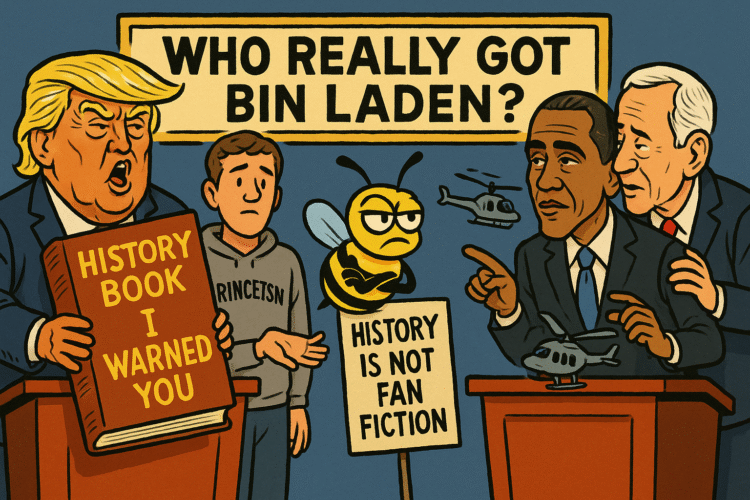
The thing about Donald Trump’s storytelling is that it is less history than it is improv theater. He does not so much recall events as audition alternate scripts, testing which version gets the biggest laugh, gasp, or cheer from the crowd. The fact-checkers arrive on cue, scripts in hand, to point out that the timeline makes no sense, the cast of characters were not in the room, and the alleged prophecy was more like a weather report. Trump, undeterred, exits stage right with a shrug and a promise to workshop the bit again tomorrow.
This week, the workshop performance was bin Laden: The Remix. At a Navy anniversary event in Norfolk, Trump reminded his audience—once again—that he was the lone prophet who saw Osama bin Laden coming back in 2000, if only America had listened. Joe Biden, he added, was the coward in the Situation Room who “didn’t want” the terrorist taken out. CNN’s Daniel Dale, one of the few journalists who still reads things for a living, dismantled the narrative brick by brick.
What emerges, if you actually look at the record, is not prophecy. It’s projection. Trump has turned a passing line in a ghostwritten book into a recurring miracle, a parable in which he alone foresaw the 9/11 attacks, alone demanded bin Laden’s head, and alone would have acted with the courage that Biden allegedly lacked. The only problem is that none of it happened.
The “Book” That Became a Bible
Let’s start with The America We Deserve, the 2000 campaign-season tome that Trump has cited for two decades as proof of his clairvoyance. The book’s relevant bin Laden passage is short and painfully generic: bin Laden is mentioned as one of several dangerous figures on the global stage. There is no call for assassination, no tactical outline, no urgent “take him out before he takes us down.”
It is the equivalent of a fortune cookie that reads: “Bad men may do bad things.”
Yet in Trump’s telling, that vague warning has been retrofitted into a full-blown national security directive, a classified memo that only he, the outsider, dared to publish. Over time, the line hardened into prophecy. At rallies, he declares with a showman’s flourish: “I warned America about bin Laden!” The crowd, primed by repetition, cheers. The fact that the original text is more shrug than prophecy does not matter—because the crowd does not fact-check fortune cookies.
The “One-Hit Wonder” Problem
Complicating Trump’s clairvoyant act is the inconvenient history of his own dismissals. At various points, Trump has minimized bin Laden as a “one-hit” terrorist, a blip on the screen rather than an existential threat. This makes sense when you remember that Trump’s guiding principle is not consistency but applause. When bin Laden’s infamy was useful to burnish his foresight, he was a global menace. When it was more convenient to mock the “mainstream” for exaggerating terrorism, bin Laden was a nobody.
The trick of Trumpism is to hold both contradictions in one hand, drop whichever one feels heavy in the moment, and declare the other a pearl of wisdom. If you are a devotee, you nod along. If you are a journalist, you end up with whiplash and a headache.
Enter Pete Hegseth, Time Traveler
But this week’s revisionist flourish introduced an even juicier impossibility: Trump claimed he warned “Defense Secretary Pete Hegseth” about bin Laden in 2000. For the uninitiated, this would sound plausible—until you remember that Pete Hegseth was at Princeton that year, probably struggling through finals week, not running the Pentagon.
Hegseth only became Secretary of Defense in 2025, a quarter-century later. To believe Trump’s story is to believe that Trump casually leaned over at Mar-a-Lago and whispered national security secrets to a 20-year-old undergrad in between keg stands and thesis drafts. The only other explanation is that Trump now travels through time, seeding warnings into the heads of future loyalists who will later ascend to power.
This would make The America We Deserve not a campaign book but a kind of sacred codex, a Trumpian Book of Revelations, distributed across time so that his chosen disciples can claim they were always already warned. Convenient, no?
Biden in the Situation Room
Of course, the revisionist tale requires a villain. Enter Joe Biden, cast by Trump as the hesitant man in the Situation Room who “didn’t want” the bin Laden raid to happen.
The actual record is well-documented. In 2011, when the intelligence pointed to a suspicious compound in Abbottabad, Obama’s top advisers were divided. Biden, ever the cautious institutionalist, advised waiting for more certainty before sending SEAL Team Six into another sovereign country. Others, like Leon Panetta, pushed for action.
Obama listened, absorbed, and then, as presidents are paid to do, made the call. The raid went forward. Bin Laden was killed. His body was buried at sea from the USS Carl Vinson. Biden later explained that, while he voiced caution in the meeting, he privately told Obama to “follow your instincts.” It was a politician’s hedge, yes, but hardly the cowardice Trump paints it to be. Biden, like everyone else, was weighing risks.
But nuance does not fill stadiums. So Biden becomes the anti-hero, the trembling hand. Trump, retroactively, becomes the decisive man who saw it all coming eleven years earlier, whispered it to a college student, and would have saved the towers if only the world had listened.
The Navy’s 250th Anniversary Rally
That Trump chose to trot this story out at the Navy’s 250th anniversary event in Norfolk is both fitting and grotesque. The Navy, after all, carried out the burial at sea. The Navy exists in history, with logs and timelines and sailors who know what actually happened. Yet Trump used the anniversary to perform another draft of his bin Laden fan fiction, to applause, because the applause matters more than the ship logs.
This is the corrosion Dale describes: when enough people repeat a false version of events, the weight of repetition begins to rival the weight of evidence. Memory is not just what happened; it is what is told. And Trump’s great innovation has been to tell, and retell, until the lie begins to function like truth.
Revisionism as a Political Strategy
Why does this matter? Because the bin Laden story is not just a one-off tall tale. It is part of a larger pattern in which Trump and his allies attempt to launder revisionist myths into the bloodstream of political debate.
- Media blackouts that never happened.
- Migrant caravans inflated into biblical hordes.
- Military readiness described as “hollowed out” by Democrats, only to be “rebuilt” by Trump, regardless of budgets or troop levels.
Each myth has the same function: to paint Trump as the lone savior, to paint Democrats as weak or treasonous, and to sow just enough doubt that the factual record blurs. The shutdown fights of this October provide the perfect backdrop: chaos in Washington, competing narratives, and a base eager for stories of betrayal and redemption.
Fan Fiction as Governance
If you strip away the outrage, Trump’s method is almost literary. He is writing fan fiction of American history, inserting himself into the canon. Every rally is a chapter, every boast a scene, every contradiction a retcon. One day, he is the Cassandra of counterterrorism, ignored by the elites. The next, he is the lone sheriff who would have shot bin Laden himself. Tomorrow, he might be the SEAL who parachuted into Abbottabad, gun in hand, the others just there for cover.
The joke, of course, is that his fans are not in on the joke. They are the audience, but they are also the copy editors. If they cheer, the story stands. If they boo, the draft is revised. And over time, the applause becomes a form of authorship. History is not what the archives say; history is what the arena remembers.
Democrats, Take Notes
Here’s the bitter pill: while we laugh at the absurdity of Pete Hegseth, Time Traveler, Trump is once again controlling the narrative. He decides the frame, his opponents fact-check it, and he still gets the headline. Democrats, meanwhile, treat messaging as a book club: let’s parse the text, let’s argue the moral nuance, let’s publish a careful rebuttal.
The rebuttal is correct, but the story is already out there. Trump wins not by being right but by being first and loudest. He builds a false architecture and dares anyone to knock it down. By the time the fact-checkers arrive with their chisels, the crowd has already toured the building, taken photos, and declared it beautiful.
If Democrats want to survive this narrative war, they cannot just be librarians cataloging lies. They have to be builders too. Build stories that are true, yes, but tell them like they matter. Build frames that capture attention. Stop letting Trump’s fan fiction be the only paperback on the shelf.
Closing: Memory Theft
What Trump is attempting is not mere braggadocio—it is memory theft. He steals the valor of the SEALs, the prudence of Obama, the caution of Biden, and replaces it with his own legend. He rewrites history so thoroughly that one day, children may grow up believing Trump really did whisper to a young Pete Hegseth across the ivy halls of Princeton, warning of a terrorist mastermind that only he could see.
And if that story sticks, if the applause is loud enough, then the theft is complete. We will have lost not just the facts but the ownership of memory itself.
The cure is not just fact-checking. It is narrative reclamation. Tell the truth like it is a story worth remembering. Tell it loudly, repeat it shamelessly, and refuse to let fan fiction overwrite the record. Because in politics, memory is power. And right now, too many are willing to let the loudest liar be the only librarian.