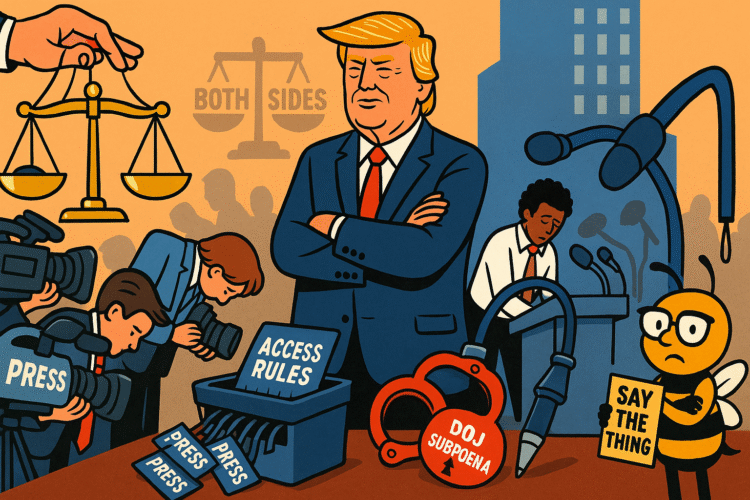
As billionaire owners consolidate outlets and executives sand down the truth, America’s press swaps watchdog bite for brand-safe whispers while power tightens the faucet on facts.
I keep a short list of American rituals that used to mean something: the Fourth of July, jury duty, and a headline that calls a thing what it is. Two of the three still limp along. The third now arrives pre-laundered, triple-polished, and framed like a museum plaque: “Critics say,” “some contend,” “a controversial move that sparked debate.” Translation: the truth has been sent to HR for a tone review.
This isn’t accidental. During Trump’s second term, the press has been re-architected from the lobby up. Ownership has climbed the building, legal risk has moved into the corner office, and the language has developed a nervous tick. We are witnessing a convergence: billionaire stewardship, consolidation fever, layoffs dressed as “strategy,” access rules that tighten like a vice, and a newsroom culture terrified of sounding decisive. Put it together and you get the spectacle of a press bowing without admitting it’s on one knee. Trump doesn’t have to muzzle reporters; the industry is doing the gentling for him.
Let’s set the table. A handful of investors now set the tone for much of what Americans see and how they see it. They don’t run newsrooms to win Pulitzer Prizes; they run portfolios. Portfolios like durable revenue, low litigation risk, and content that doesn’t upset advertisers, regulators, or the parent company’s bigger bets. That preference filters down like office air: pick the center lane, polish the verbs, round the edges. Meanwhile, the deal drum keeps pounding—mergers here, “partnerships” there, “reorgs” everywhere—each one promising the Street a slimmer headcount and a friendlier balance sheet. No newsroom has ever been sharper after a thousand cuts. They just bleed more politely.
Inside the buildings, editors now triage with a calculator. Ratings slide, ad rates sink, subscriptions wobble, and the response is as predictable as a press release: “discipline.” Discipline means layoffs, beat consolidation, and a new obsession with “brand safety,” a phrase that has never once produced a sentence worth reading. You can almost hear the directives in the copy: if a word might alarm power, use the cousin that went to finishing school. Authoritarian becomes maximalist. Lies become false claims. Retaliation becomes an unusual personnel action. Threats to the election become musings. When the stakes are this high, the euphemism is not a style choice; it’s an accomplice.
Trump understands this ecosystem the way an arsonist understands wind. He doesn’t need to win legal doctrines when he can win the headline. He doesn’t need to outlaw reporting when he can starve it, chill it, and bury it under “both sides” until readers forget which side is holding the match. Flood the zone with noise. Punish sources. Reward profiles that treat power like a quirky brand. Float a rule that squeezes access, then dare the press to walk away. If they do, say they’re biased. If they don’t, say they’ve agreed. Either way, the cameras roll and the verbs get gentler.
Consider how the tone shifted this year. Major outlets stopped being surprised by authoritarian impulses and started describing them like weather. “Storm clouds gather,” as if a press office drafted the forecast. When the Pentagon rolled out new media rules that would have made a civics teacher cough, too many write-ups treated the dispute as a lovers’ quarrel: reporters “expressed concerns,” officials “defended the policy,” and somewhere around paragraph eight the Constitution waved weakly from a chaise lounge. When the Justice Department loosened the guardrails on probing reporters’ records in leak cases, the copy landed like a scheduling note. The chilling effect wasn’t hypothetical; sources went quiet. That’s how it works. You don’t have to criminalize a phone call if you can make the caller imagine a subpoena.
The effect on coverage is immediate and everywhere. Watch the sequencing. The Trump quote goes first. The policy follows second, de-weaponized by passive voice. The consequences go third, softened by attribution to “critics” and “advocates.” Somewhere far below the fold, the plain sentence that should have led the story puts on its shoes and tries to catch up. Readers learn to imitate the dance: maybe it’s serious, maybe it’s normal, who can say, everyone is so upset these days. Mission accomplished.
Meanwhile, the industry’s internal politics nudge everything toward compliance. Cable news divisions get “decoupled,” “reorganized,” “reimagined,” and “right-sized.” Translation: headcount falls and independence thins. Newsrooms that once shared muscle with opinion shops are told to build separate bodies, but the treadmill speed stays the same and the budget is half. The bosses issue memos about agility and focus. Staffers clean out desks. On the way out, some of them whisper what the memos won’t say: investigative beats are being traded for panel shows, field reporting for nicely lit rooms with clever chyrons, urgency for the illusion of balance.
And the legal environment? Think of it as a hallway that narrows every month. Access rules harden. Leak protections soften. Agencies discover the modern magic trick: do by “guidance” what you might not survive as a rule. Newsrooms either accept the dance or hire lawyers and lose six months to PTO meetings with compliance. All of this rewards power with time. Time turns scandals into “controversies,” turns documented abuses into “disputes,” and turns plain speech into career risk. By the time the definitive investigative package lands, the country has moved on to the next panic.
Now add the litigation strategy that keeps the worst stories in the dark. The administration and its allies have learned to replace public discovery with quiet settlement. That’s where accountability goes to nap. A lawsuit that would have expelled documents into daylight now produces a joint statement about moving forward. The press receives a note, not a trove. The next ambitious reporter remembers the last legal bill and pitches a safer story. The newsroom ledger prefers certainty; the public interest prefers sunlight. Guess which one reports to the CFO.
The result is not that nothing gets reported. It’s that the most important stories get translated into a dialect designed to pass through corporate allergy tests. With language this cautious, even the most urgent facts arrive as suggestions. Trump thrives in that environment, not because he commands censors, but because he commands attention. He changes the subject faster than the bravest editor can approve a clause. He points at imaginary enemies; the press dutifully interviews the figments; the headline packages both and calls it even. He floats “ideas,” the press frames them as “floated ideas,” and suddenly the Overton window has a new skylight.
There is also the brute arithmetic of fewer gatekeepers. Squeeze the number of owners and you squeeze the number of appetites. Put newsrooms inside entertainment conglomerates and you inherit reflexes designed to avoid government retaliation, advertiser squeamishness, and the wrong kind of audience mobilization. Call it prudence if you like; it feels a lot like surrender. When a handful of CEOs can pick up the phone and ask a news division to “dial down the heat,” they won’t need to ask twice. “Dial down” a hundred times across a hundred days and you’ve rewritten a country’s understanding of what’s happening to it.
If this sounds too abstract, follow the consequences through a life. A press that bows writes softer about purges inside agencies and harsher about the decorum of the people who object. It names the loyalty pledge a “policy shift.” It calls a ban on dissent “a controversial move.” It gives oxygen to “election integrity” rhetoric while burying the structural facts about suppression behind euphemisms like “changes to voting access.” It treats attacks on the free press as “spats” and attacks on the civil service as “reorganizations.” It asks voters to show up with a microscope when what we need is a bullhorn.
Why does the euphemism matter so much? Because language is the only tool the press owns outright. The Pentagon can seize a badge; a billionaire can buy a newsroom; a regulator can hold up a merger or wave it through. Only the sentence belongs to the journalist at the keyboard. When we replace “threaten” with “hint,” “order” with “signal,” “retaliation” with “shake-up,” we are not being neutral; we are choosing sides—the side of sleep.
And please spare me the lecture about objectivity. Objectivity does not mean describing a fire from the arsonist’s point of view. It means measuring facts against reality without fear of the outcome. If the rule would violate the Constitution, the sentence can say so. If the statement is a lie, the sentence can say so. If the merger would narrow the field and strengthen a single owner’s leverage over the agenda, the sentence can say so. The public does not need the press to sound angry. The public needs the press to sound awake.
So what would awake look like? Start with a vow to banish the weasel words that do most of the bowing. No more “raised questions” where the answer is obvious. No more “critics say” as a mask for the newsroom’s own reporting. No more burying the lead under three paragraphs of spin you know you’ll contradict by paragraph seven. If the policy chills speech, write it. If the access rule smells like prior restraint, write it. If the administration’s litigation strategy systematically keeps evidence out of public files, write it, and publish the empty docket next to the empty quote.
Next, rebuild the muscle that mergers and layoffs have melted. That means beats, not panels. Bodies in courtrooms, not feeds on screens. Bureau chiefs who can say “run it” without checking if the adjoining division just signed a sponsorship with a government contractor. It means telling Wall Street that the news division is not a fenceline to be grazed, but a public trust that requires appetite for litigation, appetite for subscriber churn, appetite for the occasional advertiser tantrum. If that appetite is not present at the top, viewers will feel it at the bottom—in the difference between an anchor who speaks like a person and an anchor who speaks like a lawyer doing improv.
We should also stop pretending that access is the same thing as reporting. If the price of an interview is the promise to treat fictions as positions, decline the hour and publish the fact check instead. The country does not need another split screen of a falsehood and a frown. It needs a paragraph that begins, “Here is what actually happened.” If that paragraph costs you your next booking, count it as proof you’re doing the job.
There are structural fixes that would help. Stronger labor contracts to preserve headcount on core beats. Firewalls between news and other divisions that are more than engraved plaques. A default posture of taking rules to court when they sandwich the press between flattery and obedience. Press-freedom groups willing to sue as quickly as they write statements. Owners willing to accept that watchdog journalism is not brand safe by design—it has teeth, it leaves marks, and it occasionally bites the hand that strokes the check.
And then there’s the audience. The audience has to reward clarity over drama. That means subscriptions that survive a bad week and complaints that arrive when the headline wobbles, not just when it offends your side. It means understanding that a newsroom cannot out-perform its owners forever, and that some owners do not want it to. If you want courage, pay for it. If you want the truth plain and early, forgive the lack of glamour.
You’ll notice I haven’t argued that Trump should be covered less. Quite the opposite. He should be covered more plainly, more relentlessly, and with fewer detours into etiquette. The question is not whether his latest statement “raises concerns.” The question is whether the statement is a test balloon for another slice off the guardrails: voting, speech, independence of the civil service, rule of law. He governs by pushing and watching who yields. The press, of all institutions, cannot be the first to step back.
The irony is that the press still has the talent. Reporters are cutting through the fog every day. Producers are holding the line under crushing schedules. Editors are slipping the essential sentence into drafts that would otherwise read like perfume ads for power. But heroism as a work-around is not a business model. A free press is a system, and our system is being tuned to hum at the frequency of deference.
If you need a final image for your fridge, take this: a row of cameras aimed at a podium, each lens slightly fogged by breath from a parent company that doesn’t want trouble. Behind the podium stands a politician who understands that fog better than anyone alive. He smiles because he does not need to seize the cameras. He only needs them to hesitate. A half-second will do. In that half-second, “threat” becomes “float,” “order” becomes “proposal,” and democracy starts to sound optional.
Here is the vow that would break the spell. We will say the thing and accept the consequences. We will run the story even when the booking evaporates. We will hold the line on language because the language is the line. We will treat access as a tool, not a leash. We will measure “discipline” not by how few we offend, but by how clearly we inform. We will name the pressure when it arrives and publish the emails that try to make us polite. We will do this because the job is not to survive the moment. The job is to make sure the public does.
Trump doesn’t need the press to love him. He only needs it to blink. Stop blinking.
That is how the media stops bowing. Not with a manifesto or a new logo, but with the next headline that says plainly what happened, who did it, and why it matters—no quotation marks for courage, no italics for truth, no velvet rope for power.
And if that headline costs a booking, an advertiser, or a merger sweetheart’s good mood, frame the invoice and hang it in the newsroom. Call it what it is: the price of a spine.