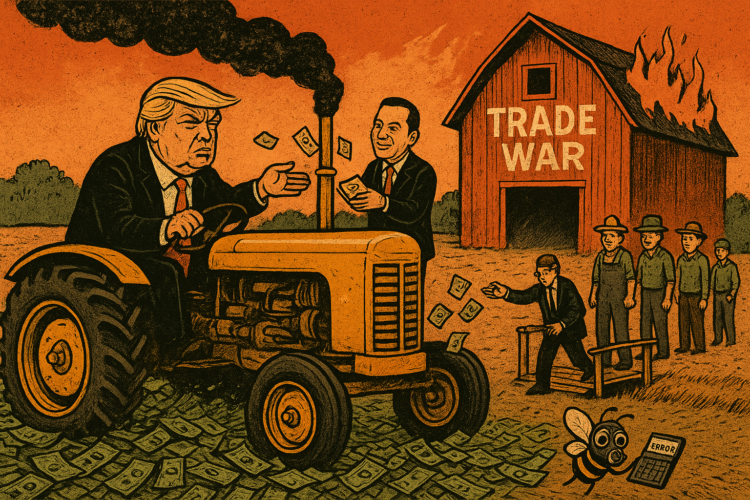
The arsonist has returned to the scene of the crime, not to put out the fire, but to sell the victims a very expensive glass of water.
On Monday, the political circus will descend upon Washington with the heavy, frantic energy of a infomercial host realizing his product is defective. President Trump, flanked by a curated selection of farmers who look suitably weathered and grateful, will unveil a twelve billion dollar aid package designed to rescue the American heartland from the consequences of his own policies. They are calling it the “Farmer Bridge Assistance” program, a name that evokes sturdy infrastructure and helping hands. It suggests a bridge over troubled waters, a lifeline extended to the drowning. But if you look closely at the blueprints of this particular bridge, you will notice that it does not span a natural disaster or a market fluctuation. It spans a canyon that Donald Trump dug himself, using a shovel made of tariffs, and now he is asking the American taxpayer to fill the hole with cash.
The centerpiece of this package is eleven billion dollars in one-time payments. This is a direct injection of liquidity into a sector that has been bludgeoned by prices hovering near 2020 lows and input costs that have skyrocketed into the stratosphere. It is a bailout, plain and simple. It is the kind of massive government intervention that Republicans usually decry as socialism, unless the recipients are wearing John Deere caps instead of student loan debt. The administration will frame this as a necessary shield against the “unfair” practices of foreign adversaries, specifically China. They will tell you that the farmers are the foot soldiers in a glorious trade war, and that this money is their combat pay.
But let’s be surgically precise about what is actually happening here. This is not combat pay. This is hush money. This is a bribe paid to a crucial voting bloc to keep them from noticing that the trade war is not a strategy, but a suicide pact. The reason crop prices are low is because the markets are glutted. The reason the markets are glutted is because China, in a predictable act of retaliation against Trump’s aggressive tariff regime, stopped buying American soybeans and corn. We poked the dragon in the eye, and the dragon decided to shop in Brazil.
Now, the administration is scrambling to fix the breakage. Treasury Secretary Scott Bessent and Agriculture Secretary Brooke Rollins will stand there, nodding solemnly, as the President explains that he is the savior of the agrarian economy. They will ignore the fact that the “input costs” crushing these farmers—the price of fertilizer, machinery, and fuel—are inflated in part by the very protectionist trade policies Trump champions. When you tax steel and aluminum, tractors get more expensive. When you disrupt global supply chains, fertilizer prices jump. The farmers are being squeezed by the President’s left hand, and fed crumbs by his right.
And who pays for the crumbs? You do. This is the structural irony that makes the whole tableau so grotesque. The American taxpayer is currently caught in a double-bind of extortion. First, we pay higher prices at the store for everything from washing machines to avocados because tariffs are taxes on consumption. We pay the premium for the trade war every time we swipe our debit cards. And now, we are being asked to pay again, through our tax dollars, to bail out the industries that were decimated by those same tariffs. We are funding the arsonist’s matches, and then we are funding the fire department.
The administration will claim that this draws from past aid during Trump’s first term, as if that precedent makes it better. It doesn’t. It just proves that this is a chronic condition. We have normalized the idea that the federal government’s role is to act as an insurance policy against the President’s impulses. We have accepted a cycle where the White House breaks the economy for a press release, and then patches it up with a printing press. The “stability” that farming communities are seeking ahead of the harvest is a stability that used to exist naturally, before we decided to treat global trade like a game of blackjack played by a man who counts cards poorly.
The political theater of the Monday announcement will be thick enough to chew. The President loves a backdrop of agriculture. It allows him to cosplay as a man of the people, a billionaire in a suit standing next to men in denim, united by a shared grievance against a world that refuses to bend the knee. But the grievance is manufactured. The “strains” with China are the direct result of a policy choice to prioritize performative toughness over economic reality. We are told that “China pays the tariffs,” a lie so durable it should be used to pave roads. China does not pay the tariffs. U.S. importers pay the tariffs. U.S. consumers pay the tariffs. And U.S. farmers pay the price when China retaliates.
The $12 billion figure is not just a number. It is an admission of failure. If the trade war were working, if the “purchase pacts” and the tough talk were actually opening markets and leveling the playing field, our farmers would be selling their crops for a profit. They wouldn’t need a bridge. They would need bigger silos. The fact that we have to print eleven billion dollars to hand out in “one-time payments” is proof that the market is broken. It is proof that the customer has left the building. It is proof that you cannot bully the global economy into submission without breaking a few million eggs.
But the most galling part is the selectivity of the socialism. When a single mother in Detroit needs help with childcare so she can work, we are told the deficit is too high. When a student in Ohio needs relief from predatory loans, we are told about personal responsibility and the sanctity of contracts. But when a soybean farmer in Iowa loses money because the President decided to start a trade war on a Tuesday, the checkbook opens instantly. The deficit ceases to exist. The concept of “market forces” is suspended. The farmer is not a failed business owner; he is a patriot who must be made whole.
This “Farmer Bridge Assistance” is a bridge to nowhere. It does not fix the structural problem. It does not reopen the Chinese market. It does not lower the cost of fertilizer. It just buys time. It buys silence. It buys votes. It keeps the tractor running for another season, burning fuel that costs too much, harvesting crops that have nowhere to go. It is a holding pattern disguised as a rescue mission.
And the taxpayers are the ones in the cargo hold, paying for the fuel. We are paying to subsidize a policy that hurts us. We are paying to fix a mistake that is being sold to us as a victory. We are paying for the privilege of being lied to.
The timing, of course, is impeccable. Harvests are coming. Midterms are always looming in the psychological distance. The administration needs to shore up its base. They need to make sure that the rural counties that vote red stay red. And nothing keeps a county red quite like a direct deposit from the federal treasury. It is patronage politics on a grand scale, a Tammany Hall operation run out of the Department of Agriculture.
The “Bridge” program targets crop farmers specifically. These are the people most exposed to the trade war. They are the tip of the spear, or perhaps the tip of the shovel. By targeting them, the administration is trying to cauterize the wound before it turns into gangrene. But the wound is self-inflicted. The President stabbed the economy in the thigh, and now he is handing us the bill for the bandages.
We should also talk about the “reduced exports despite a recent purchase pact.” This is the diplomatic way of saying that the previous agreements were not worth the paper they were signed on. We were promised that China would buy billions in American agriculture. We were promised a bonanza. Instead, we got a trickle. And now, even the trickle is drying up. The retaliatory tariffs are doing exactly what they were designed to do: hurt the President’s political base. China understands American politics better than we understand Chinese economics. They know exactly where to apply the pressure.
So on Monday, when you see the flags and the tractors and the smiling faces in Washington, try to look past the spectacle. Try to see the ledger. Try to see the invisible line item on your own household budget labeled “Trump’s Trade War Tax.” Because that is what this is. It is a tax you pay at the grocery store, and a tax you pay on April 15th. It is a wealth transfer from your pocket to the people who voted for the man who emptied your pocket.
The “Bridge” is not for the farmers. The bridge is for the administration. It is a bridge over the gap between their rhetoric and their results. It is a bridge over the reality that protectionism makes us poorer. And you are the toll booth.
There is a profound sadness in watching the farming communities seek “stability.” Farming is hard enough. It is a gamble against the weather, against pests, against the soil itself. To add a gamble against the ego of the President is cruel. Farmers deserve better than to be used as pawns in a geopolitical staring contest. They deserve open markets. They deserve fair prices. They deserve a government that doesn’t break their legs and call it a massage.
But they aren’t getting that. They are getting a check. And in the short term, a check feels like relief. It pays the bank. It buys the seed. It keeps the lights on. But in the long term, it is a trap. It makes them dependent on the very whims that destroyed their livelihood. It turns them into wards of the state, reliant on the next bailout, the next “bridge,” the next bridge to the next election.
As Treasury Secretary Bessent stands there, a man of Wall Street pretending to understand the soil, one has to wonder if he sees the absurdity. He knows how markets work. He knows that subsidies distort price signals. He knows that this is bad economics. But he also knows who the boss is. And in this administration, bad economics is the official policy, as long as it looks like good politics.
So the $12 billion will flow. The press releases will fly. The base will cheer. And the rest of us will go to the supermarket, look at the price of bread, and wonder why it feels like we are paying for the same loaf twice. Because we are. We are paying the tariff price, and we are paying the bailout price. We are the suckers at the table, and the dealer is dealing from the bottom of the deck.
The “one-time payment” is a myth. There is no such thing as a one-time payment in a trade war that never ends. There will be another package next year. And the year after that. As long as the tariffs remain, the pain will remain. And as long as the pain remains, the checkbook will remain open.
It is a perpetual motion machine of fiscal irresponsibility. It generates inflation, debt, and dependency, all while producing zero actual value. It is the perfect Trumpian policy: loud, expensive, and completely hollow.
So let’s give a round of applause for the Farmer Bridge Assistance program. Let’s hear it for the bridge that connects the President’s ego to the taxpayer’s wallet. It is a marvel of modern engineering. It can carry billions of dollars in debt without collapsing, as long as nobody looks too closely at the foundation.
Receipt Time
The invoice for this little adventure in economic populism is sitting on your kitchen table. It is buried in the grocery bill that is twenty percent higher than it was four years ago. It is hidden in the tax return you just filed. It is a line item that reads “Ego Maintenance Fee.” We are paying $12 billion to fix a problem that didn’t need to exist. We are paying to patch a hole in the hull of a ship that the captain drilled himself because he thought it would make the boat go faster. And the worst part isn’t the money. The worst part is the insult. They are taking our money to clean up their mess, and they expect us to say thank you.