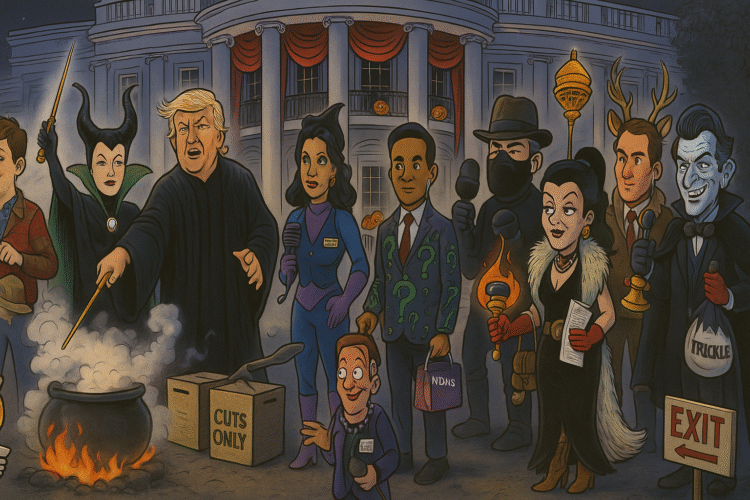
Under the glitter and smoke, the costumes translate into deregulation, propaganda, and cuts that land on real people.
There are holidays that ask for reverence, others that ask for ritual. Halloween asks for honesty. Put the thing you want on your face and watch the room tell you who you are. At the White House, the fog is theatrical, the pumpkins are symmetrical, and the candy bowl is filled with product placement. The invitations read like a civics test written by wardrobe stylists. Costumes are not disguises here, they are mirrors with better lighting. So we stage the party and let the cast walk through in one long breath, a roll call of personas that double as indictment. The joke must land fast, then linger, because the mask is only interesting if it reveals policy underneath.
Enter Donald Trump as Lord Voldemort of Mar a Lago, pale glow, tailored cloak cut to move like a courtroom curtain, a wand carved from a gold putter, and a cluster of horcrux boxes that look like moving crates stacked beside a smoky cauldron. He raises a pinkie to shush the music and purrs, Only the best dark arts, many people are saying. The prop master gives him a glitter fog that smells like fresh nondisclosure agreements and golf course fertilizer. It plays as satire unless you remember that the real horcruxes were boxes, that the man in the cloak declared secrets his personal furniture, that national security turned into set dressing. The wand is a neat touch. In this house, if you control the pen, you control the world, or at least the procurement calendar. The policy under the makeup is simple enough to fit on a place card. If a rule checks a donor, break it. If a court slows you down, shop for a new judge. If a file belongs to the public, pretend it belongs to your biography. He smiles for the children waiting in line, then pockets a sucker labeled Executive Privilege and calls it a mint.
Melania Trump follows as Maleficent of Photo Ops, horned headpiece, cheekbones sharp enough to cut ribbon, a glitter staff that only works near cameras, and a cloak lined with green jacket fabric that reads in the light like a private joke. I curse thee with a very short appearance, she whispers, then materializes precisely where the lens is, then vanishes to the room where handlers keep the schedule safe from questions. The costume is couture with calibrated edges. It is also a thesis about image as governance. The staff that only glows when the red tally light blinks is what communications shops now call strategy. You do not need to explain anything substantive if you can produce an image that floats an inch above scrutiny. The policy under this cape is the policy of portfolio: the East Wing can be demolished and rebuilt as a palace extension, the Rose Garden can be paved for better heels, the White House can be reimagined as brand architecture. If you are searching for childcare investments or food security line items, enjoy the cloak instead. It is lined with fashion week.
J. D. Vance arrives as Two Face, VC Edition, half flannel, half fleece vest, the line dividing him as crisp as an exit clause. He flips a coin that has Sand Hill on both sides and grins, Either way, the investment wins. This is the costume that reads like a footnote to a term sheet. Half small town charm, half boardroom austerity. He will frown on your pain in the diner, then vote to starve your union in committee. He will send a text about heritage, then file a press release about discipline that trims your EBT. The coin is not a gag. It is a doctrine. Political risk is tolerable so long as capital gains still clear. The policy beneath the greasepaint is the policy of capital insulation. Social programs are moral hazards, but incentive zones for private equity are nation building. Family leave will undermine productivity, but accelerated depreciation is scripture. When he says either way the investment wins, he means regardless of how you vote, the spreadsheet will eat.
Marco Rubio comes as the Riddler of Thirst, neon question marks stitched across a suit that reads television green in every light, a tiny water bottle holster built into his belt like a survival kit, and a rolling debate podium with a cup holder. Riddle me this, how small can my hands be, he smirks, a throwback to a trauma he will never metabolize. Rubio’s costume is a memory palace for old humiliations, which is why it fits like custom penance. He is the policy of equivocation come to life. He will name the danger, then vote to confirm it. He will write a line about conscience, then discover a procedural reason to ignore it by noon. The bottle holster is not an accident. Hydration is the brand. In practice, the policy beneath the question marks is habit. If there is a hard choice between a donor’s appetite and a constituent’s need, he will sip and stall, then hide inside the nearest committee to insulate the choice with jargon.
Pam Bondi shimmers in on a rolling tide as Ursula of Crisis Comms, a shell necklace filled with NDAs that clink like champagne glasses, a glitter gavel that turns subpoenas into scheduling conflicts, contract scrolls that unfurl themselves toward television studios. Sign your voice to me and watch the headlines flip, she sings, which is not a lullaby so much as a retainer agreement. The eight limbs of her gown reach toward microphones unclaimed by opposing counsel. Bondi’s power is narrative procurement. If the facts are rough, change the camera angle. If the contract is ugly, change the platform. If the ethics are a scream, drown them in a sea of statements that insist you are being mean to process. The policy under the sequins is the policy of law by press release. Oversight is a talk show segment, not a risk. Pay attention to the necklace. Silence is always the most expensive jewelry in the room.
Tulsi Gabbard glides in as Mystique of Cable Bookings, reversible catsuit that flashes red, then blue, then gray, a cape that reads independent like a billboard, a guest host badge clipped to a neckline engineered for split screens, a surfboard broom for fast exits. I change colors, not camera angles, she purrs. The costume is a perfect storyboard for a media economy that converts contradiction into brand equity. Her silver gift is elasticity. The policy beneath the body paint is not a program. It is airtime. If a movement needs a convert, she will be there with a monologue about freedom. If a network needs a contrarian, she will arrive with a monologue about courage. The public good is incidental to the booking. She is not selling solutions. She is selling segments that feel like solutions for eight minutes, which in this house counts as governing.
Russ Vought stomps in as Sauron the Auditor, a flaming eye visor that blinks red whenever a child gets a school lunch, a giant green ledger ring clutched like a relic, and a stamp that says Cuts Only in a font you can hear from the balcony. One budget to rule them all, he booms, and in the darkness bind them. Vought’s costume is the least metaphorical of the night, because the budget is the policy and the policy is the ideology. If you can starve the administrative state, you can starve the parts of the country that rely on it. If you can collapse public capacity, you can declare private rescue the only option left. The ring is a mnemonic device. When deficits grow after tax cuts, he will stamp Cuts Only with righteous fury and call it moral clarity. The children watching at the rope line will not get the reference. They will just lose after school programs and then hear that the real problem is teachers.
Pete Hegseth strides in as Bane of the Culture Wars, mask cocked at a heroic angle, foam bat hoisted like grievance, an unopened bar of soap clipped to his belt as a visual punchline. You merely adopted hygiene, I was born ignoring it, he intones, then laughs and slaps a staffer on the back hard enough to rattle a press pass. This is the costume of performance toughness, a gym selfie turned into policy. Hegseth’s superpower is to call basic public health advice tyranny, then demand uniforms for toddlers at story hour. The policy beneath the mask is a two step. First, elevate daily life into a war. Second, demand surrender. If you wonder why school boards now require security details for librarians, here is your clue. The bat is foam for legal reasons. The fear it sells is real enough to move elections.
Linda McMahon floats in as Queen of Hearts, SBA Edition, a WWE mic scepter sparkling with a history that is louder than the room, an SBA briefcase tucked under one arm like a trophy, a ring bell in the other hand. Off with those interest rates, apply by quarter end, she calls, then blows a kiss toward a row of regional bankers who suddenly look very alert. McMahon is one of the few on this carpet who knows the crowd. She has sold violence as spectacle and spectacle as morality. The policy beneath the crown is transactional and proud of it. Loans flow if the optics align. Small business is a brand deployed on behalf of those who can afford to be called small. The ring bell means time is up whenever she decides it is. If you want a federal program that measures success by branded tentpoles and press hits, you could not pick a better stage manager.
Robert F. Kennedy Jr. tumbles in as the Joker of Independents, purple suit pressed within an inch of self-parody, podcast microphone clipped to a lapel like a corsage, ballot line lanyard draped across his chest. Why so pluralistic, he asks, as if the country were a deck of cards that will always cut in his favor. This is a costume built for a mirror. The policy beneath the paint is chaos marketed as courage. His campaign is not a platform, it is a brand extension, a promise that everyone who hates everyone else can find a home in the shape of his face. The damage is not symbolic. Every minute he siphons leaves the country debating a legacy instead of a future. He will insist this is independent thinking. It is more often a subsidy for power.
Kristi Noem sweeps in as Cruella de Vil of the Prairie, faux fur stole tipped in pheasant feathers, an oversized ranch belt buckle that reflects the chandelier like a halo, and a redacted memoir clutched to her ribs like a hot water bottle. Spots are a branding choice, she smiles, then pretends not to hear the dog bark offstage. Noem’s costume is knitted from the kind of frontier mythology that sells in donor retreats. The policy beneath the pelt is punitive by design. She will turn border policy into a cattle drive spectacle and call it sovereignty. She will write the power to punish into every county where a judge will sign. She will laminate cruelty with the word grit and sell it to people who think governing is a rodeo. The redactions in her book are not legal. They are strategic. The truth is only useful when it sells.
Sean Duffy swaggers in as Gaston of Cable Woods, plaid hero shirt tailored far too well for a chainsaw, a cheese state hat tucked inside a pocket to be deployed for any swing state segment, an IFB earpiece glowing with producer prompts. No one logs on like Gaston, he booms, then repeats it into his phone for a short that will post before the music stops. Duffy’s costume is a frat prank turned into a brand. The policy beneath the chest puff is extraction. He will invite you to love the woods, then vote to sell the logging rights for a district ribbon cutting. He will wear a flannel to your town hall, then auction your broadband to a company that does not know your ZIP code. The smile is genuine in a way that is hard to fight. It is also trained to survive every fact.
Treasury Secretary Scott Bessent closes the parade as Dracula of Yield Curves, cape lined with bond charts, calculator fangs that click when he says good morning, and a treat bag labeled Trickle. I vant to suck your liquidity, he intones, and the room laughs that kind of nervous laugh people do when they sense the joke is not entirely joking. The policy beneath the cape is orthodox finance with a side of theater. Liquidity means your mortgage and your job, but the cape turns it into a parlor trick. If wages rise, call it a beast. If buybacks rise, call it discipline. If rates hurt, blame the previous tenant. If deficits balloon, host a symposium about trade winds. The bag labeled Trickle is empty on purpose. The message is that empty bags are a kind of virtue.
You could let the costumes remain costumes, call it a clever theme, file it under holiday coverage, and go about your evening. But the house is not neutral, and neither are the masks. Each character is a field note about how image laundering hides appetite for control. Voldemort’s wand is deregulation as a weapon. Maleficent’s disappearing act is the privatization of civic space. Two Face is the conversion of public office into an investor relations podium. The Riddler is the normalization of stalemate as virtue, a long drought of courage disguised as prudence. Ursula is the capture of accountability by communications. Mystique is the triumph of booking over belief. Sauron is the religion of cuts that never apply to donors. Bane is the conversion of public health into a prop for grievance. The Queen of Hearts is the fusion of show business and federal lending. The Joker is the monetization of confusion. Cruella is the aesthetic of punishment. Gaston is the extraction model in flannel. Dracula is the ritual that turns your paycheck into a chart.
Laughing is allowed. In fact, laughing is required if you want to stay human around this much power. But the laugh only matters if it clears enough fog to see the table where candy becomes policy. Children will collect mini chocolate bars that melt by the radiator on the ride home. Adults will collect rules that harden in the Federal Register. Costumes are a language, and this is a fluency test. Can you translate Maleficent’s cloak into a debate about the East Wing being remodeled as a donor atrium. Can you translate Voldemort’s horcrux crates into the conversation about classified documents treated like souvenirs. Can you translate Sauron’s green ledger ring into an understanding that a budget cut is a math sentence with a body count. Can you translate Bane’s foam bat into the new bans on books, the new rules on curriculum, the idea that librarians require security details because a television set needs a villain. Can you translate Dracula’s cape into the sentence your grocery store has been trying to tell you for two years.
Satire is not a substitute for oversight. It is an x ray that shows you where to look. The country is exhausted by outrage that turns over every twelve hours, which is why politics has embraced production design. It wants you giggling at the horns. It hopes you forget the ledger. It wants you tweeting the cape. It hopes you do not ask about the bag labeled Trickle. It wants you threatened by the mask. It hopes you never learn to read the seam.
So we end this haunted tour with a simple rule that does not need a costume. Name the policy under the mask before you leave the room. When someone waves a gold putter wand, ask which regulation it plans to kill and who profits. When someone’s staff only glows near cameras, ask which appropriation is being moved while the light is on. When the coin has Sand Hill on both sides, ask how the tax code is about to be edited. When the question marks sparkle, ask what votes were cast in the dark. When the shell necklace rattles, ask who signed and why they were told they had to. When the catsuit changes color, ask what the color covers. When the ledger ring gleams, ask which line item is a child. When the mask snarls about hygiene, ask why the clinic lost its funding. When the scepter taps the SBA briefcase, ask who qualifies and who does not. When the purple suit smiles, ask who gets hurt while the ratings climb. When the fur catches the light, ask who is being punished to make the coat. When the plaid flexes, ask which forest is for sale and which upload speeds were promised to whom. When the cape swirls and the chart winks, ask who gets the empty bag and who calls that discipline.
The trick is not that they hide. The trick is that we stop naming. Halloween gives you permission to identify the monster and then eat a caramel apple in front of it. Governing demands more. It wants you to say the monster’s policy out loud and then push the door marked Exit until the hinges remember their job. Power hopes you will confuse mockery with movement. It is better to confuse them with memory. Keep a list. Write the costume next to the statute, the gag next to the budget line, the prop next to the procurement, the catchphrase next to the committee vote. Tape it to your refrigerator like a school calendar. Invite your neighbors over and read it out loud. Refuse to let the fog machine set the plot.
The party goes late. Staffers scrape glitter off the Resolute desk while contractors measure a wall for a new portrait. Out on Pennsylvania Avenue, the costumes thin and the air gets cold. In the windows, you can see silhouettes moving props back into storage. Tomorrow they will rinse the candy bowls and schedule the next briefing, and the masks will return to closets that smell like foundation and ambition. The thing about Halloween is that it ends. The thing about policy is that it does not. The only honest way to honor both is to go home, take off your own mask, and write down what you saw. Not the horns. The ledger. Not the cape. The chart. Not the joke. The choice.
Then show up, not as a critic with a punchline, but as a witness with a vocabulary. Say what the costume said, then say what it tried to hide. Laughter is the start. Language is the weapon. Accountability is the point. And the door, which still opens if enough hands push at once, is the proof that the haunted house is a set built on exits, not a future built on fear.