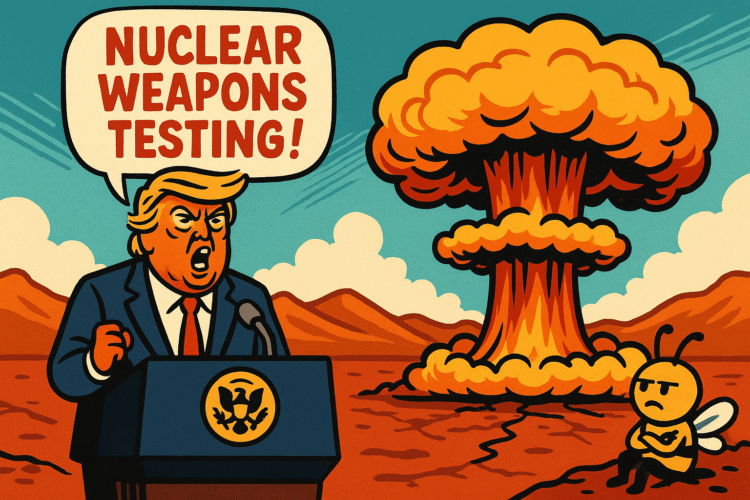
There’s a certain poetry to it, really. A president who once bragged about acing a dementia test now wants to bring back nuclear testing, apparently to prove he can still make something explode.
In a pre-summit flourish that left even his own defense officials blinking through radiation metaphors, Donald Trump announced that he had directed the Pentagon to “immediately resume nuclear weapons testing.” Immediately, like ordering room service. The last U.S. explosive test was in 1992, back when dial-up was cutting edge and global arms control still pretended to be sacred. Now, three decades later, the man whose administration can’t fund a government for a full fiscal quarter wants to detonate plutonium in the Nevada desert because it “projects strength.”
The global community heard it as what it is: a tantrum with a mushroom cloud budget.
The Fallout of Nostalgia
The Comprehensive Nuclear Test Ban Treaty (CTBT) was supposed to end this chapter of human stupidity. The United States signed it in 1996 but never ratified it. We didn’t need to. We still honored the moratorium because even the hawks understood the optics of turning the desert into a fireworks show again.
But Trump, standing at the podium with the confidence of a man who once tried to buy Greenland, declared that it was time to “show leadership.” He used the word the way a toddler uses a steering wheel on a carnival ride.
What he means by “testing” remains unclear. The Pentagon and the Department of Energy’s National Nuclear Security Administration (NNSA) are still trying to decode whether he’s talking about subcritical tests, the kind that stop short of a chain reaction, or full-scale explosive tests that would light up the desert and international law at once.
The ambiguity is the point. It’s political theater masquerading as strategy. It’s the art of the nuclear deal.
From Tweet to Tremor
The directive went out first on social media, naturally, sometime between a Truth Social post about “fake unemployment numbers” and an all-caps attack on California’s governor. Within hours, the Pentagon received an order to “begin preparations.” Officials familiar with the matter described it as “vague to the point of parody.”
By noon, NNSA staff were huddled in emergency briefings at the Nevada National Security Site, the rebranded name for the old Nevada Test Site, a linguistic cleanup that fooled nobody. The same desert that once saw over a thousand nuclear detonations was being discussed like a dormant volcano.
The timeline unfolded like a parody of bureaucracy: presidential whim at breakfast, agency panic by lunch, and legal chaos by dinner.
Within the first twenty-four hours, questions began piling up like radiation badges:
- Does the Pentagon have statutory authority for this without congressional appropriations?
- Does NEPA, the National Environmental Policy Act, still apply when the president thinks treaties are suggestions?
- Would the Department of Energy even cooperate, or would the career scientists simply stall until the next administration?
The answer to all three, so far: nobody knows.
The Bureaucracy of Armageddon
To restart explosive testing, the government would need to untangle three decades of oversight regimes, environmental reviews, and interagency rules. NEPA alone would require an Environmental Impact Statement, a process that takes years, not weeks.
The NNSA’s Stockpile Stewardship Program, built precisely to avoid testing, has spent billions developing computer models, laser simulations, and subcritical experiments to maintain confidence in the arsenal without lighting the sky. To test again would be to admit the system failed, or worse, that the system’s success was irrelevant to political spectacle.
The Department of Defense doesn’t even run the tests. That’s DOE’s domain. The two agencies share custody of the arsenal like divorced parents who don’t speak anymore. Trump’s order throws them both into joint custody of chaos.
One DOE official reportedly muttered, “We don’t even have the staff for this, much less the moral clarity.”
Xi, Putin, and the Great Detonation Contest
The announcement came hours before Trump’s summit with Xi Jinping, a convenient bit of pre-show machismo. It was meant to rattle China, whose arsenal has grown to roughly six hundred warheads. It may also have been aimed at Russia, which recently conducted tests of its exotic “Poseidon” underwater system and a new strategic missile variant.
But arms control experts warn that reentering the nuclear testing race isn’t deterrence, it’s invitation. If the United States blows up the moratorium, so will everyone else.
The Comprehensive Test Ban Treaty Organization (CTBTO) in Vienna immediately issued a statement reminding the world that testing, even by a signatory that never ratified, sends a signal of license. The U.N. Secretary-General added that it “undermines decades of restraint.” Translation: congratulations, America, you’re the reckless friend everyone was hoping would stay sober.
Allies from Europe to East Asia began issuing careful, nervous statements of “concern.” Translation again: we are terrified but trying not to provoke a tweetstorm.
Nevada: The Once and Future Crater
You can feel the dread building in Nevada. The state’s congressional delegation, Democrats and Republicans alike, have already vowed to block any funding or land-use approvals. The thought of returning to the era of “downwinders,” when entire communities were irradiated by tests in the 1950s and 60s, is political kryptonite.
For decades, Nevada has lived off tourism, not plutonium. It sells spectacle, not fallout. Yet here comes Trump, ready to rebrand the desert as an influencer backdrop for apocalypse.
If the order proceeds, the NNSA would likely begin with subcritical experiments in underground facilities at P-Tunnel or U1a Complex, but that distinction means little once the world sees seismic data and satellite imagery. A flash is a flash.
And if it escalates to an actual detonation, the old Test Site would roar again for the first time since the first Bush presidency. A generation that’s never seen the desert burn could learn what a shockwave feels like in their bones.
Legal Fallout
Under NEPA and the Administrative Procedure Act, any decision to resume testing would trigger immediate lawsuits. Environmental groups, state governments, and possibly even federal employees could sue over lack of public notice, absence of environmental review, and violation of statutory processes.
Congress would demand hearings. The Government Accountability Office would start audits. The courts would slow everything down.
Unless, of course, the administration skips all that. “Emergency national security authority” has become the all-purpose hall pass of modern government. The president doesn’t have to argue law if he can argue urgency.
And that’s the danger: the collapse of process in the name of performance.
The Arms Race as Branding
Trump doesn’t need a mushroom cloud. He needs a headline.
Announcing the “resumption of testing” is a narrative weapon. It tells his base that America is “strong again,” that we’re “not afraid to push the button,” that we’re “back on top.” It’s the geopolitical version of a professional wrestling entrance, complete with pyrotechnics and a theme song about winning.
If the Pentagon or DOE resists, the White House can claim “deep state obstruction.” If the world protests, he can frame it as proof of American dominance.
Every possible outcome feeds the story he wants to tell: that only he has the guts to make the desert glow.
Experts on Edge
Arms control veterans sound like trauma survivors watching a drunk driver grab their keys. Former NNSA officials warn that even subcritical tests risk misinterpretation by other nuclear states. “Once you start, you can’t unring that bell,” said one.
The CTBTO has already activated global monitoring stations. Russia and China are undoubtedly recalibrating their own test sites. Satellite images from Lop Nur in China and Novaya Zemlya in Russia already show “increased readiness.”
Within weeks, the diplomatic architecture that kept the test ban stable could collapse. Once one domino falls, others follow. India, Pakistan, North Korea. The global norm against testing could vanish like ozone.
Markets React, Politicians Pretend
Wall Street analysts immediately noted “heightened risk premiums” across energy and commodities markets. Defense stocks, naturally, surged. Nothing stimulates shareholder confidence like the promise of taxpayer-funded existential dread.
Republican allies cheered the move as “projecting strength.” Democrats demanded hearings. Cable networks rolled out grainy footage of 1950s test footage, all white shirts and sunglasses against desert light, a generation too naive to understand what it was breathing.
Somewhere in all this, actual nuclear physicists tried to remind the public that the existing arsenal is safe, secure, and more than capable of ending civilization without any new explosions. But in the Trump era, quiet competence doesn’t trend.
The Desert’s Memory
The Nevada desert remembers. It holds ghosts in its sand, miners, soldiers, technicians, families who lived downwind and buried their children in irradiated soil. Those memories never faded, they just got paved over by casinos and solar farms.
To restart testing is to dig those ghosts back up. To remind the land what it means to serve as proof of power. To let the earth itself take a body count for the sake of political theater.
If the order moves forward, it won’t just test weapons. It will test the country’s capacity for restraint, its tolerance for spectacle, and its willingness to believe that might makes right, even when the sky glows wrong.
Checkpoints on the Road to Detonation
In the coming weeks, watch for the bureaucratic tells:
- Whether the NNSA issues a “Notice of Intent” for environmental review.
- Whether appropriations committees insert or block funding language.
- Whether DOE or DOD publish draft EIS documents under NEPA.
- Whether lawsuits start landing in federal court alleging APA violations.
- Whether any “temporary site preparations” begin at Nevada under the euphemism of “maintenance.”
Every one of those steps will tell us if this is bluster or blueprint.
For now, it feels performative, like a schoolyard dare broadcast at global scale. But the machinery of government is full of people who know how to make it real.
The Theater of Detonation
There’s an old saying in the test community: “Every shot leaves a scar.”
Trump’s new order is the latest in a long line of self-inflicted wounds. It doesn’t make America safer. It doesn’t modernize deterrence. It doesn’t solve China’s buildup or Russia’s belligerence. It just burns political oxygen to feed one man’s addiction to spectacle.
Maybe it never gets to the point of a countdown. Maybe bureaucrats stall until sanity returns. But even the hint of testing again unravels a global norm that took generations to build.
If the desert glows again, it won’t be strength we’re projecting. It will be nostalgia, the deadliest drug in politics.
Because every empire that ever fell thought it could control the fire one last time. And if this goes forward, America might learn again what the desert sounds like when a government mistakes thunder for applause.