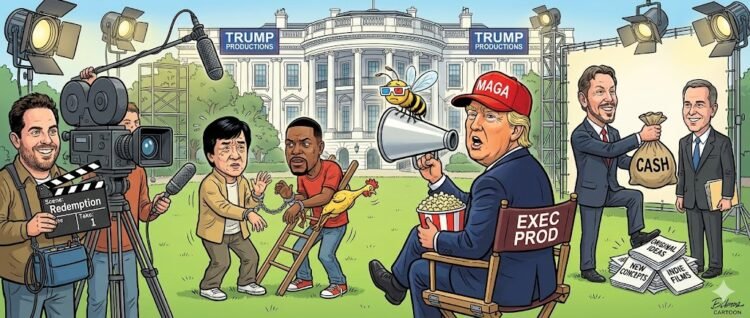
We often tell ourselves that power is about nuclear codes, interest rates, and the invisible hand that moves aircraft carriers across the chessboard of the Pacific. But in the twilight of the American empire, power is apparently the ability to force a major Hollywood studio to greenlight a buddy cop sequel that nobody asked for because the President of the United States misses the specific, comforting rhythm of Chris Tucker shouting at Jackie Chan.
The resurrection of Rush Hour 4 is not a story about fan demand. It is not a story about a brilliant script that finally cracked the code. It is a parable about the terrifying whim of a 79-year-old man who has decided that if he cannot fix the economy, he can at least fix his Saturday night movie rotation. The film had been gathering dust in a corporate drawer since 2017, largely because its director, Brett Ratner, had become a radioactive isotope in Hollywood following multiple allegations of sexual misconduct. In a normal timeline, that would be the end of the story.
But we do not live in a normal timeline. We live in a reality where the President can pick up the phone, call his billionaire friend Larry Ellison—whose Skydance Media now controls Paramount—and essentially order a cultural airstrike on the concept of “cancellation.” The result is the lurching, zombie-like return of a franchise that feels less like a movie and more like a state-sponsored comfort blanket for a leader who believes the 90s never should have ended.
The mechanics of this deal are a study in the new cronyism. Ratner didn’t get back into the director’s chair because he apologized or because he reinvented his craft. He got back in because he made a forty-million-dollar documentary about Melania Trump for Amazon MGM. He paid his tribute to the crown, and in exchange, he was granted a pardon from the cultural gulag. He shopped the Rush Hour script for years, getting door after door slammed in his face by Warner Bros. and the streamers, who looked at his baggage and decided it wasn’t worth the headache.
Then the call came from the White House. Suddenly, the calculus changed. Larry Ellison, a man whose wealth insulates him from everything except the desire to be close to power, agreed to finance the project. Paramount, reading the tea leaves of a second Trump term where antitrust regulators are weaponized against enemies and rubber stamps are handed out to friends, hammered out a distribution deal with Warner. It was a transaction that bypassed the entire creative ecosystem of Hollywood and connected the Oval Office directly to the greenlight committee.
Critics like Puck’s Matt Belloni have already christened this venture “the dumbest possible state-controlled media,” and they are right. But it is also the most revealing. It slots neatly into the administration’s broader, stated agenda of “retraditionalizing” Hollywood. This isn’t just about one movie; it’s about terraforming the culture war until it resembles a Blockbuster Video shelf from 1998.
We are seeing the assembly of a sort of cultural cabinet, a league of extraordinary gentlemen who haven’t been relevant since the Clinton administration. Sylvester Stallone, Jon Voight, and Mel Gibson have been floated as informal envoys, the elder statesmen of a masculinity that Trump recognizes and understands. They are the avatars of an era where problems were solved with a roundhouse kick and a one-liner, where the good guys were obvious, the bad guys were foreign, and the women were decorative.
Trump is not just watching movies; he is trying to curate reality to match the movies he likes. He is fixated on resurrecting the “masculine legacy franchises” because they offer a coherent moral universe that comforts him. In Rush Hour, the loud American and the stoic foreigner overcome their differences to punch bad guys. It is simple. It is loud. It is devoid of the nuance, the ambiguity, and the “wokeness” that he believes has poisoned the modern world.
But there is a dark, gnawing irony at the heart of this project. This is a President who consistently insists that the cupboard is bare when it comes to the actual needs of the citizenry. We are told there is no money for SNAP benefits to feed hungry families. We are told housing vouchers are too expensive. We are told student debt relief is a fiscal impossibility that will bankrupt the republic. The answer to every plea for social scaffolding is a shrug and a lecture on austerity.
Yet, when it comes to reviving a mid-tier action comedy franchise to soothe the President’s nostalgia, heaven and earth can be moved. The capital flows instantly. The studio heads bow. The distribution deals are signed. It turns out that the resources exist, they are just allocated according to the whims of the King rather than the needs of the peasants.
We are left to watch as Jackie Chan and Chris Tucker are pulled out of semi-retirement to serve as the unofficial court jesters of MAGA. They are being drafted not to entertain the masses, but to perform for an audience of one. The global reach of the American studio system, once the envy of the world for its ability to export dreams, is being repurposed to export the specific daydreams of a geriatric leader who wants to feel like it’s 1998 again.
This blurring of the line between personal fandom, propaganda, and public culture is disorienting. It forces us to ask whether we are living in a democracy with a film industry, or a cinematic universe where the showrunner has a nuclear arsenal. When the President gets to pick the sequels, the culture ceases to be a reflection of the people and becomes a projection of the leader’s psyche.
The danger here is not that Rush Hour 4 will be a bad movie—though the odds are certainly in favor of that. The danger is what it signals about the consolidation of power. It signals that there is no sphere of American life, no matter how trivial, that is safe from the intervention of the executive. It signals that the “free market” of ideas is actually a rigged casino where the house always wins, provided the house is owned by a donor.
Ratner’s rehabilitation is the perfect subplot for this era. It proves that in Trump’s America, there are no permanent consequences for misconduct, provided you are useful to the regime. You can be disgraced, you can be exiled, but if you are willing to hold the camera for the First Lady, you can come back. It is a moral hazard writ large, a signal to every bad actor that redemption is just a favor away.
As we brace ourselves for the inevitable press tour, where Tucker and Chan will be forced to smile and pretend this was a labor of love rather than a command performance, we should remember what we are actually watching. We are not watching a movie. We are watching a flex. We are watching a demonstration of raw, unadulterated power used for the most petty and personal of ends.
The President wants to laugh. He wants to see things blow up. He wants to hear the familiar banter of his favorite characters. And because he is the President, and because his friends own the studios, he is going to get exactly what he wants. The rest of us are just extras in the background, wondering why we can’t get healthcare but we can get a sequel to a movie that should have stayed in the 90s.
Receipt Time
The financing of this film is a roadmap of the new oligarchy. Larry Ellison isn’t just a studio head; he is a top donor, a tech titan, and a man whose interests are deeply entwined with the regulatory environment of the next four years. By financing Trump’s pet project, he isn’t just making a movie; he is buying insurance. He is ensuring that when the time comes to discuss AI regulations or cloud computing contracts, his call will be taken. The $100 million budget for an action comedy is a rounding error compared to the billions at stake in federal contracts. It is a bribe disguised as a blockbuster. And the fact that it is happening in plain sight, celebrated as a “return to form” for Hollywood, is the ultimate indictment of a system that has decided it is easier to cater to the king than to compete in the marketplace.