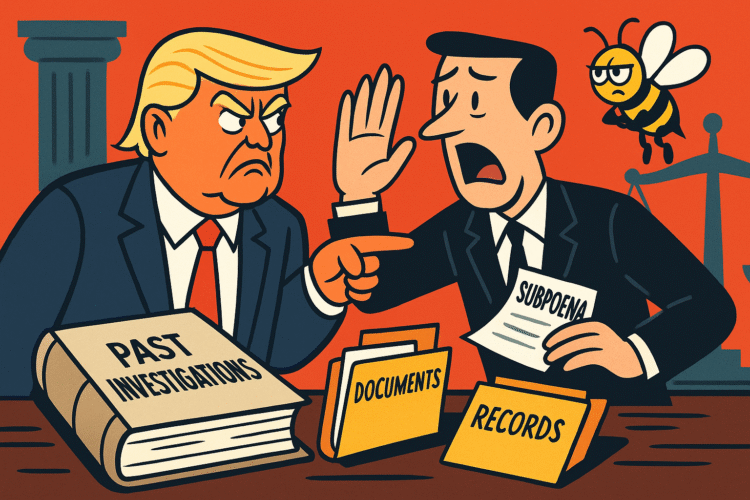
There is a certain kind of breaking news alert that feels less like journalism and more like a smoke alarm that only goes off after the house is already engulfed. The latest comes from the Southern District of Florida, the federal jurisdiction that has spent the past decade juggling everything from Mar a Lago search warrants to the sort of indictments that inspire cable news hosts to dust off their Latin. Verified reporting indicates that the U.S. Attorney there convened a division wide meeting after two prosecutors abruptly resigned rather than sign on to what insiders are now calling a “grand conspiracy” probe into former intelligence and law enforcement officials. Nothing says robust democratic institutions like your top prosecutors walking out five minutes before the meeting that decides whether their office will be repurposed as a political trebuchet.
The meeting reportedly took place in the afternoon, which is the perfect time to decide whether the Department of Justice will remain a law enforcement agency or pivot fully into historical revisionism. For months, Trump allies have been hyping this Florida based probe as the venue to rewrite the last decade with the power of subpoena. Not figuratively. Literally. According to their public posts, this is the investigation that will prove everything from the Russia probe to the Steele dossier to the Crossfire Hurricane timeline was a deep state fever dream designed to persecute the one man who has never, in the entire trajectory of American governance, been persecuted by anything except tofu and factual statements.
Even more sensational were the reports that a grand jury would convene in January, a detail blasted across social feeds with the breathlessness normally reserved for meteor impacts and Taylor Swift Easter eggs. Newsrooms scrambled. Analysts perked up. And court watchers began rummaging through dockets like raccoons rifling a bag of winter trash, looking for any hint of who was being targeted, why, and under which statute. Meanwhile, the prosecutors who walked out did so precisely because they did not want to be part of a criminal investigation designed by political surrogates who appear to believe that obstruction statutes are optional if invoked with patriotic fervor.
To understand how this moment became possible, we need a timeline. It begins with the resignations, both apparently submitted in rapid succession once it became clear that the office was being asked to sign onto an investigative blueprint that reads like a Reddit manifesto. Following the departures, the U.S. Attorney called every division member into a unit wide huddle, a sentence that does not inspire confidence when discussing federal law enforcement. Shortly afterward, social media was ablaze with claims that grand jury sessions were on deck for January. And layered beneath it all was the unmistakable echo of previous efforts to target the investigators who worked on 2016 election interference, efforts that fizzled under previous administrations but have been resurrected with new force by people who think accountability is a one way street.
Legally, this is a minefield with the lights switched off. Grand jury secrecy under Rule 6(e) means that anything the public thinks it knows is almost certainly incomplete or spun. DOJ appointment and supervision rules create specific chains of authority that cannot be bypassed without creating reversible error. If lawmakers become targets, the Speech or Debate Clause will hover over the proceedings like a grim reaper with tenure, ready to dismantle any subpoena that tries to tug legislative acts into the criminal arena. And looming over everything is the risk of obstruction if presidential directives, public threats, or preemptive pardons intersect with ongoing grand jury work. The law does not bend simply because one branch of government wants a specific narrative to prevail. At least, not yet.
The stakes are high enough that watchdog groups are already issuing statements about the weaponization of criminal law for political purposes. Defense attorneys are gaming out how subpoenaed witnesses will navigate compelled testimony after recent mass pardons narrowed the Fifth Amendment to a thin, brittle wafer. Agencies and carriers are bracing for expansive records demands, because these investigations often begin with data sweeps that treat phone metadata like a buffet to be devoured at scale. And journalists are trying to decode which parts are legal fact, which parts are political performance, and which parts are a hybrid performance art piece with subpoenas as props.
The broader context is unavoidable. Criminal law is now a political cudgel in the hands of a president and a movement determined to reverse engineer the last ten years of investigative history. The idea is not subtle. If you prosecute the investigators, then the original investigation becomes suspicious. If you turn former intelligence officials into targets, then the intelligence they produced becomes tainted. If you throw a cloud of conspiracy over anyone who ever said the words election interference out loud, then the documented evidence of interference begins to look like partisan choreography rather than a national security assessment. This is not law. This is psychology with a badge.
There is also an uncomfortable truth that even satire cannot soften. The DOJ is built on norms that assume the people in charge actually care about legal legitimacy. When they do not, the structure bends. Not in a single dramatic moment. It bends through memos, recusals that never happen, taskings that should never be ordered, and the quiet rearrangement of priorities. It bends when prosecutors who refuse to cross lines resign, leaving behind colleagues who may or may not be willing to say no. It bends when meetings are convened not to protect cases from political interference but to align everyone on how much interference they can stomach before it becomes untenable.
All of this makes the next seventy two hours especially important. This is when the office must decide whether to file internal comfort memos, the kind that clarify scope, conflicts, and chains of command. These memos matter because they become evidence later if anyone claims the investigation was improperly influenced. Judges may issue orders clarifying which prosecutors have lawful authority to sign subpoenas, which signals whether the grand jury claims are grounded in fact or theater. Grand jury reporting dates may surface on the docket, which would provide the first concrete indication of whether January sessions are real or imagined. Targets may receive preservation notices, which mark the moment when the government formally believes evidence is at risk. And reporters may finally begin to print the verbs plainly, identifying who ordered what, which statutes are being invoked, and whether this is an investigation looking for facts or facts being tortured until they confess to a prewritten conspiracy narrative.
There is a saying in federal prosecution circles, quietly passed down through generations of lawyers who still believe the law has a backbone. Real cases build themselves. Conspiracies require curation. What we have here is not a case that built itself. It is a case being constructed like a diorama, with political figures choosing targets first and hoping that evidence materializes through sheer force of belief. The danger is not simply that this probe exists. The danger is that its existence signals a shift in how criminal justice is understood by the people who wield it. It becomes less a system of accountability and more a tool for rewriting history.
It is no coincidence that the rhetoric around this investigation mirrors the rhetoric used by the president and his allies for years. When the facts do not support your story, you do not change your story. You change the facts. You hunt the investigators. You cast doubt on everything and demand allegiance as the price of entry to reality. You use grand juries as theaters of intimidation. And you pretend that the law is whatever you need it to be in the moment you need it.
But the law does not disappear because someone wishes it to. It frays. It stalls. It is pressured. But it remains, waiting for someone with enough standing and enough courage to point to the wreckage and say, out loud, that none of this is normal. Whistleblowers begin that process. So do resigning prosecutors. So do judges who issue narrowly written orders that do not name names but signal that boundaries are being crossed.
It will be tempting to treat this as just another moment in a political era defined by absurdity. But satire only lands when the audience understands the stakes. If this probe proceeds as rumored, the stakes are not merely reputational. They are structural. Using criminal law to chase ghosts from the past is the kind of thing countries do when they are tired of democracy’s untidiness and want a narrative that fits on a bumper sticker. If the prosecutors who resigned are telling the truth about why they left, then the SDNY and EDNY may not be the only offices where the future of independent prosecution is being quietly debated in hallways and whispered over late night drinks.
The next ninety six hours will reveal everything. And the test will not be whether the subpoenas fly or the grand jurors file in. The test will be whether the country recognizes the difference between prosecution and performance. Whether judges insist on rule based authority. Whether the DOJ leadership confirms or contradicts its own internal documents. Whether the press prints the story plainly rather than drowning it in euphemism. Whether the public sees the shape of the attempt, not just its surface.
Because in the end, this is not about the deep state or the investigators or the targets. It is about power. Who gets to use it. Who gets to refuse it. Who gets to bend it toward their narrative. And who stands up and says that criminal law is not a toy, not a weapon, and not a political consolation prize for losing the last ten years of fact based history.
Satire can only do so much. The rest is up to the people willing to say the quiet part out loud: this looks less like an investigation and more like a prosecution in search of a script.