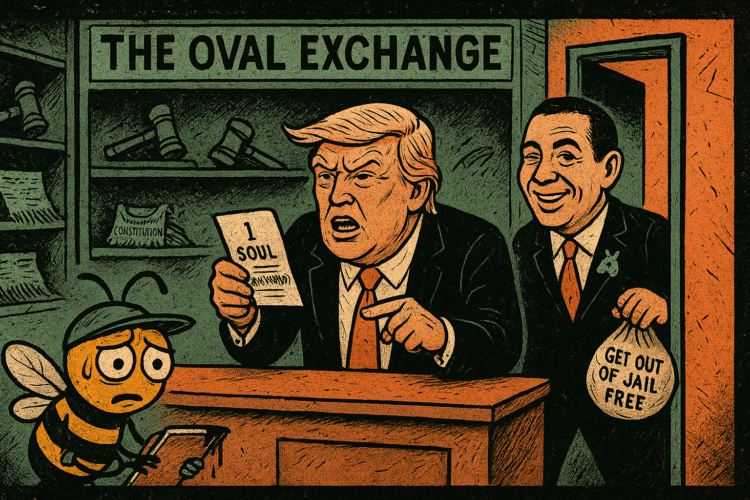
The President thought he was purchasing a party switch with a pardon, but he forgot that in Texas, you take the cattle and leave the cowboy holding the rope.
There is a specific, grimy elegance to the way Donald Trump approaches the presidency. He does not view it as a constitutional office or a sacred trust. He views it as a swap meet. Every power granted by Article II is just inventory on a shelf, waiting to be traded for a favor, a compliment, or a vote. Usually, these transactions happen in the subtext, hidden behind layers of executive privilege and carefully worded press releases about “justice” and “mercy.” But on December 3, the subtext decided to scream. The President issued full pardons to Democratic Representative Henry Cuellar and his wife, Imelda, wiping away a sweeping federal indictment that alleged a $600,000 bribery-and-conspiracy scheme involving Azerbaijani oil money and Mexican bank drafts. And then, mere days later, the President went on social media to scream about “LOYALTY.”
It was the geopolitical equivalent of buying someone a drink at the bar and then flipping the table when they refuse to go home with you.
The sequence of events is so clumsy it would be cut from a season of Veep for being too on-the-nose. First, the White House framed the pardon as a noble strike against a “weaponized” Department of Justice. They claimed that Cuellar, a moderate Democrat who occasionally votes with Republicans and frequently annoys his own party, was the victim of a Deep State witch hunt. Never mind the gold bars, the shell companies, or the fact that the indictment read like a how-to manual for laundering foreign influence. In Trump’s narrative, Cuellar was a martyr. He was a fellow traveler on the road of persecution.
But then came the filing deadline.
The unspoken assumption in Trump’s orbit—an assumption that was likely spoken very loudly in private phone calls—was that the pardon came with a price tag. The price was a party switch. Trump wanted Cuellar to cross the aisle, defect to the GOP, and help consolidate a Republican majority in the House. It was a simple transaction: I give you your freedom; you give me your seat.
Henry Cuellar, however, apparently decided to play a different game. He took the pardon. He pocketed the clemency. He watched the federal charges evaporate like mist in the Laredo heat. And then he filed for reelection as a Democrat.
The resulting explosion from the White House was instantaneous and revealing. Trump publicly scolded Cuellar for a “lack of LOYALTY.” Note the capitalization. It is not “judgment” or “ideology” or “patriotism.” It is LOYALTY. It is the feudal demand of a lord to his vassal. By using that word, and by linking it directly to the pardon, the President stripped away the last shred of pretense that this act of clemency had anything to do with justice. It was a purchase order. And the goods were not delivered.
The Quid Pro Quo with the Quiet Part Out Loud
We are used to corruption in Washington. We are used to the subtle greasing of wheels and the revolving door of lobbyists. But this is something different. This is corruption that doesn’t even have the decency to be ashamed of itself. It is a transactional rescue operation performed in plain sight, with the receipt posted to Truth Social.
Pardons are lawful. The Constitution gives the President broad, almost unchecked power to grant clemency for federal crimes. But using that power as political leverage, as a carrot to induce a party defection, pushes the boundaries of the law into the territory of bribery. If a donor pays a President for a pardon, that is a crime. If a Congressman pays a President with a vote or a party switch, is that any different? The currency has changed, but the transaction remains the same.
The “optics,” a word we use when we want to sound polite about something hideous, are catastrophic. A pardon issued just before a trial is suspicious enough. A pardon followed immediately by a presidential demand for partisan reciprocity is a confession. It creates fertile ground for congressional ethics probes, DOJ internal reviews, and state-level inquiries. But in this environment, “fertile ground” usually just means more mud for the pigs to wrestle in.
The beauty of the Cuellar maneuver is that it exposes the hollowness of the “weaponized justice” narrative. If Trump truly believed Cuellar was innocent, or that the DOJ was corrupt, then the pardon would be its own reward. Justice would be served. The fact that he is angry—that he feels owed—proves that he knows exactly what Cuellar is. He knows Cuellar is (allegedly) corrupt. He just didn’t care about the corruption; he cared about the leverage. He wasn’t freeing an innocent man; he was buying a compromised one.
The “Pardoned Democrat” Paradox
Now we have to look at the concrete electoral consequences, which are equally absurd. Cuellar is running for reelection in a newly redrawn Texas district that leans Republican. He is doing so as a Democrat who was just pardoned by a Republican President who is now attacking him. The political calculus here is so complex it requires a supercomputer to untangle.
Does the pardon help him? Maybe. It keeps him out of prison, which is generally considered a plus for a campaign. But it also brands him as Trump’s pet, or worse, Trump’s failed investment. Democratic voters in the district have to decide if they want to vote for a guy who was saved by the MAGA king. Republican voters have to decide if they want to vote against the guy their leader just tried to recruit.
It transforms the pardon into a blunt instrument of party calculus. Trump thought he was buying a defection. Instead, he might have just handed the Democrats a seat they would have lost if Cuellar had gone to jail. The irony is delicious. By trying to be clever, by trying to subvert the judicial process for political gain, Trump may have accidentally strengthened the very party he was trying to weaken.
House leaders are now in a bind. Do they discipline Cuellar? Do they embrace him? He is a man who walked through fire and came out with a letter from the President saying he’s clean. But everyone knows the letter is fake. Everyone knows the stains are still there. The “weaponized” DOJ didn’t invent the bank drafts from Mexico. They didn’t hallucinate the Azerbaijani influence. The evidence was there. The pardon didn’t erase the facts; it just erased the consequences.
The Ethics of the Bazaar
This episode forces us to confront the degradation of the pardon power itself. The Founders intended it to be a safety valve, a way to correct miscarriages of justice or heal national wounds. They did not intend it to be a stash of Bitcoin to be traded for political favors.
When you use clemency as a recruitment tool, you corrode the separation of powers. You tell the judicial branch that their work is irrelevant if the defendant has something the President wants. You tell the legislative branch that their members are for sale. You tell the public that there is no such thing as “guilt” or “innocence,” only “leverage” and “loyalty.”
The press investigations will dig into this. They will triangulate the timelines. They will find the intermediaries who brokered the deal. They will ask who said what to whom. But we already know the answer. The answer is in the tweet. “Lack of LOYALTY.” That is the whole story.
It suggests a worldview where the Presidency is a feudal lordship. The King grants favors, and the subjects pay tribute. If the tribute is withheld, the King rages. It is not the behavior of a democratic leader. It is the behavior of a mob boss who is angry that the guy he sprung from the joint didn’t kick up the envelope on Friday.
The Grifter vs. The Grifter
There is a certain dark comedy in watching two transactional politicians try to hustle each other. Trump, the master of the deal, thought he had Cuellar cornered. Cuellar, a survivor of South Texas politics, saw an opening. He took the pardon, which he desperately needed, and refused to pay the price, which he deemed too high.
It is a reminder that in a world of zero integrity, trust is impossible. You cannot have a “gentleman’s agreement” when neither party is a gentleman. You cannot have a contract when both sides view contracts as suggestions.
Trump is furious because he feels cheated. He feels like he paid for a service he didn’t receive. But he can’t sue. He can’t go to the Better Business Bureau. He can only tweet. He is trapped in the logic of his own corruption. He corrupted the pardon power to get a political win, and the corruption ate the win.
Cuellar, meanwhile, has to walk the halls of Congress knowing that he is a walking, talking monument to the transactional nature of modern politics. He is not free because he was innocent. He is free because he was useful. And now that he has ceased to be useful to the man who freed him, he is vulnerable in a new way.
The Institutional Aftershocks
The legal aftershocks of this will be felt for years. Journalists and watchdogs will use this case as a baseline for measuring future abuses. “Is this a Cuellar situation?” will become the question whenever a pardon looks fishy.
It also invites state-level inquiries. Presidential pardons only cover federal crimes. If there are state crimes buried in that $600,000 scheme, Cuellar is not out of the woods. And now, he has a very powerful enemy who might encourage local prosecutors to take a look.
The Justice Department, currently being purged and reshaped by the Trump administration, has to swallow this indignity. They spent years building a case. They tracked the money. They flipped the witnesses. And then the boss walked in and kicked over the sandcastle. It is demoralizing. It drives good people out of government. It signals that the work of justice is secondary to the whims of politics.
And what of the voters? They are left to watch this spectacle and wonder if any of it is real. The indictment was real. The money was real. The pardon is real. But the “justice” part? That seems to be the only fiction in the story.
The “weaponized DOJ” narrative has become a self-fulfilling prophecy. By claiming the DOJ is political, Trump justifies using the pardon power politically. He breaks the system to prove it is broken. It is a cynical loop that leaves the rule of law in ruins.
The Loyalty Test
Ultimately, this story is about the definition of loyalty in the Trump era. Loyalty does not mean fidelity to the Constitution. It does not mean fidelity to the law. It does not even mean fidelity to a party platform. It means personal submission to the leader.
Cuellar failed the test. He took the gift but refused the submission. In doing so, he exposed the mechanism. He showed us the gears grinding behind the curtain. He showed us that the “mercy” of the President is actually just a down payment.
The fact that Trump shouted about it so publicly is a gift to the satirist, but a curse to the country. It removes the ambiguity. We don’t have to guess if there was a quid pro quo. The quo was demanded in all caps.
So we enter the 2026 cycle with a new precedent: The President can and will trade justice for votes. And if you are a politician facing indictment, you have a choice. You can hire a lawyer, or you can hire a lobbyist who knows the way to Mar-a-Lago. Just make sure you read the fine print on the loyalty oath before you sign the receipt.
Receipt Time
The bill for this transaction has been left on the table, and the tip is an insult. We are paying for this theater with the credibility of our legal system. We are watching the concept of “equal justice under law” be replaced by “justice for those who have something to trade.” The receipt shows a charge for “Clemency” and a credit for “Betrayal,” and the balance due is the public trust. The pardon of Henry Cuellar wasn’t an act of grace; it was a bounced check in the marketplace of political favors. And the only thing sadder than the corruption is the incompetence of the people trying to pull it off.