A field guide to déjà vu in a country pretending it has never read this chapter
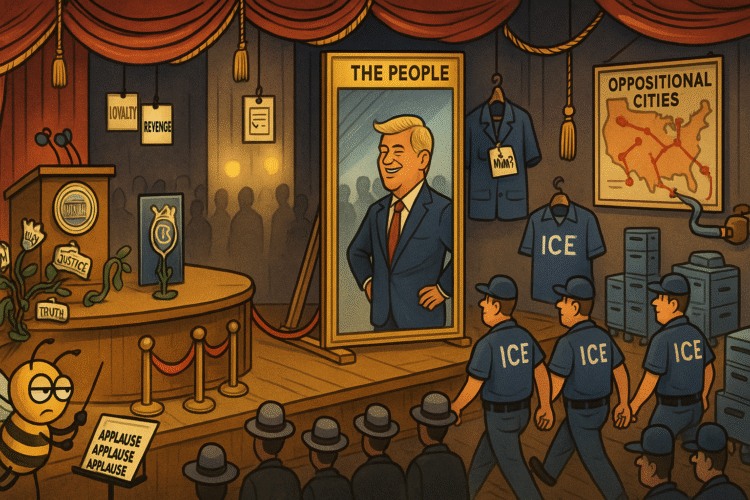
He tells a story about a wounded nation and casts himself as the cure, and the lights are bright because glare is a better costume than truth and the soundtrack thumps because rhythm is easier to remember than evidence. The promise is not complicated, only loud, that humiliation will be reversed and chaos will be sorted and civilization will be rinsed like a shirt on laundry day, and if you squint hard enough at the staging you can see a familiar silhouette from an older theater where the script already played to disastrous reviews. We were taught to call that earlier production a cautionary tale, but caution is not fashionable in a culture that prefers the dopamine of spectacle, so we pretend not to recognize the set while quietly measuring the exit signs, just in case.
The parallel begins with grievance promoted to destiny, because the quickest way to turn a crowd into a congregation is to tell them their pain has a holy sponsor, then hand them a villain shaped like anyone who does not love the leader correctly. In both eras the leader is a narrator with a favorite pronoun, and it is not we, history shrinks to fit the mirror and the path forward narrows until it looks like a runway to a private plane. Restoration is promised without receipts, and the crowd nods because receipts are for shoppers and what they want is sacrament, because sacrament is easier to explain to your uncle than a spreadsheet.
The pageantry is not decoration, it is the oxygen, and the balcony becomes the rally, then the rally becomes the broadcast, then the broadcast becomes a constant algorithm that follows you to the restroom and recommends a chant while you wash your hands. Glare makes you feel informed even when you are only illuminated, and a glittering stage is a disinfectant for doubt, because the human brain is a magpie that thinks shine means security. The old story had floodlit parades and synchronized arms, the new one has playlists and merch and cameras set to the angle that makes power look like purpose.
The press must be renamed to make this work, because no cult enjoys a mirror unless it can choose the angle, and both versions of the show prefer critics recast as pathogens rather than colleagues. Once reporting becomes a contagious disease, anyone carrying facts becomes a biohazard, and the right medicine is whatever the man with the microphone prescribes while looking directly into the lens like a late night vitamin salesman. Bias becomes any sentence that fails to curtsy, balance becomes a tie score between the truth and the most confident lie, and the public learns to grade reality on a curve that resembles a signature.
Then the courts, because referees are glamorous until they throw a flag, and suddenly independence looks effete and legal constraint looks like sabotage and judges acquire nicknames as if they were tabloid characters rather than constitutional adults. The earlier chapter taught us that contempt for lawful guardrails is not a phase, it is a business model, and jokes about limiting doctrines are just throat clearing before the executive tries to swallow the room. If the crowd laughs at the punchline, the next attempt is less joke and more memo, and the memo turns into a doctrine tested against sleepy institutions that forgot where they stored their spines.
Scapegoats arrive as metaphors before they arrive as manhunts, because language is a rehearsal for the hand, and both periods adore the vocabulary of contamination and purity since those words do moral labor quickly and photograph well. Neighbors become categories, categories become case numbers, case numbers become maps with arrows, and the solution is always removal, since removal is tidier than justice and far more televisual than empathy. When a leader calls difference a diagnosis, the cure is already shopping for uniforms, and the crowd practices immunity by pretending not to know the family next door.
This is where the so called immigration fix graduates into theater with teeth, and the agency designed for civil enforcement starts dressing like a personal legion, because nothing flatters a strongman fantasy like a federal badge that comes with zip ties and a budget. The promise is simple and not simple, that ICE will act on desire as if desire were statute, that mass roundups will be logistics rather than lives, that neighborhoods will be canvased the way catalogues are mailed, and the applause will drown out the paperwork. The earlier century used brown shirts, the current century prefers polos with tactical vests, but the choreography is the same, produce fear on Monday, declare it solved on Tuesday, then announce that fear has been scheduled for Wednesday just in case the ratings dip.
When the state’s own soldiers seem insufficiently available, the solution is to flatter the dream of federalizing the National Guard, not for floods or fires or bridges but for a leader’s grievances that have been rebranded as emergencies, because emergencies are the magic spell that turns hesitation into obedience. The request is always wrapped in law and order perfume, but the scent is possession, that the commander in chief should inherit every uniform in the land like a closet of obedient jackets that can be worn to match the mood. The earlier chapter used decrees and street militias, the present fantasy prefers press conferences and talking points, yet the intention hums the same tune, take what belongs to the many and let one person sign the travel orders.
Oppositional cities are recast as hostile jurisdictions, which is administrative poetry for disobedient neighbors, and the budget becomes a leash that can be yanked whenever a mayor wins an argument on television. If the city votes the wrong color or protects the wrong people or prosecutes the wrong allies, the machine tries to close the valve on money and then opens the valve on enforcement, so that policy becomes punishment with receipts. The earlier era had lists and block ward heelers, the current era has spreadsheets and routing numbers, but the logic is the same, make dissent expensive until the council meets in whisper tones.
We cannot avoid the quiet subtext in any of this, because the show prefers not to whisper about racism at all, it prefers to wink about it and then blame the audience for seeing the wink, but the casting choices give the plot away. Blatant racism is not an accidental subplot, it is the drumline, and every time the language swaps citizen for breed or neighborhood for infestation or visa for invasion, the mask slips and the chorus cheers anyway. The earlier period wrote the slur into law with a catastrophic thoroughness, our present stars prefer plausible deniability paired with volume, but a foghorn is not a nuance even if it claims to be weather.
Meanwhile, the leader keeps floating the idea that he alone should be immune to the laws that inconvenience him, which is the late stage tell in every authoritarian romance, and he frames it as efficiency and calls it historical and pretends the Constitution is a fussy roommate who needs a hobby. Oaths become optional for friends and mandatory for critics, and mercy is renamed for one tribe while discipline is renamed for their enemies, and the country is invited to accept this vocabulary because it comes packaged with a flag and a playlist. The earlier chapter solved this with an oath to the man, our chapter auditions the same trick with theories that inflate the executive until the room forgets its size.
If you are waiting for the uniforms to change color, you will miss the rehearsal dinner where the guest list gets sorted into diners and dishes, and the policy memos learn to pronounce purity like a prayer. Fascism loves manners when manners keep dissent quiet, it loves balance when balance gives lies a microphone, and it loves fatigue most of all because fatigue is the cousin of surrender and surrender is easy to schedule. The thirties trained audiences to love the march because the march felt organized, the present trains audiences to love the livestream because the livestream feels intimate, but intimacy can be a very efficient lie.
Let us stay with ICE for a moment because the marketing is persuasive, that law is simply being enforced the way one enforces a parking meter, when in fact the pitch is to convert a civil system into a show of force that answers to a single mood. The crowds are told that raids are like house calls, that detention is like a temporary clinic, that mass hearings are both careful and fast, and that the word sanctuary is an insult rather than a value. A republic that can recite the Pledge of Allegiance should be able to recite the Fourth Amendment, yet the chant gets louder and the knock gets earlier and suddenly neighbors whisper about go bags like they are talking about umbrellas.
Federalizing the National Guard is sold as a remedy for paralysis, but paralysis is often the word used by people who are trying to bypass consent, and the dream here is not coordination, it is control, an army in the hall closet that can be summoned for the optics of order. Floods and fires and bridges are legitimate missions that respect geography and command chains and state sovereignty, while turning the Guard into a personal crowd control instrument converts federalism into a decorative word that looks handsome on a podium. It is the difference between a shared tool and a borrowed hammer that never gets returned, and the borrower insists the hammer asked to stay.
Targeting oppositional cities is not an overstatement, it is the municipal flavor of spite, a strategy that punishes policy disagreement by starving services until the potholes become metaphors, and then using the metaphors as proof that the city deserves punishment. You can close a grant, slow a shipment, delay a clearance, reroute a team, and before long the mayor is spending half their day explaining why the buses no longer align with the hospital shifts. This is not theory, this is budgeting as bat, and it teaches a lesson no civics textbook would dare print, that federal power becomes personal when the person in charge believes the map is a scoreboard.
The racism piece sits like a stain the lighting tech cannot hide, and yet the show insists the stain is patriotic, and crowds are encouraged to call it honesty whenever the line reads like a eugenics postcard with better hair. Policies that pretend to be colorblind reveal themselves by who gets stopped, who gets searched, who gets detained, who gets counted twice, and who is never counted at all, and the promises about safety always seem to come with a photo in which the safe people look like the leader’s favorite mirror. The old story had pseudoscience with charts and calipers, the new story has podcasts with confidence and guests who use the word heritage like it pays rent.
If all of this feels like a heavy lecture, let us try humor, because satire is the little flashlight you keep near the breaker box, and we will need it when the rhetorical power cuts out. Picture the leader presenting a catalog titled One-Man Government, free shipping on orders large enough to smother a city, and on page one is a special edition ICE, now with ninety percent more discretion, page two is a National Guard that folds into a briefcase for convenient federal use, and page three is a bulk discount on selective prosecutions that smell like revenge and come with decals for the truck. The fine print is, as always, invisible ink that only appears after your neighbor signs for the package.
The media will argue about tone like a family debating wallpaper while the ceiling sags, and the showrunners know this, because nothing paralyzes like the etiquette of evenhandedness, especially when one hand has already pocketed the map. Some outlets will say the plan to federalize everything that moves deserves a fair hearing because fairness photographs well, some will describe the transformation of civil agencies into a traveling security entourage as a policy difference between friends, and some will call slurs honest talk about uncomfortable truths while checking the metrics in real time. There is nothing authoritarian loves more than an anchor thanking them for their candor.
What about religion, since every strongman script tries to rent a pew, and the bargain is usually simple, you bless my project and I will bless your list of desired injustices that look righteous from a certain pew, and together we will rename mercy until it fits the election calendar. The earlier chapter enjoyed uniforms near the altar, our chapter enjoys flags near the pulpit, but the trade reads the same, use moral vocabulary to anesthetize policy that would otherwise sound like a siren. It is remarkable how quickly the Beatitudes become a budget line for new handcuffs when the lighting is good.
Business leaders will tell themselves they can make a profit while the storm circles, because capital is a champion rationalizer and the quarterly call needs a bedtime story that ends with less regulation and more predictability and a polite distance from the raids on Thursday. The earlier generation of industrialists thought they were the ventriloquists and woke up as the puppets, and then discovered their hands were not free when the show advanced to its final act. We can save everyone time if we admit that personal rule does not share the stage, it only borrows your resources until the applause requires a new joke.
Let us return to the early thirties for a short, unfunny moment, because the point is not to cosplay historians but to respect a pattern, and that pattern tells us that the slope is not slippery by accident, it is waxed by design. First you normalize the chant, then you normalize the knock, then you normalize the oath to a man, then the uniforms take confidence from the laughter they hear on television, and finally the country wakes up and insists it never saw the rehearsal. We are not there, we are simply surrounded by people asking if the shoes onstage look comfortable, which is the wrong question when you are standing near the trapdoor.
Now the necessary utility section, which is not glamorous, because the answer to this performance is not a better performance, it is fluorescent lighting in boring rooms where people keep copies of things and refuse to skip signatures that were designed to slow hot tempers. Show up for the administrative parts of freedom, which is like telling a teenager that the magic trick is called flossing, but sometimes the difference between a civil agency and a personal militia is a preposition in a manual that someone bothers to read out loud. The satire can make you laugh, but the phone calls make you safe.
Humor again, since we are trying to keep you awake without numbing you, and let us imagine a White House customer service line where the National Guard is out of office because they are already busy sandbagging a river and cannot attend the president’s grievance rehearsal at the airport. Picture a mayor calling to ask where their transit grant went and a hold message explaining that fairness is currently delayed while the leader tests a theory about loyalty points, please remain on the line for another four fiscal years. Picture a press conference where the podium mispronounces a city’s name for the third time and then threatens to remove its courthouse as a lesson in geography.
We circle back to racism because it never left the room, it only changed the lighting, and the insistence that all this has nothing to do with color collapses the moment the map of targeted people is placed next to the voting districts that keep ending up in the crosshairs. If the policy were blind, the outcomes would not squint so hard in one direction, and if the motive were safety, the metrics would not leave so many safe people out of the picture. There is a reason the show keeps booking guests who say demographic shift like it is a weather alert, and it is not because they are practicing meteorology.
The comparison to the thirties is imperfect, because everything is imperfect, and also necessary, because complacency loves originality and insists that modernity is an inoculation rather than a costume change. Our institutions still have muscles, even if they prefer yoga to weightlifting, and federalism still exists, even if it needs coffee, and juries still sit in twelve ordinary chairs that have saved more lives than a thousand speeches. The mirror shows you enough to act, no prophecy required, only the stubborn endurance of people who will not allow an agency to become a stage prop or a city to become a chew toy.
In the end the strongman romance sells one product, a country that belongs to a single voice that promises to arrange your anxieties into a playlist that always ends with applause. The alternative is duller and more durable, a republic that insists on being owned by people who rarely trended and often brought snacks to a long meeting. If you want to know which future you are buying, do not stare at the glittering curtain, stare at the paperwork and ask whether the signature belongs to all of us or just to someone who likes to hear himself narrate democracy as if it were a hobby.
So we laugh where we can, not to make light, but to make seeing possible, and we count what matters, and we refuse to let ICE become a traveling show for a leader’s mood, and we insist the National Guard is for natural disasters, not political ones, and we treat oppositional cities as places where people live rather than venues to be fined for incorrect vibes. We tell the truth out loud about racism with the same energy used to deny it, we track the slur hiding inside the policy acronym, and we do not confuse a chant with consent simply because it rhymes. If the earlier chapter taught us anything, it is that the curtain does not fall on its own, someone has to pull the rope, and then stay to sweep the stage while the audience complains about the dust.
The mirror loves him because the mirror is paid to, but the room belongs to us as long as we keep the lights ordinary and the rules exact, and the uniforms where they were intended to be, serving law rather than desire. We are not doomed, we are not unique, we are not helpless, we are simply invited, daily, to choose between carpentry and theater, between counting and chanting, between neighbors and categories, between a city and a scoreboard. Choose the boring miracle that lasts, choose the law that says no to everyone equally, choose the joke that reveals the contract hiding beneath the confetti, then choose it again tomorrow, because schedules, unlike prophecies, can be kept.