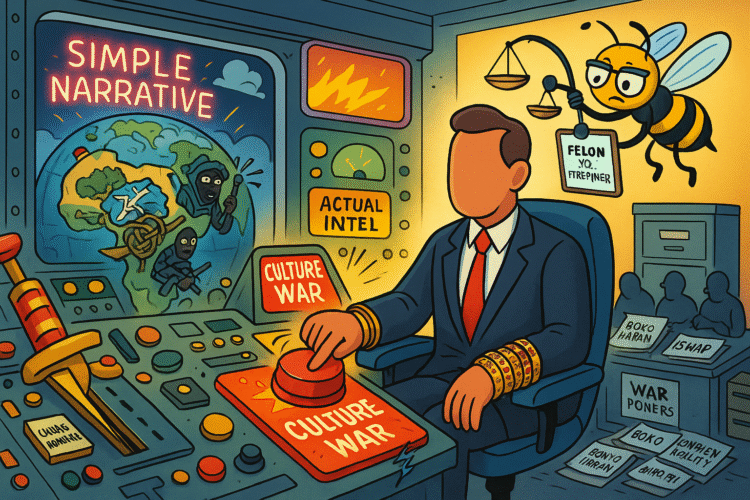
When a complex security crisis becomes a stage prop for a felon who cannot legally hold a handgun, but gets to command the largest military on Earth
Let us begin this meditation in the American contradiction that keeps giving: a man with thirty four felony convictions cannot own a firearm, cannot pass a background check, cannot even walk into Cabela’s without violating release conditions, yet he can, apparently, direct the Pentagon to prepare for “possible action” on the African continent because he read a headline, panicked an evangelical email list, and decided God needed a new press secretary.
If you ever needed a summary of late stage American governance, there it is.
A felon cannot buy a revolver, but he can rattle the world’s largest military because he wants to impress “Christians” who treat foreign policy like a prophecy chart.
And that brings us to the current fever dream. Verified coverage shows that President Donald Trump, in his latest spiritual audition tape for the culture war electorate, has escalated claims of Christian persecution in Nigeria. He is threatening to halt aid. He is directing the Pentagon to prepare options for “possible action.” He is pushing to place Nigeria on the International Religious Freedom Act’s Country of Particular Concern list.
Meanwhile, Nigeria’s government is standing there like a tired parent at a grocery store watching a toddler have a public meltdown, saying gently but firmly that insurgent violence in their country kills both Christians and Muslims, and that any help from Washington should respect sovereignty rather than act like a weaponized sermon.
Nigeria is not a religious-themed episode. It is a state with more people than Russia and more complexities than any American campaign speech can handle. But Trump does not want complexity. He wants applause.
The Non-Election-Year Crusade Nobody Asked For
This is not an election year. There is no ballot box at the end of this tunnel. This is not strategic. It is not diplomatic. It is not internationalism.
This is Trump trying to lock down a political base that sees the world through a single lens: are Christians being persecuted somewhere, anywhere, at any scale large or small, in any context that can be hammered into a PowerPoint? If yes, then send the Marines.
And if the facts do not show persecution, the facts can be rearranged.
Trump has found his new favorite toy: Nigeria as a symbolic battleground for Christian suffering. It is inaccurate. It is inflammatory. It is irresponsible. And it is precisely the kind of thing someone does when they are losing control of reality but gaining control of a voter demographic that loves biblical worldbuilding.
What Is Actually Happening in Nigeria
There is a real security crisis in Nigeria. A catastrophic one.
But not the one the President is selling.
Nigeria’s violence comes from multiple overlapping sources:
Boko Haram’s enduring insurgency in the northeast.
ISWAP’s territorial ambitions.
Bandit networks that kidnap and massacre indiscriminately.
Farmer-herder conflicts sharpened by climate pressures.
Communal violence in central states where religious identity often overlaps with land and political grievances.
In these conflicts, Christians have died. Muslims have died.
Villages have been burned.
Families displaced.
Regional stability shaken.
But the idea that this is a one-directional war on Christians is not what any Nigerian security analyst is saying. It is not what their government is saying. It is not what intelligence assessments say. It is not what casualty data says.
This is a nation experiencing violent extremism, fragmentation, and governance strain.
Not a spiritual sequel to medieval persecution fantasies.
The Timeline of Trump’s Deep End Descent
The last few days would read as satire if not for the nuclear codes and multiple aircraft carriers involved.
Trump posts on Truth Social about Christian genocide in Nigeria.
He goes on camera announcing he has directed the Pentagon to prepare for “possible action.”
He threatens aid cuts.
He signals that he wants Nigeria labeled as a Country of Particular Concern under IRFA.
Agencies scramble behind the scenes to figure out whether this is a policy directive or a tantrum.
Nigeria responds with diplomatic poise.
President Bola Ahmed Tinubu reminds the world that violence is not unilateral.
He stresses sovereignty.
He stresses proportionality.
He implies, politely, that America should stop conducting foreign policy via domestic culture war.
But here we are anyway.
The Legal Tools Trump Pretends He Understands
The International Religious Freedom Act allows the United States to impose sanctions on countries that violate religious liberty. But it also allows the president to waive those sanctions for basically any reason that fits in a footnote.
So Trump can scream persecution while quietly waiving penalties later.
It is the geopolitical equivalent of threatening to ground Nigeria but allowing dessert anyway.
Aid cuts are no easier. Congress controls funding. The courts have already slapped down attempts to condition or halt aid unilaterally. Trump pretending he can shut the faucet off is political theater, not law.
If he genuinely contemplates military engagement, the War Powers Resolution demands congressional consultation. It demands timing. It demands reporting. And it demands the kind of paperwork he famously hates.
Felons cannot purchase firearms, but they still have to file the forms.
Presidents cannot start foreign action without oversight, but they still have to file the forms.
The irony writes itself.
Why This Push Resonates With Some Americans
Trump knows exactly which demographic will adore this story.
It is the same group that made “spiritual warfare” trend on TikTok.
The same group that sees geopolitical conflict as divine proof.
The same group that interprets any violence against Christians anywhere as the final sign of the end times.
The fact that Muslims die in equal numbers from the same insurgencies is inconvenient.
The fact that bandits and extremist groups target everyone is inconvenient.
The fact that the Nigerian government has been fighting these groups for years is inconvenient.
But inconvenience is not a barrier.
It is simply ignored.
The Diplomatic Risk of Turning a Country Into a Sermon
Nigeria is not a chessboard piece.
It is the continent’s largest population.
It is a major economic hub.
It is a regional security anchor.
Treating it like a prop carries consequences.
It undermines cooperation.
It destabilizes messaging.
It emboldens extremists who thrive on narratives of foreign aggression.
It signals to other nations that Washington is governed by whims rather than intelligence.
And it tells the world that America’s foreign policy can be hijacked by the domestic spiritual anxieties of one man who cannot legally borrow a friend’s pistol.
U.S. Strategic Position After the Niger Withdrawal
Another inconvenient detail:
The United States no longer has strong basing leverage in the region following the withdrawal from Niger.
If Trump thinks he can snap his fingers and launch a clean, efficient intervention, he is speaking from a place of absolute ignorance.
There is no easy staging.
There is no clean insertion.
There is no fantasy scenario where drones and special forces solve a conflict that Nigeria itself has been grappling with for over a decade.
But Trump’s foreign policy has never rested on feasibility.
It rests on theatrics.
What Oversight Bodies Are Actually Saying
Advisers and watchdogs who actually study Nigeria point out:
Boko Haram has not disappeared.
ISWAP is growing in sophistication.
Banditry is economically motivated, not spiritually motivated.
Communal violence is often political first, religious only on the surface.
This is not a crusade.
This is a multidimensional conflict.
And when Trump frames it as spiritual warfare, he is not helping Nigeria.
He is helping himself.
The Checkpoints That Separate Policy From Performance
Here is what to watch if you want to know whether this is real or theater:
Will the State Department formally issue a CPC designation?
If yes, will it attach sanctions or quietly waive them?
Will the Pentagon submit a War Powers report or back away from the cliff?
Will Congress impose guardrails on any “possible action”?
Will casualty data shift public perception toward accuracy rather than propaganda?
Will allies push back against unilateral American rhetoric?
Because if none of these things materialize, then what we witnessed was not foreign policy.
It was a livestreamed religious fantasy.
Section Title: The Felon With a Superpower
There is something almost mythic in the absurdity of the moment.
A man convicted of thirty four felonies cannot vote in some states, cannot own a firearm, cannot work in sectors requiring background checks, cannot enter certain countries and cannot lease a storage unit without raising eyebrows.
Yet he can, in this moment, command fleets, mobilize troops, sanction nations and destabilize a region with a single phrase crafted to impress people who believe America is the last fortress of Christendom.
The tragedy is not that he has this power.
The tragedy is that he uses it to perform for a crowd rather than govern for a world.
And Nigeria, a nation fighting real horrors, gets recast as a character in his spiritual drama.
The world deserves better than this.
And so do we.