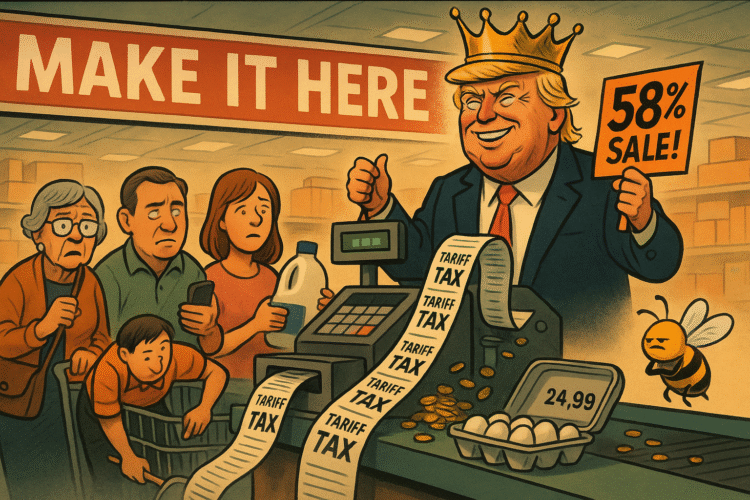
It’s a strange feeling to live inside a macroeconomic cautionary tale while your grocery receipt doubles as documentation. From North Carolina’s Walmarts to Oregon’s farmers’ markets, the new national pastime isn’t baseball—it’s comparing the price of eggs like it’s insider trading. Somewhere between the auto aisle and the frozen section, America’s grand experiment in “decouple-by-diktat” has stopped being a theory and started being a lifestyle.
The 58% tariff blitz, soon to become a 100% blanket levy if President Donald Trump gets his wish, was supposed to teach China a lesson. Instead, it’s teaching everyone else a crash course in unintended consequences. The math is grim: about a trillion dollars in corporate tariff pass-throughs by year’s end, nine hundred billion landing squarely on consumers, and a typical household absorbing roughly $2,400 in annual pain. That’s not “America First.” That’s “Everyone Else Last.”
Sticker Shock Nation
A Guardian canvass this week reads like a dispatch from the front lines of retail despair. Shoppers are tired, shelves are thinner, and the self-checkout machines now mock you in two languages. In Raleigh, a retiree named Doris explains that she’s started driving to two different stores to cobble together her weekly list: one for discounted vegetables, another for store-brand detergent that doesn’t smell like regret. “I fought inflation once,” she says, “but this feels personal.”
In Portland, a tire shop owner named Marco points to his wall of Goodyears like a general surveying a dwindling arsenal. “These used to come from China,” he sighs, “now they come from Ohio, at a price that could make a grown man cry.” His customers are delaying replacements, patching treads, and bargaining like it’s a souk.
Across the country, the story repeats. Electronics retailers warn of post-holiday “SKU thinning”—a euphemism for “say goodbye to variety.” Appliance sellers quietly swap model numbers to disguise the sticker shock. Grocers cut back on imported produce and bulk up on domestic private labels. What was once globalization’s abundance is now a scavenger hunt wrapped in patriotic packaging.
The Tariff That Ate Thanksgiving
It began in October, with Trump threatening a full 100% levy on Chinese goods after Beijing’s rare-earth clampdown. The announcement hit the markets like a sledgehammer wrapped in a slogan. Retailers scrambled, importers called lawyers, and consumers googled “What does 100% tariff mean?”
By November 1, unless an off-ramp materializes, every crate, container, and cheap coffee maker crossing the Pacific will arrive pre-seasoned with the economic equivalent of chili powder: inflation that burns twice.
Corporate America, meanwhile, is caught in a hall of mirrors. Officially, the tariffs are “national security measures.” Unofficially, they’re a campaign prop. The legal justifications read like Mad Libs: “To protect [noun], we must tax [noun] imported from [geopolitical rival].” The Commerce Department insists this is about sovereignty. The Treasury Department insists it’s “transitory.” The Federal Reserve insists it’s about to be a migraine.
Central bankers, normally allergic to plain English, are now warning that “the consumer sting has not yet been fully realized.” Translation: if you think it’s bad now, wait until Christmas.
Decoupling at Gunpoint
In the early days of the tariff surge, corporations did what they always do—pretend to absorb the cost. Executives reassured investors that they’d “manage exposure,” a term that means “pray to the gods of price elasticity.” But margins are not magic. Eventually, the pain migrates from the boardroom to the checkout aisle.
When you add a 58% surcharge to imports that undergird the entire retail ecosystem—electronics, apparel, appliances, hardware—you don’t get resilience; you get rationing. The Midwest is already seeing regional price spikes because logistics chains that used to be fluid are now clogged with paperwork and paranoia. West Coast ports, once symphonies of efficiency, now resemble tax collection offices with cranes.
It’s a decouple-by-diktat economy, run by tweet and tremor.
The Patriot’s Price Tag
Politically, the tariffs were meant to look like strength. In practice, they feel like a tax wrapped in a tantrum. The slogan was “Make it here.” The fine print is “Pay for it there.”
Polling from swing counties already hints at buyer’s remorse. Independent voters, who once cheered the “economic patriotism,” now face $6 cereal and $4 gas. The average household’s $2,400 tariff burden is invisible until it isn’t—until the cart total jumps and the cashier avoids eye contact.
The administration insists that “short-term discomfort” is necessary to achieve “long-term independence.” That phrase has been used to justify everything from austerity to annexation. Independence, it turns out, costs extra.
Even small-town conservatives are muttering about “Trump’s invisible tax.” One hardware store owner in Iowa put it bluntly: “He said he’d build walls, not raise prices.”
The Great American Bargain Hunt
Welcome to the new normal: the multi-stop errand loop. You start at Walmart for paper goods, swing by Aldi for off-brand cereal, then hit Dollar Tree for cleaning supplies that may or may not dissolve the surface they touch. The modern American consumer is now part economist, part scavenger, part survivalist.
Store brands have become both a badge of pride and a cry for help. The once-maligned “Great Value” logo now feels like a rebellion against economic absurdity. Social media influencers post “tariff hacks” the way Depression-era housewives shared recipes for soup made from hope and onions.
In this brave new world, the measure of patriotism isn’t a flag pin—it’s how many stores you’re willing to hit before sundown.
The Corporate Shell Game
Small retailers are caught in a no-win scenario. If they eat the tariffs, they go under. If they pass them on, customers revolt. If they complain, they’re accused of being unpatriotic.
A boutique owner in Asheville describes her dilemma: “We switched to domestic suppliers, but even their materials are imported. It’s tariffs all the way down.”
Meanwhile, corporate chains are quietly rewriting contracts to shift liability downward. Suppliers sign “cost-sharing” clauses that sound cooperative until you realize they mean “you pay for this, too.” It’s capitalism’s version of musical chairs, except the music is Kenny Loggins and the floor is lava.
The Billion-Dollar Punchline
The numbers are staggering. A trillion dollars in tariff pass-throughs by the end of 2025. Nine hundred billion paid by consumers. Two thousand four hundred dollars per household—a number that doesn’t scream on a billboard, but whispers every time you swipe your card.
The White House frames it as sacrifice. Economists call it regressive taxation with better branding. It’s wealth redistribution, but upward. Every dollar squeezed from a cashier’s paycheck becomes a bonus line on a shareholder’s report.
Trump, ever the showman, insists that the tariffs will “bring back American jobs.” What he doesn’t mention is that the first jobs coming back are in lobbying, compliance, and creative accounting. Manufacturing hasn’t returned—it’s rebranded. The factories may be in Texas, but the screws still come from Tianjin.
Inflation’s Encore Performance
Over at the Federal Reserve, the language of restraint is cracking. Chairman Powell’s latest statement was diplomatic panic: “Tariff transmission effects are continuing to evolve.” Translation: this could get ugly. Inflation, which had been cooling like a lukewarm cup of coffee, now simmers again. Rate cuts are postponed, growth forecasts trimmed, and the ghost of stagflation peeks over the horizon.
Monetary policy can’t fix a trade war. You can’t lower interest rates enough to make a $900 fridge cost $700 again. The Fed is left holding the bag while the executive branch throws grenades at supply chains and calls it strategy.
Slogans Don’t Make Steel
“Make it here.”
It sounded good. It looked good on hats. It tested well in focus groups. It’s the perfect four-word myth: nostalgic, nationalist, non-specific. But in practice, it’s economic cosplay. “Here” no longer has factories, not at the scale required. “Here” is a service economy with an Amazon Prime habit. The fantasy of total self-sufficiency died with the Walkman, but the slogan lingers like a ghost haunting checkout lines.
Now, every imported blender or phone case is a reminder that slogans don’t manufacture steel or silicon. They manufacture sentiment. And sentiment can’t cook dinner when the groceries cost double.
The Empire of Receipts
Somewhere in a Costco parking lot, a shopper loads off-brand paper towels into the trunk and mutters, “At least it’s made here.” It isn’t. The pulp came from Canada, the packaging from China, the assembly line from a contractor in Kentucky. But the story feels good, and in an age of curated myths, that’s what matters.
The tariffs were sold as protection, but they’ve become penance. We’re all paying for the illusion of control, one price hike at a time.
The great irony is that economic independence now looks exactly like dependency—on slogans, on scarcity, on leaders who treat trade wars like TikTok trends.
The empire doesn’t fall in a day. It falls $2,400 at a time.
And as the receipts flutter in the wind, the cashiers of America look up, shrug, and whisper the truest slogan of all: No kings.