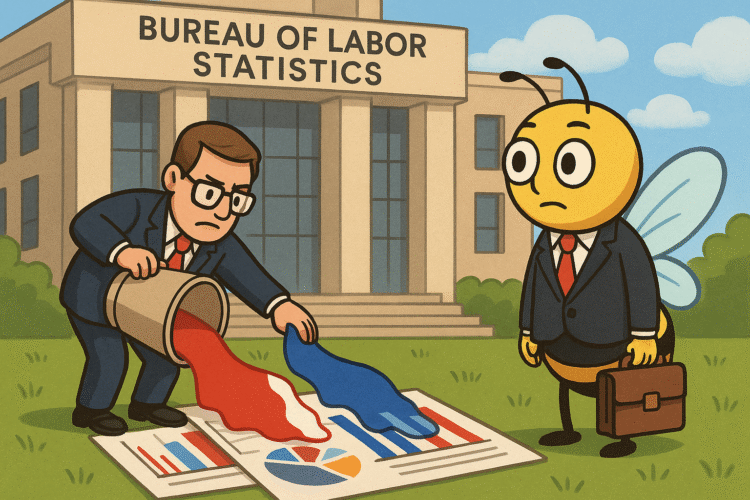
Some appointments are symbolic. Some are strategic. And then there are those that feel like they were made after a particularly spicy Heritage Foundation donor dinner — the kind where the wine flows, the words “free market” are said at least 17 times per minute, and someone accidentally promises to put their favorite think tank number-cruncher in charge of an actual federal agency.
This week, President Donald Trump announced his nomination of a senior economist from the Heritage Foundation to lead the Bureau of Labor Statistics (BLS), the nation’s official scorekeeper for jobs, inflation, and the general economic vibe. It is a choice that makes perfect sense if your definition of “labor” is writing white papers and your definition of “statistics” is whatever number makes the charts look red, white, and blue.
A Quick Refresher on What the BLS Actually Does
For the uninitiated, the Bureau of Labor Statistics is the part of the government tasked with counting things: how many people are working, how many aren’t, how much stuff costs, and how badly it’s all going. It’s the keeper of the unemployment rate, the Consumer Price Index, and the quietly devastating report that tells you your salary has stayed the same while eggs have tripled in price.
In other words: it’s the agency that takes the messy, complicated reality of the U.S. economy and distills it into the numbers politicians use to claim everything is fine, or terrible, depending on whether they’re in power.
The BLS’s work is supposed to be objective, nonpartisan, and driven by rigorous data collection. Which, if you squint hard enough, might seem at odds with the Heritage Foundation’s track record of producing “research” that lands suspiciously close to Republican talking points.
Enter: The Heritage Foundation’s Idea of an Economist
The nominee — whose name will soon be as familiar to cable news as it is to Cato Institute cocktail parties — has built a career crafting analyses that manage to make tax cuts look like moral imperatives and social programs look like failed science experiments. This is not an economist who merely interprets data. This is an economist who puts the data in a nice suit, gives it a haircut, and sends it out to argue that the free market is the only loving parent America will ever need.
It’s not that they can’t do math. It’s that the math always, miraculously, agrees with the ideology. Picture a meteorologist who predicts sunny weather on the day of your rally no matter what’s actually on the Doppler radar. That’s the vibe.
Why the Heritage Foundation Loves This Gig
The Heritage Foundation is not a stranger to public influence. It has been producing policy proposals for conservative administrations since the Reagan era, like an ideological sous-chef prepping ingredients for whatever political entrée the White House wants to serve. But running the Bureau of Labor Statistics? That’s not just seasoning the dish — that’s owning the kitchen.
Imagine being able to frame every unemployment report, every inflation number, every labor productivity measure in a way that matches your worldview. When the numbers are bad for your side, you can emphasize “long-term trends” and “seasonal adjustments.” When they’re good, you can frame them as irrefutable proof that your policies work. And when they’re disastrous in a way you can’t spin? Well, perhaps a new methodology is in order.
The Politicization of Counting Beans
The beauty — or danger, depending on your perspective — of putting a Heritage economist in charge of the BLS is that most people have no idea how the data is actually collected or calculated. They hear “unemployment is at 4.1%” and accept it as gospel. They don’t know about the survey methodologies, the sampling frames, or the adjustments that can subtly — or not so subtly — tilt the narrative.
Now imagine those choices being made by someone whose professional religion is that government should be small enough to drown in a bathtub, except for the parts that enforce their ideology. The numbers might not be “fake,” exactly, but they could start telling a very different story about whose economy is thriving and whose isn’t.
The Official Line from the White House
In announcing the nomination, Trump called the nominee “the best numbers person you’ve ever seen,” adding that “they make numbers great again.” He praised their “tremendous loyalty,” a curious metric for someone in a role meant to serve the public, not the president.
Loyalty, in this context, seems to mean a willingness to interpret economic data in ways that flatter the administration’s policies and wound its critics. It’s the kind of loyalty that turns a quarterly drop in job creation into a “strategic employment pause” and an inflation spike into “freedom surcharges.”
What Could Possibly Go Wrong?
If you believe that data should be independent of politics, then this appointment should concern you. The BLS has historically enjoyed a reputation for being one of the least politicized agencies in Washington. Even presidents who hated the numbers it produced didn’t try to meddle too much, understanding that the credibility of the data was more important than any short-term political gain.
But Trump has never been shy about challenging institutions that don’t flatter him. From the Census Bureau to the weather maps, he’s shown a willingness to bend reality when it suits him. Putting an ideological ally in charge of the nation’s most important economic scorekeeping agency is not a departure from that pattern — it’s the logical next step.
The Long Game
The real genius of this move isn’t in the immediate headlines. It’s in the slow, steady shaping of the economic narrative over time.
If a Heritage-aligned BLS head can tweak how data is presented — perhaps by introducing new “contextual measures” that highlight free-market virtues or by downplaying statistics that support labor unions and wage increases — the public perception of what’s “working” and what’s “failing” could shift subtly but powerfully. And once that perception shifts, policy follows.
It’s the kind of influence that outlasts administrations, embedding itself in the language of economic debate for years to come.
The Bee’s-Eye View
Let’s be clear: most Americans don’t read BLS reports. They hear about them filtered through headlines, tweets, and the occasional chyrons scrolling under a pundit’s furrowed brow. That’s why the framing matters. It’s not just about collecting the data — it’s about telling the story.
And with a Heritage Foundation economist at the helm, the story will have a familiar moral: government bad, markets good, tax cuts holy, and if you’re still struggling, it’s probably your fault.
Final Thought: Counting the Cost
It’s easy to shrug off an appointment like this as inside-baseball politics. But the numbers the BLS produces influence interest rates, Social Security cost-of-living adjustments, wage negotiations, and how every American feels about the state of the economy.
Put the wrong storyteller in charge of those numbers, and you can warp not just policy, but reality itself. The risk isn’t that the data will suddenly be fabricated. It’s that it will be curated — arranged into a gallery where every picture just happens to make the administration look like it’s winning, even when the rest of the country knows the rent is still too damn high.