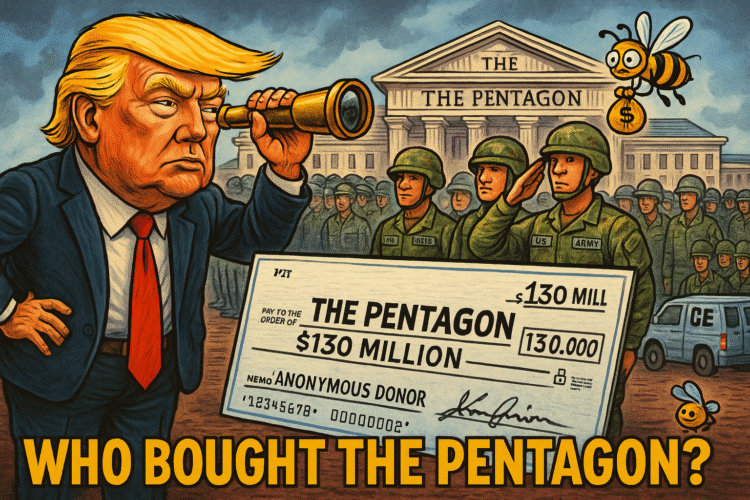
There’s something exquisitely American about a shutdown that ends with the Pentagon passing a hat. Somewhere between a bake sale and a Bond villain subplot, the Department of Defense just accepted a $130 million “gift” from an anonymous donor—yes, a literal donation—to help pay soldiers’ salaries while the government remains closed for business.
President Trump, naturally, called it a “patriotic gesture from a friend.” He didn’t specify which friend. He also didn’t specify which flag that friend flies.
The gift came through the Pentagon’s general gift authority, a bureaucratic relic originally meant for things like museum artifacts, not emergency payroll funding. But here we are: the world’s most expensive military now passing the plate like a small-town church, praying the collection covers the light bill.
The Price of Patriotism: $130 Million and Change
Let’s start with the math, because it’s the only part of this story that isn’t classified. The U.S. military’s payroll runs roughly $7.5 billion every two weeks. So this mystery donation? It doesn’t even buy 24 hours of salaries.
It’s the defense equivalent of Venmoing your landlord twelve bucks and calling it rent.
Still, it was accepted—quietly, legally, and with enough patriotic varnish to make anyone questioning it sound ungrateful. Treasury accountants and Pentagon lawyers reportedly signed off, citing 10 U.S.C. § 2601—“the authority to accept gifts.”
That statute was never meant for this. It’s supposed to cover, say, a retired general donating his portrait to the Army War College. But because shutdowns create legal gray zones, “gift” now means “anonymous cash infusion to the world’s largest employer.”
The Billion-Dollar Bake Sale
The gift’s timing was almost cinematic. Paychecks for service members were about to bounce, R&D budgets had already been raided to fund emergency payroll patches, and lawmakers were too busy blaming each other to pass a clean troop-pay carveout.
Enter the mystery benefactor, check in hand.
The optics were so dystopian that watchdogs barely knew where to start. The Anti-Deficiency Act forbids federal agencies from spending money not appropriated by Congress. But what happens when the money is given instead of appropriated? Apparently, we just call it patriotism and move on.
Even Defense Secretary Pete Hegseth, normally the administration’s most loyal cheerleader, looked like he’d bitten a lemon when asked who the donor was. “We appreciate the support,” he said, which is Washingtonese for “please stop asking before I have to lie.”
The Republic of Sponsored Salaries
If you’re wondering how a democracy built on checks and balances ends up crowdfunding its army, the answer is simple: habit.
We’ve spent decades normalizing private capital as a substitute for public responsibility. When schools lose funding, we get “Adopt-a-Classroom.” When hospitals collapse, we get GoFundMe. Now, when the Pentagon runs out of money, we get an anonymous billionaire underwriting payroll—no questions asked.
It’s only a matter of time before the Marines start wearing patches that read “Proudly Supported by Chevron.”
What’s next? A Raytheon logo on an F-35? A recruitment ad sponsored by ExxonMobil? (“Be All You Can Be—Now with Loyalty Points!”)
The symbolism is almost poetic. The same government that can’t fund school lunches can now accept anonymous wire transfers to keep soldiers paid. Nothing says “civilian control of the military” like outsourcing it to whoever can afford the most zeros.
The Legal Lie: It’s Not a Donation, It’s a Dowry
To be clear, this isn’t just tacky—it’s constitutionally radioactive.
The Appropriations Clause of the U.S. Constitution (Article I, Section 9) is unambiguous: No money shall be drawn from the Treasury, but in consequence of appropriations made by law.
Congress controls the purse. That’s the whole point. If an executive branch agency can accept private gifts to pay salaries, then appropriations become optional—and democracy becomes negotiable.
Even the framers understood that whoever pays the soldiers calls the shots. That’s why civilian control of the military isn’t just a slogan; it’s a safeguard. When payroll becomes philanthropy, the guardrails start to rust.
And because the Pentagon refuses to disclose the donor’s identity or nationality, the possibilities range from dystopian to absurd.
- A patriotic hedge fund billionaire buying goodwill?
- A foreign sovereign wealth fund testing how easily Washington sells its ethics?
- A defense contractor returning 0.01% of its profits for PR optics?
No answer is comforting.
The Trump Doctrine: Pay-to-Govern
President Trump couldn’t resist framing the donation as proof of “faith in America’s greatness.”
Faith is an interesting word choice for what is effectively a bribe with better lighting.
He bragged that he personally knew the donor—though the White House later walked that back—and mused aloud that he might create a “Patriots Fund” to let “friends of freedom” contribute during future shutdowns.
Because what’s democracy without a subscription model?
Imagine the next shutdown: “For just $9.99 a month, you too can keep the Coast Guard afloat!”
It’s the gig economy, but for governance.
The Unasked Questions
The Pentagon has declined to say who signed the acceptance letter, what vetting was done, or whether the gift included any restrictions. Watchdogs at the Project on Government Oversight and the Government Accountability Office have both opened preliminary reviews, warning that such gifts—especially undisclosed ones—could violate federal ethics laws or foreign influence restrictions.
Congress, meanwhile, is holding hearings in name only. Lawmakers who normally scream about Chinese money in TikTok are suddenly serene about anonymous millions wiring into Defense payroll accounts.
Maybe they’re afraid to ask the obvious question: what if the donor isn’t American?
What if the Republic is now partially foreign-funded, and no one bothered to tell the troops?
The Market for Loyalty
Here’s what makes this precedent truly dangerous: once you let private money plug a public hole, you’ve made dependency bipartisan.
The next donor could be domestic or foreign, conservative or liberal—it doesn’t matter. The second we allow private capital to replace public will, accountability flips.
Suddenly, generals aren’t accountable to Congress—they’re accountable to the checkbook.
And if $130 million can buy a day’s goodwill, how much buys a policy tweak? A procurement contract? A deployment delay?
Don’t say it couldn’t happen. The Pentagon already operates on a culture of revolving doors and contractor capture. This just adds the final touch: moral privatization.
The Great Irony: A Billionaire Bailout That Solves Nothing
Even setting aside ethics, the donation doesn’t solve the actual crisis. The shutdown still starves civilian agencies, freezes SNAP benefits, delays IRS refunds, and halts infrastructure projects. The troops may get one more paycheck, but the system remains broken.
In that sense, the anonymous donor didn’t fix anything—they bought an alibi.
A way for the administration to say, See, everything’s fine, while the machinery of government corrodes one agency at a time.
The White House gets to claim magnanimity; the donor gets moral credit; and everyone else gets the bill.
The Price Tag of Precedent
The $130 million might seem like a rounding error in Pentagon accounting, but it buys something priceless: precedent.
The first time you accept a “gift,” it’s a miracle. The second time, it’s policy.
And once Congress normalizes charity-for-payroll, every future shutdown will come with a shopping list. “Need troops paid? Call Bezos. Need national parks reopened? Ask Disney. Need FEMA on standby? There’s a billionaire for that.”
The public sector becomes a brand, not a covenant. Governance becomes sponsorship.
At that point, democracy doesn’t die in darkness. It dies on direct deposit.
The Absurd Future We’re Already Living In
Picture it:
- The “Raytheon Reserve Corps,” proudly defending freedom courtesy of corporate underwriting.
- Treasury issuing “Defense Bonds (Sponsored by Goldman Sachs).”
- Congressional leaders auctioning appropriations votes at gala dinners—“Tonight’s Coast Guard payroll brought to you by Koch Industries.”
It’s funny until it’s real. And it’s already halfway there.
This is what happens when a government built on taxation and representation becomes a government built on donation and branding.
You don’t lose democracy overnight. You lose it in installments, at $130 million a pop.
The Real Patriots Are the Ones Asking Questions
There’s a grim poetry to soldiers serving under a flag that no longer guarantees their paycheck but welcomes anonymous money to fund it.
Every uniform comes with an implicit promise: the state will take care of you. The moment that promise is subcontracted, loyalty becomes a commodity.
And loyalty, once bought, can be sold.
If this episode doesn’t terrify people, it’s because the collapse of accountability always looks like innovation at first. “Creative financing.” “Public-private partnership.” “Patriotism with a checkbook.”
But the principle at stake isn’t about numbers—it’s about sovereignty. Who pays the troops determines who they serve.
The Closing Argument: A Nation on Layaway
The Pentagon insists it will disclose the donor “in due time.” Congress promises “oversight.” The president beams on camera, already teasing “other friends” willing to help.
Meanwhile, 1.4 million service members just learned that their paychecks depend not on Congress, not on law, but on luck—and on the goodwill of someone rich enough to matter.
This is not stability. It’s feudalism with better branding.
In the medieval version, knights swore fealty to whichever lord paid their keep. In the modern one, troops refresh their pay portal to see if democracy got another donation.
The United States used to fund wars with war bonds. Now it funds soldiers with mystery wire transfers.
That’s not patriotism—it’s a clearance sale on sovereignty.
Final Section: The Cost of the “Gift”
The most dangerous phrase in American politics isn’t “government spending.” It’s “private generosity.” Because when charity fills the holes that Congress refuses to, the republic becomes a patchwork quilt of influence.
The Pentagon can call this gift patriotic all it wants, but a country that needs donations to pay its soldiers has already lost something far more precious than solvency.
Call it what it is: a bailout of accountability, disguised as gratitude.
Because a nation that once prided itself on civilian control of the military is now learning the fine print of that phrase: civilian control includes whoever can wire eight figures before the next payday.